How to Monetize Embedded Analytics: 4 Methods + ROI

SaaS products generate data that helps customers understand performance, spot issues and make better decisions. The commercial opportunity comes from deciding which analytics belong in the core product and which can become a paid upgrade.
Monetizing embedded analytics means turning a product's analytics layer into a revenue stream through pricing tiers, paid add-ons, custom dashboards and white-label offerings. It gives SaaS companies a way to package deeper reporting around the value customers already see in their own data.
McKinsey found that high performers are "three times more likely to report data monetization contributes more than 20% of revenue." That does not mean every SaaS product should expect the same outcome. It shows what can happen when analytics becomes a product capability with a clear commercial model.
Luzmo, the embedded analytics infrastructure for product teams, helps SaaS companies deliver secure, multi-tenant analytics without building the reporting foundations in-house.
Key takeaways
- Monetize embedded analytics in four ways: analytics pricing tiers, paid add-ons, custom customer-facing dashboards, and a white-label dashboard editor.
- The ROI case is expansion revenue + retention + lower support cost + faster sales, minus the cost of not shipping.
- Most teams sit between "analytics as a tier differentiator" and "analytics as a paid add-on."
How do you monetize embedded analytics?
You monetize embedded analytics by charging for the analytics your product already delivers, through four routes: analytics pricing tiers, paid analytics add-ons, custom customer-facing dashboards, and a white-label dashboard editor sold to premium customers. Each route packages reporting customers already value into something they pay to access, rather than giving all of it away in the base plan.
Product teams do this because it turns analytics from a cost centre into a revenue line; that shift from feature-you-maintain to line-item-that-grows is the essence of analytics monetization.
4 methods to monetize embedded analytics
| Method | Best when… | Pricing model fit | Example | Effort to ship |
|---|---|---|---|---|
| Pricing tiers | Analytics is the upgrade incentive | Feature-based / freemium | Strobbo | Low |
| Product add-on | Seat-based pricing or mixed reporting needs | Seat-based | Timewax | Low |
| Custom dashboards | Enterprise wants tailored metrics/layouts | Enterprise / per-deal | Intent Technologies | Medium |
| White-label editor | Customers want to build dashboards | Premium / standalone | Selligent | Higher |
- If you have freemium/feature tiers → gate analytics behind a higher tier (pricing tiers).
- If you price per seat → sell analytics as a fixed add-on, not a plan jump (product add-on).
- If enterprise buyers want bespoke reporting → offer custom dashboards per deal.
- If customers want to build their own → license a white-label editor.
1. Analytics pricing tiers
Analytics pricing tiers are the most direct monetization path for products with feature-based plans. Analytics becomes the upgrade incentive: customers on free or lower tiers see that reporting is available, but access it only when they move up.
A SaaS email marketing product, for example, might reserve performance dashboards for Pro and Enterprise customers. Data-hungry marketers on the free tier upgrade to get them. The analytics feature drives the conversion; the product keeps the revenue.
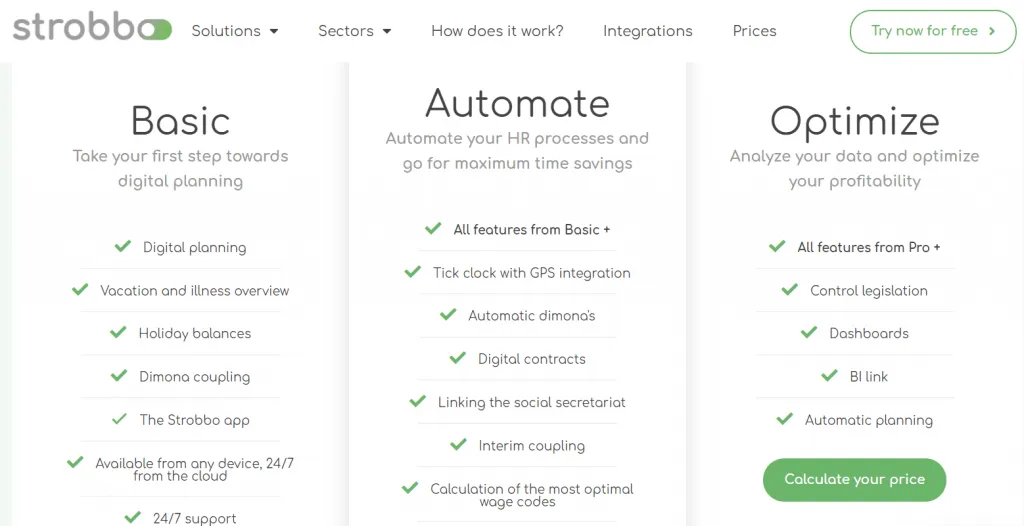
This also works beyond freemium. Strobbo, a personnel management platform, upsells customers from mid-tier to high-tier with analytics dashboards. Around 40% of their larger clients have purchased the analytics add-on, with power users checking dashboards up to five times a day.
Where analytics is indispensable to the user's workflow, a free trial model also works: customers get full reporting access for a limited period, then decide whether to upgrade or lose it.
2. Paid analytics add-ons
A paid analytics add-on works better than a plan upgrade when your product uses seat-based pricing or serves a broad customer base with different reporting needs. Instead of asking customers to move to a much larger plan just to access better data, sell advanced analytics as a fixed monthly or annual module. The core product price stays accessible; data-heavy accounts have a clear option when their reporting needs grow.
The add-on needs a clear promise. It might include advanced dashboards, self-service exploration, additional data connections, or reporting access for more stakeholders. Customers should understand what changes after purchase and why it helps them make better decisions.
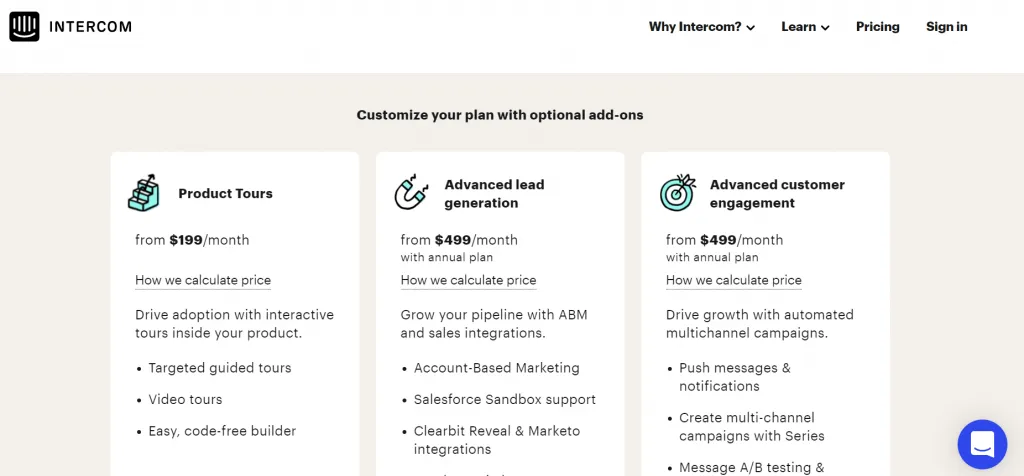
This model also gives product teams useful signal. Timewax, a resource planning platform, restructured their pricing so customers could select analytics as a feature of choice within their plan. After the change, 11% of customers chose analytics as their preferred add-on, and the sales team found it significantly easier to convert trial users to paid customers. If customers adopt the add-on, return to it frequently, and bring more people into the analytics experience, that is evidence the capability deserves a larger role in the product.
3. Custom customer-facing dashboards
Standard analytics dashboards work for most users. Enterprise customers often want more from that analytics: custom metrics, tailored layouts, and reporting scoped to their specific workflow. This is customer-facing analytics in its most tailored form, shaped around each account's way of working.
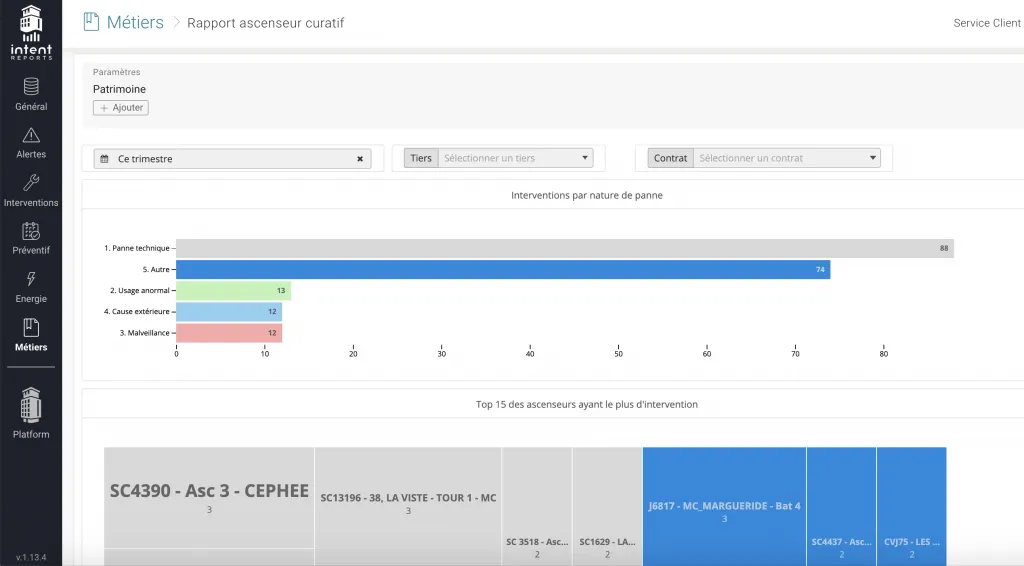
Intent Technologies, a construction software platform, offers customized dashboards to enterprise customers on top of their standard analytics. The result was straightforward: they recovered deals that had stalled because competitors could not match the reporting flexibility.
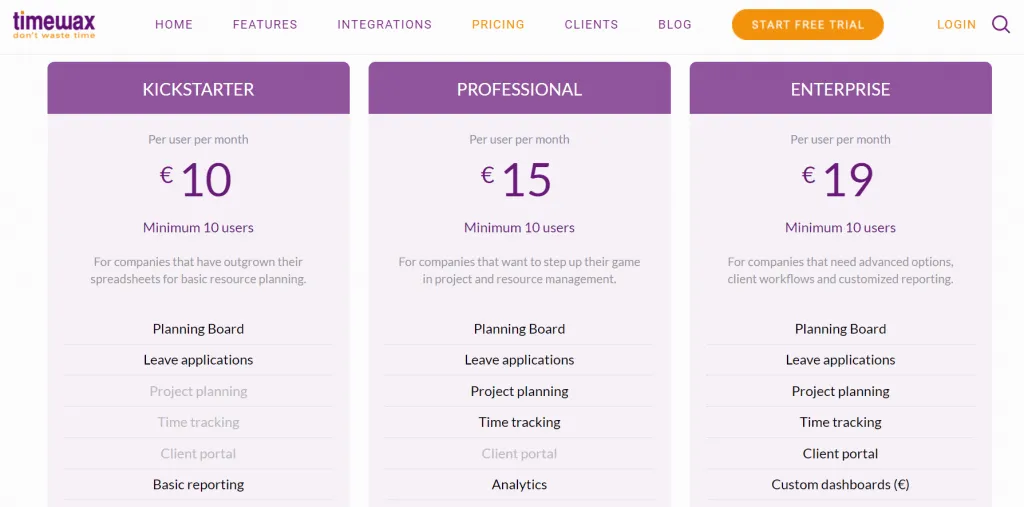
Custom dashboards can run alongside tiered pricing rather than replacing it. Timewax uses both: standard dashboards are available in premium plans, and the embedded dashboard editor is offered as a bonus feature to customers who migrate to new pricing plans.
4. White-label dashboard editor
Some customers want to build their own analytics rather than work from a template. A white-label analytics editor gives them that: a fully branded composable analytics experience that lives inside your product, not in a separate BI tool. Delivering it means choosing embedded analytics tools that support white-labeling end to end.
Selligent Marketing Cloud offers basic dashboards to every user and markets a white-label dashboard editor module to power users as a distinct upsell. The editor is their product; it just happens to run on embedded analytics infrastructure.
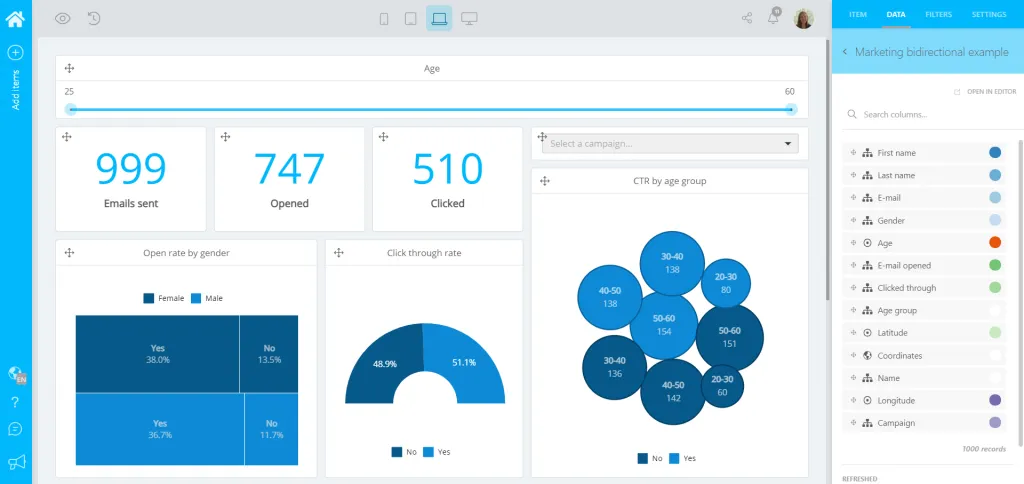
White-labeling also lets a team validate pricing before scaling. Offer the editor to a small group of enterprise accounts first, confirm willingness to pay, then roll it to the broader base.
What is the ROI of monetized analytics?
ROI is the question every product owner faces before committing to an analytics build. The right frame is not just what analytics generates in new revenue; it is also what the absence of analytics costs.
The cost of not shipping analytics is real. Users who cannot access their data inside your product export to spreadsheets or file manual report requests. Managers who cannot prove your product's value to their stakeholders do not renew. Prospects comparing your product against one that ships analytics choose the competitor. Those are measurable losses, not hypothetical risks.
Where monetized analytics drives return:
- Expansion revenue. Analytics tiers and add-ons are an upsell path that scales without increasing your seat count. Customers upgrade to access reporting; that incremental ARR compounds over time.
- Retention. Customers who use analytics inside a product have higher retention than those who do not. A user who can see their own outcomes inside your product has a reason to stay. A user relying on exports does not.
- Support cost reduction. Every custom report request your team handles manually has a cost. Embedded self-service analytics reduces that volume. Spaceflow, a PropTech platform, cut manual reporting requests by 80% after migrating off Tableau.
- Sales velocity. Analytics accelerates deals. A prospect who can see reporting working in a trial is closer to signing. Intent Technologies recovered stalled enterprise deals specifically because their analytics offering gave buyers what they needed to justify the contract internally.
The question of whether to build analytics in-house or use embedded analytics infrastructure changes the ROI calculation significantly. A custom build requires months of engineering time before any user sees a dashboard: data pipelines, a query layer, multi-tenant security, white-label control, and ongoing maintenance. An embedded analytics platform removes that build cost.
Lansweeper is the clearest proof of that trade-off. By embedding analytics with Luzmo instead of building in-house, Lansweeper skipped three years of development time and jumped straight to a full-blown BI experience for its customers. According to Maarten Saeys, CPO, the NPS of its beta customers went through the roof once the analytics shipped — the return here shows up as customer satisfaction and retention, not only avoided engineering cost.
Luzmo's pricing avoids the months of engineering a comparable in-house build requires, and teams can go from signed contract to a working embedded dashboard in days.
For a practical framework on what users pay for, how to spot upgrade signals and how to turn analytics into a revenue line, read our Analytics Monetization Guide.
Where are you on monetization maturity?
Not every product team is ready to package analytics into a premium tier on day one. Monetization typically follows a progression:
- Reporting included: basic dashboards ship in all plans, no direct revenue from analytics itself.
- Analytics as a tier differentiator: reporting is reserved for higher plans; it drives upgrades.
- Analytics as a paid add-on: analytics is a distinct revenue line, priced and sold separately.
- Self-service analytics as a premium feature: customers build their own dashboards; that capability commands a premium.
- Analytics as a product: white-label or AI-powered analytics is a standalone offering with its own go-to-market motion.
Most product teams sit between stages 2 and 3.
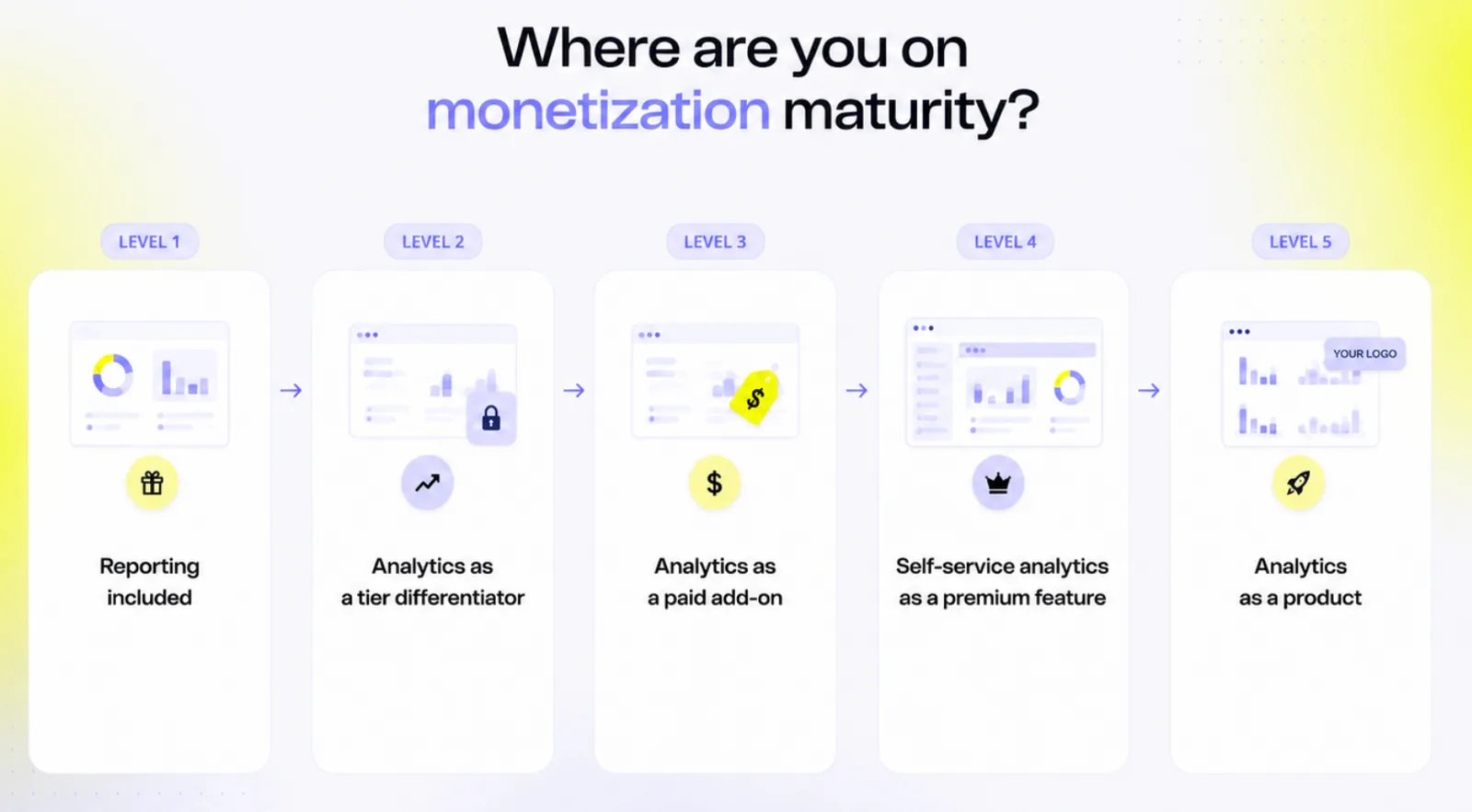
The customer-facing analytics maturity model maps the full progression and what infrastructure each stage requires.
Analytics monetization examples
The methods above are not theory. Each one is a real analytics monetization example running in a live product today, and seeing them side by side is the fastest way to recognise which route fits your own pricing. Here is how four Luzmo customers turned embedded analytics into revenue.
Selligent is the clearest analytics monetization example. The marketing automation platform offers basic dashboards to every user, then markets a white-label dashboard editor to power users as a distinct, paid upsell in its premium pricing tiers. The editor is a product Selligent sells; it just happens to run on embedded analytics infrastructure, mapping exactly onto method 4. Read the Selligent case study.
Strobbo monetizes through pricing tiers. The personnel management platform upsells customers from mid-tier to high-tier with analytics dashboards, and around 40% of its larger clients have bought the analytics add-on.
Timewax monetizes through a product add-on. The resource planning platform restructured pricing so customers pick analytics as a paid feature of choice, and 11% chose it as their preferred add-on.
Intent Technologies monetizes through custom dashboards. The construction software platform offers tailored enterprise reporting and recovered stalled deals competitors could not match.
Four products, four monetization methods, one infrastructure layer underneath.
Start monetizing your platform's data
Pick one method that fits your current pricing model and a single user segment where analytics has clear value. Then check whether your embedded analytics infrastructure can support what that segment needs: multi-tenancy, white-label control, self-service, and the ability to extend without a rebuild.
Companies that have gone to market with a new analytics product have done it in as little as two months. The infrastructure is not the constraint; the decision is.
FAQ
All your questions answered.
How do you measure the ROI of embedded analytics?
Measure direct revenue and wider product impact. Useful indicators include analytics adoption, repeat dashboard use, upgrade rate, expansion revenue, renewal influence, and reporting-related support requests. Measure each separately before aggregating.
Should analytics be included in every plan?
Some level of reporting often belongs in the standard product because customers need visibility into their own results. Advanced controls, deeper analysis, customisation, or editing rights can become premium features when users need more than the baseline experience.
Which monetization method works best for seat-based pricing?
A product add-on, priced separately from the per-seat fee. It lets customers who need advanced reporting pay for it without requiring a full plan change or disrupting the seat-based model.
When is a white-label dashboard editor the right choice?
When customers need control over reporting views, serve their own users, or manage multiple teams or client accounts. It works best when the product can enforce permissions and tenant boundaries while giving customers meaningful flexibility.
How do SaaS companies monetize embedded analytics?
SaaS companies monetize embedded analytics through four routes: analytics pricing tiers, paid add-ons, custom customer-facing dashboards, and white-label dashboard editors. The right mix depends on how central analytics is to the product and what customers pay for.
Can you charge customers for dashboards?
Yes. Dashboards are one of the most common analytics features to monetize, whether gated behind a pricing tier, sold as a paid add-on, or offered as a white-label editor customers use to build their own.
Written by

Ship the future of your data
Let us show you what Luzmo can do for your product.

Book your session with our analytics expert.