Composable Architecture vs. Microservices: Pros and Cons
Monolithic architecture has been the default way to develop software for decades now. And while this approach is seemingly simple at the beginning of software development, it has a snowball effect. The bigger your product, the more clunky the development process.
Two methods came up as a way to build digital experiences in a faster, more flexible way. Composable architecture and microservices are both ways to add scalability in your development process, but which one should you choose?
Let’s find out.
Composable architecture vs. microservices architecture: definition
Composable architecture is an approach where you create software using interchangeable, modular components that can be recombined to create different functionalities. These modules can be reused in the backend and front-end across the same app or different apps.
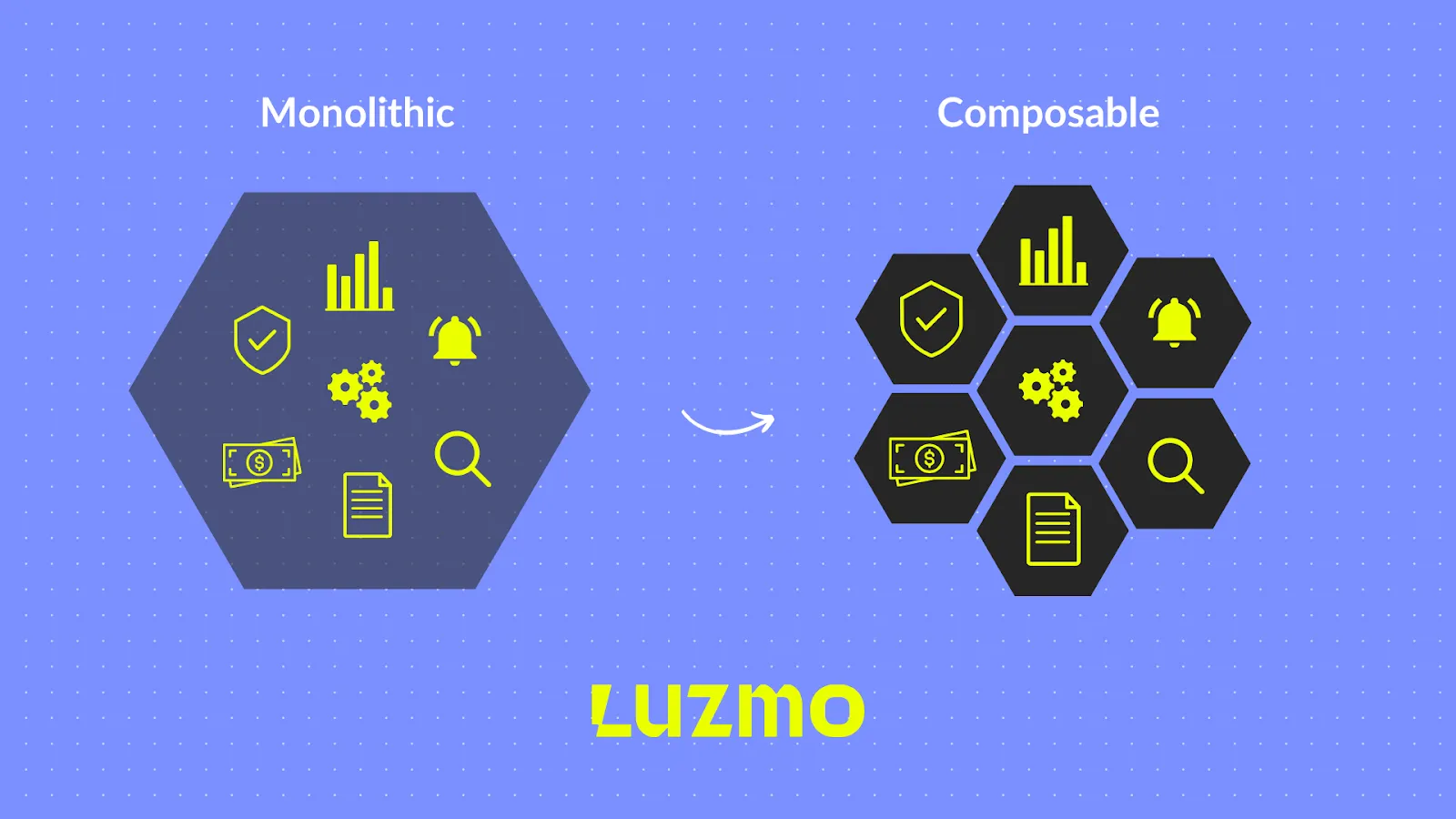
This modular approach is similar to building a structure using LEGO bricks. One LEGO piece can be used as a wall to a house or a part of a ship: it has many different use cases and can be adapted, as your needs and requirements change. There is massive flexibility and modularity, but you need to plan where each piece goes in advance.
Microservices is an approach where an application consists of small, independent services that communicate with each other through a network. Each service has its own business capability and it can be used, developed, deployed, and scaled independently.
It’s like different organs in the human body. The heart and the liver each have unique functions and work independently on their own, but together, they enable the human body to function properly. One organ cannot do the job of another one and managing the entire system (the human body) requires careful coordination of all the independent functions.
Examples of composable architecture and microservices
So far, we’ve just dabbled in theory and metaphors. Let’s look at some practical examples instead.
The MACH alliance is a good example of composable architecture. It stands for microservices, API-first, cloud-native and headless. It’s a group of companies that advocate for a modern, composable approach to building digital experiences and achieving digital transformation.
Some members of the MACH architecture alliance include BigCommerce, Vtech, Contentful, and others that use APIs (application programming interfaces) as architectural foundations.

An example of an app that falls into composable architecture is the Shopify Plus platform. Besides the platform itself, you have options for integrating third-party services, such as payment gateways, analytics, and inventory management tools.
An example of microservices is the framework called Docker. It allows developers to package microservices together and make them portable and scalable.
And in terms of apps, a good example of microservices is Uber. They transitioned to microservices to support the massive growth of their operations. With microservices, they have separate functions for payment processing, ride requests, driver management, etc.
The pros and cons of both approaches
Depending on your business needs and available resources, you’ll opt for the architectural approach that makes the most sense for your situation. Here is what you should consider when choosing software systems for your business.
The downsides and benefits of composable architecture
Pros:
- Flexibility: developers can easily modify and reconfigure components, so your company can quickly adapt to new changes and requirements in configurations
- Reuse of elements: you can reuse different components across projects or within one project thanks to the composable architecture approach
- Scalability: you can scale an individual component separately based on stakeholder or user demand
Cons:
- Complexity: managing dependencies and integrations between different components can be challenging
- Performance overhead: integrating and managing multiple software components can cause deteriorated performance in your software
- Standardization issues: if there is no standardization between components, this can lead to inconsistencies and technical debt
Pros and cons of microservices
Pros:
- Independence: you can develop, deploy, and scale services independently, which improves fault isolation and if a failure happens, its impact is minimal
- Scalability: each service can easily be scaled independently based on your needs, which allows you to optimize your resources
- Technology diversity: allows teams to choose the best tech stack and building blocks for each service, which speeds up performance from the backend
Cons:
- Operational complexity: if you have a large number of microservices, managing, deploying, monitoring, and communicating between them can be a hassle
- Network latency: as different microservices and providers communicate with each other, this increases latency and potential points of failure
- Data management: ensuring data consistency between different microservices is complex, especially if a transaction spans multiple services
Use cases for both approaches
Perhaps the best way to learn which approach is suitable for your business functions is to look at some real-world examples.
Composable architecture
Enterprise businesses: large companies that need libraries of reusable components for future use can benefit from this software architecture. You can decrease your time to market and launch new features more quickly and easily when your development teams use the composable approach.
Ecommerce businesses: an ecommerce platform can have a large number of features. Composable commerce requires a high degree of customization to meet the needs ecommerce retailers and enhance the customer experience.
Content management systems (CMS) or sales content management software: in systems that need to incorporate different types of content from a variety of sources, composable is the best option.
Microservices
SaaS platforms: for software vendors that want to have a variety of independent components while building a product. Microservices allow different teams to work independently from each other on different features without disrupting the function of the main product.
IoT platforms and services: in an ecosystem with a large number of different devices and platforms, it’s important to have a unified user experience and this is where microservices can help. Developers can work independently on each codebase while the entire system functions without interruptions.
Financial services: for platforms that need high availability and modularity of individual components and constant uptime of financial services, microservices are a great choice.
Which one should you choose?
These are both fairly new approaches to building technology and choosing the right one for your web or mobile app can feel difficult. In reality, it’s fairly simple.
If you need flexibility, ease of component reuse, and customization capabilities, composable architecture is the better choice.
If you need fault isolation, independent deployment cycles, and scalability, you should opt for microservices.
There is also a third alternative. You could use microservices as the foundational blocks for your software architecture but inside a composable architecture. This allows you to assemble microservices into different features or operations.
And if you want to add embedded analytics to your software, Luzmo fits right into your composable architecture, functioning as a microservice for data visualization and analytics.
With Luzmo Studio, product teams can design and customize dashboards and visualizations that integrate seamlessly into their applications. Luzmo IQ enables users to explore data through AI-powered insights and natural language queries, making analytics accessible to everyone in your product. Meanwhile, Luzmo AI allows SaaS platforms to embed intelligent data exploration directly into their apps, helping users uncover insights instantly.
Together, these tools make it easy to integrate powerful analytics into a composable architecture without adding unnecessary development complexity.
Book a free demo with our team to learn more about how Luzmo can help you!
FAQ
All your questions answered.
What is the main difference between composable architecture and microservices?
Composable architecture focuses on building software using modular, reusable components that can be combined in different ways to create new functionalities. Microservices, on the other hand, divide an application into smaller independent services that each handle a specific business capability. While both improve scalability and flexibility, composable architecture emphasizes reusable building blocks, whereas microservices emphasize independent services.
Can composable architecture and microservices be used together?
Yes, many modern software systems combine both approaches. Microservices can serve as the underlying services, while composable architecture organizes those services into modular features that can be reused across applications. This combination allows teams to scale services independently while maintaining flexibility when building new user experiences.
Which architecture is better for SaaS platforms?
Both architectures can work well for SaaS platforms depending on the product’s needs. Microservices are ideal for scaling independent features and enabling teams to work on different services simultaneously. Composable architecture is often preferred when SaaS platforms need flexibility, rapid feature development, and reusable components across multiple applications.
Written by

Ship the future of your data
Let us show you what Luzmo can do for your product.

Book your session with our analytics expert.