20+ Product Management Frameworks To Become a Better Software PM
Great products don’t just come around. Building a product requires vision, planning, and research. And often lots of meetings. Product management frameworks will help you keep a structured development process and stay focused on initiatives that matter.
But which frameworks do even exist? Which ones are good for your specific team and product? Here’s a quick guide to all the most important product management frameworks.
We’ll discuss the pros and cons of each to help you make a better decision for your next software project.
What is a product management framework?
A product management framework is a structured approach to developing and launching products.
These tools help product managers carry out their strategy from idea to result. Product frameworks help both junior and seasoned product managers become more efficient.
Effective product development is a complex process. You can’t tackle every step with the same framework. And depending on how your product team operates, some models might be a better fit than others. Luckily, you can have your pick between countless methods for product and project management.
There are four main types of product management frameworks:
- Discovery frameworks
- Prioritization frameworks
- Design frameworks
- Product strategy frameworks
We’ll discuss a few frameworks in each category in detail below.
Why use product management frameworks?
Product teams want to bring successful products to market by making better decisions. Product management frameworks will get you one step closer to that goal.
Here are some of the many benefits they have:
- More structured processes lead to more efficient product management and a better user experience
- Easier to identify opportunities and risks quicker
- More team alignment means faster delivery on the product roadmap, a faster launch of an MVP, better reactions to customer feedback and more
However, there are some potential dangers that you should watch out for when choosing any product management framework. For example:
- Follow a model too strictly, and your team might become less agile instead
- Choosing the right framework takes time, which could slow you down
- If you use frameworks the wrong way, you could lose time and money by making poor decisions
Like any tool, it’s important to pick a product management framework that fits your needs. Below, you’ll find a few examples to get started.
20+ Popular Frameworks for Software Product Managers
Frameworks for discovery
During product discovery, product managers get a deep understanding of their customer’s needs and pain points. Discovery frameworks expose and translate these needs into a product or feature, which increases retention and profitability.
- Lean Canvas
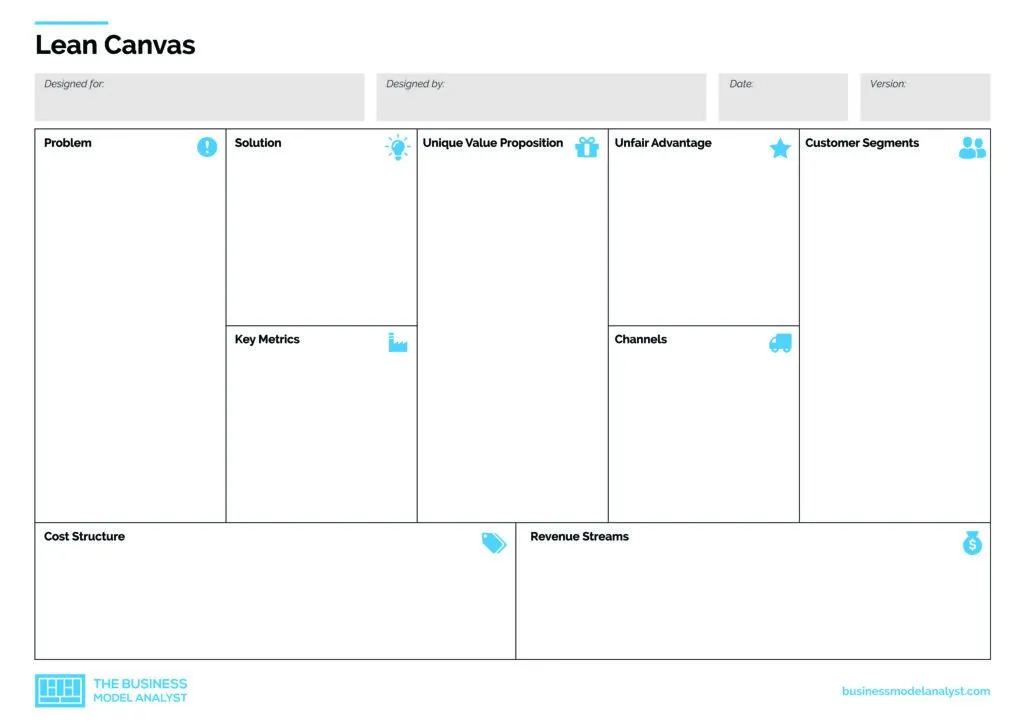
Ash Maurya’s Lean Canvas is an adaptation to the business model canvas. Lean Canvas has become popular among startups. It’s a great canvas for exploring, based on 9 simple blocks.
In the Lean Canvas, you’ll jot down the essentials in minutes. Problem, solution, USP, market segments and more. The result is a simplified business model in less than an hour.
- Double Diamond
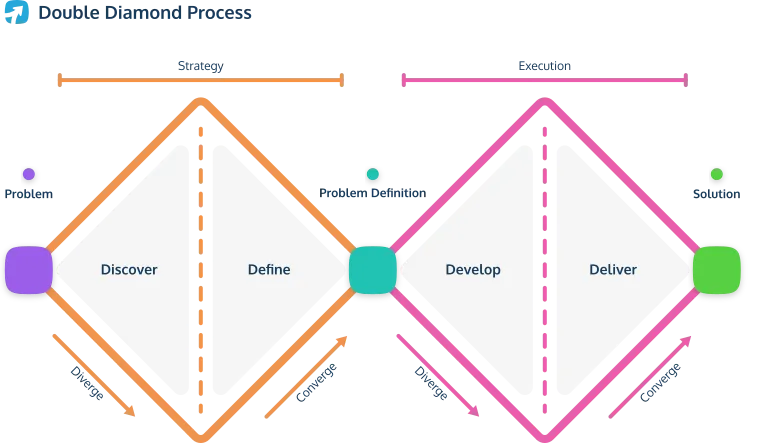
The double diamond framework takes you through two brainstorms.
You will first identify every possible challenge you want to solve. Then, you’ll narrow it down to the key problem you want to focus on in the customer journey and your development process.
Once you pinned down the problem, you will do the same by brainstorming as many solutions as possible. Then, you’ll settle down on the most fitting solution.
The double diamond method is great for product teams that want to innovate. Create diverse user stories to look beyond the most straightforward solution at hand.
More frameworks
- Dual-track agile: for agile product management
- Opportunity-solution tree: for visualizing the different paths to what you want to achieve
- Working backwards: starting from the desired final product and working your way back
- 4D: for full-circle product management
Frameworks for prioritization
Every product manager has faced the challenge of prioritization. There are a ton of models that make the job at hand easier.
- Kano model
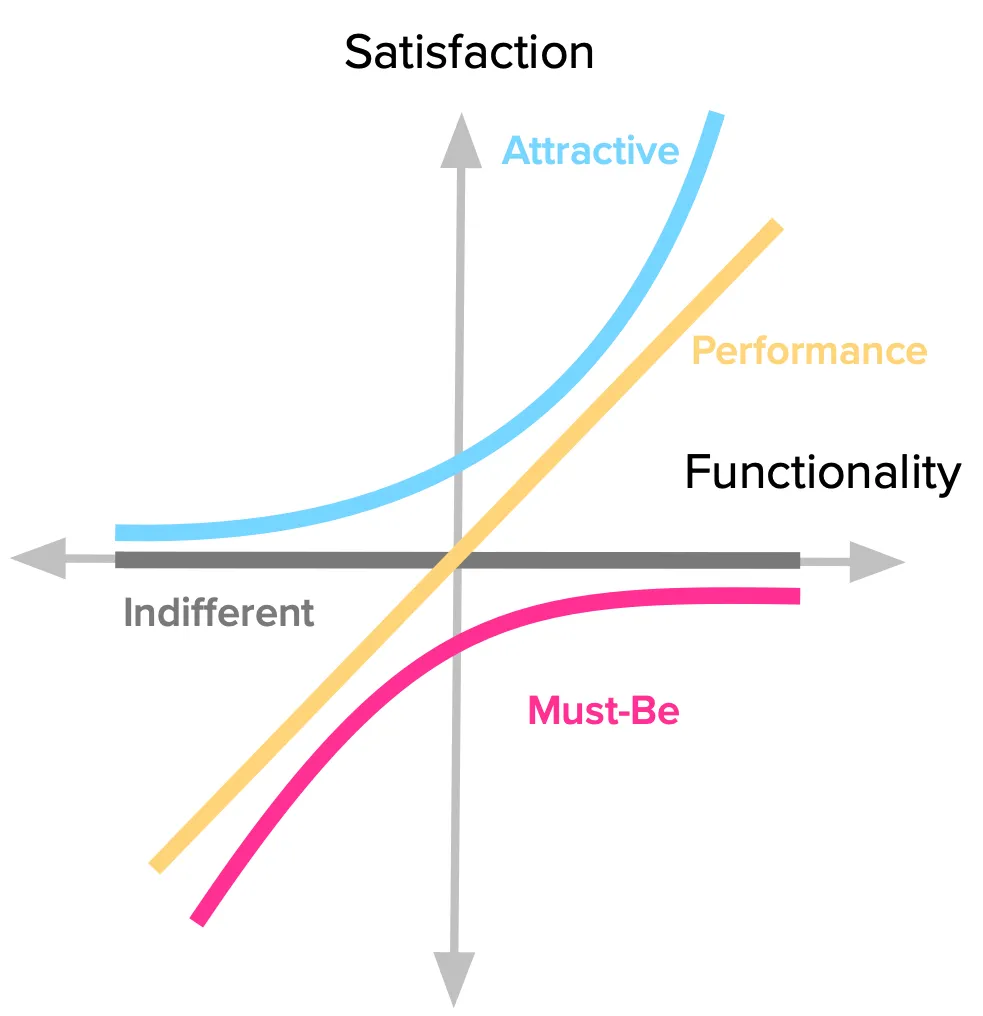
The kano model is a simple framework to prioritize features based on two key factors.
- Customer satisfaction. How do your customers feel about this feature?
- Functionality. How have you implemented this feature?
If you struggle to align your product roadmap with business objectives, give kano a try. Whether your focus is business continuity, innovation or both.
- RICE prioritization framework
The RICE method evaluates product ideas on 4 factors.
- Reach: “How large is the target group for this product or feature?”
- Impact: “How much will this idea affect our progress on business goals?”
- Confidence: “Do we have data or research to back up our gut feeling?”
- Effort: “How much work will it require to complete this idea?”
With RICE scoring, product teams can quickly spot both low-hanging fruit and long-term gains. It is a great framework to go from strategy to a tactical product roadmap and improve your workflows.

More frameworks
- Weighted impact scoring: a scoring model to rank your priorities and start validating your ideas
- MoSCoW method: quickly distinguish must-haves from nice-to-haves
- Product Opportunity Evaluation Matrix: assess market opportunity for different product ideas and establishing if a new product can succeed
- TribeRank: involve team members outside your regular scrum team
Frameworks for product design
- Design Sprint Methodology
Jake Knapp from Google Ventures came up with the 5 phases of the Design Sprint Methodology. With one phase for each workday, you can test new ideas faster. This time-bound method is great for teams who struggle with time management.
Below are the five stages of the design sprint planning.
- Map
- Sketch
- Decide
- Prototype
- Test
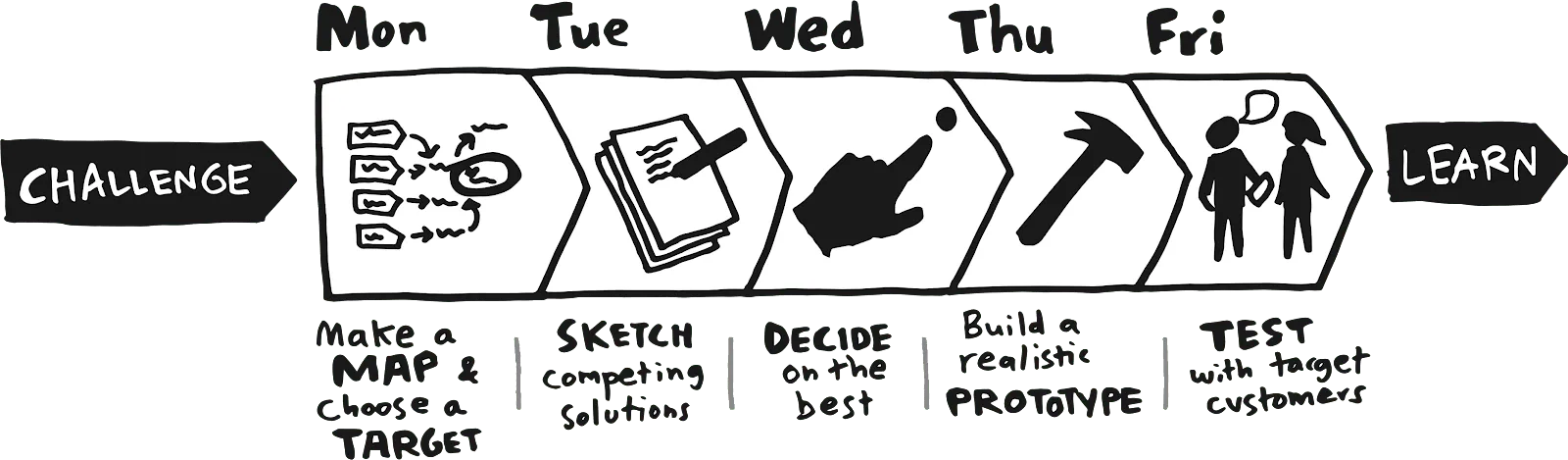
PS. it is also worth doing your research on iterative design to fully understand the design sprint methodology, including exploring sprint planning tools.
- CIRCLES method
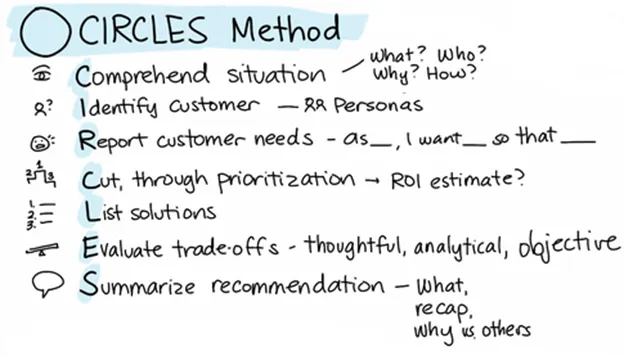
The CIRCLES method organizes your responses to product design questions. Many product managers use this method to ace their product manager job interviews.
With these 7 steps, you’ll be able to answer any product design question thoughtfully. Here is what the acronym stands for:
- Comprehend the situation
- Identify the customer
- Report customer’s needs
- Cut, through prioritization
- List solutions
- Evaluate tradeoffs
- Summarize your recommendation
More frameworks
- Game Thinking: their model applies elements of game design to product design and solving customer problems
- Design Thinking: one of the most well-known methods in product design to help with the decision-making process
- Psych: think about every UX action as an emotional event to improve your funnel conversions and user activation
- Pretotyping: a technique to test product ideas on the market objectively and rigorously and establish your unique value proposition
Frameworks for strategy
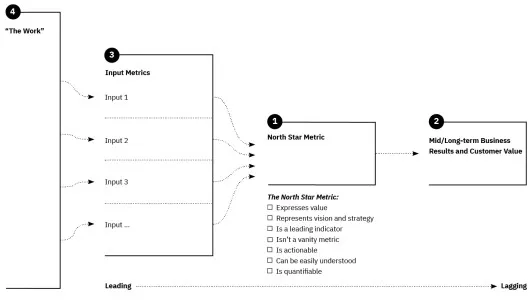
- North Star framework
The North Star framework aligns your entire product strategy around a single metric. This method works best for high level strategic alignment. It connects the product vision directly to business objectives. It can help you clean out your backlog and prioritize the work that matters.
- Jobs-to-be-Done framework
If you want to build customer-centric products, the Jobs-to-be-Done Theory is one of the best frameworks. Before anything else, it looks at the customer's needs.
For example:
❌ People don't want customer support software.
✅ Instead, they want happy customers.
The method helps you uncover unmet needs, and expose what your customer needs to achieve their goals. By optimizing for outcomes, your product strategy will put the customer at the center. It’s also useful if you want to find out what is necessary to build a good minimum viable product.
Anthony Ulwick's book, Jobs to be done, is a great resource to get started with this framework.
More frameworks
- GIST: an agile planning method resulting in lighter product planning and more velocity
- AARRR Pirate Metrics: a growth framework that tackles the full product lifecycle, also popular in product marketing
- ICED theory: a model to make your product sticky and increase product usage
- Radical Product Canvas: a set of templates to build an allround product strategy
How to pick the right product management framework for your SaaS product
Choosing from so many frameworks can be an overwhelming task. Here are a few questions to answer before you decide.
- What domain of product management will you use the model for?
- Which collaboration challenges does your product team struggle most with?
- Does the model work for your current product and development team size?
- Are you working on an early-stage product or an enterprise application you are looking to expand?
- Do you have many external stakeholders that should be involved in the product, development and design process?
- How many users does your product already have?
- Do you need help with product adoption?
- How much user feedback is already available at hand?
- Which methods or models have worked well in the past?
- Which methods or models did not work well?
With these guiding questions, you’ll get a better assessment of your current status and needs.
Building a product is a complex process. But with the right framework at hand, you’ll be equipped to build the best product experience for your customers. We encourage you to play around with these models to find out what works best for you.
Is customer-facing analytics currently on your roadmap? We’ve built a framework for product managers to assess and improve their current reporting features. Read the whitepaper to explore the Customer Analytics Experience framework.
Written by

Ship the future of your data
Let us show you what Luzmo can do for your product.

Book your session with our analytics expert.