ThoughtSpot Pricing 2026: How Much Does ThoughtSpot Cost?

ThoughtSpot pricing starts at $25 per user per month for Essentials and $50 per user per month for the user-based Pro plan, billed annually. Pro also has a usage option starting at $0.10 per credit. Enterprise pricing is custom, while ThoughtSpot Embedded offers a Developer plan and a sales-led Enterprise plan.
Those entry prices do not describe every deployment. The final cost depends on the plan, user and data limits, optional capabilities, the chosen pricing unit and the commercial terms for an embedded use case. This guide separates the public prices from the questions a buyer still needs ThoughtSpot to quote.
Pricing checked against ThoughtSpot's official pricing page on August 10, 2026. Confirm current terms with the vendor before purchasing.
Before we get into the pricing model, it’s worth understanding the core product and its main components.
What is ThoughtSpot known for?
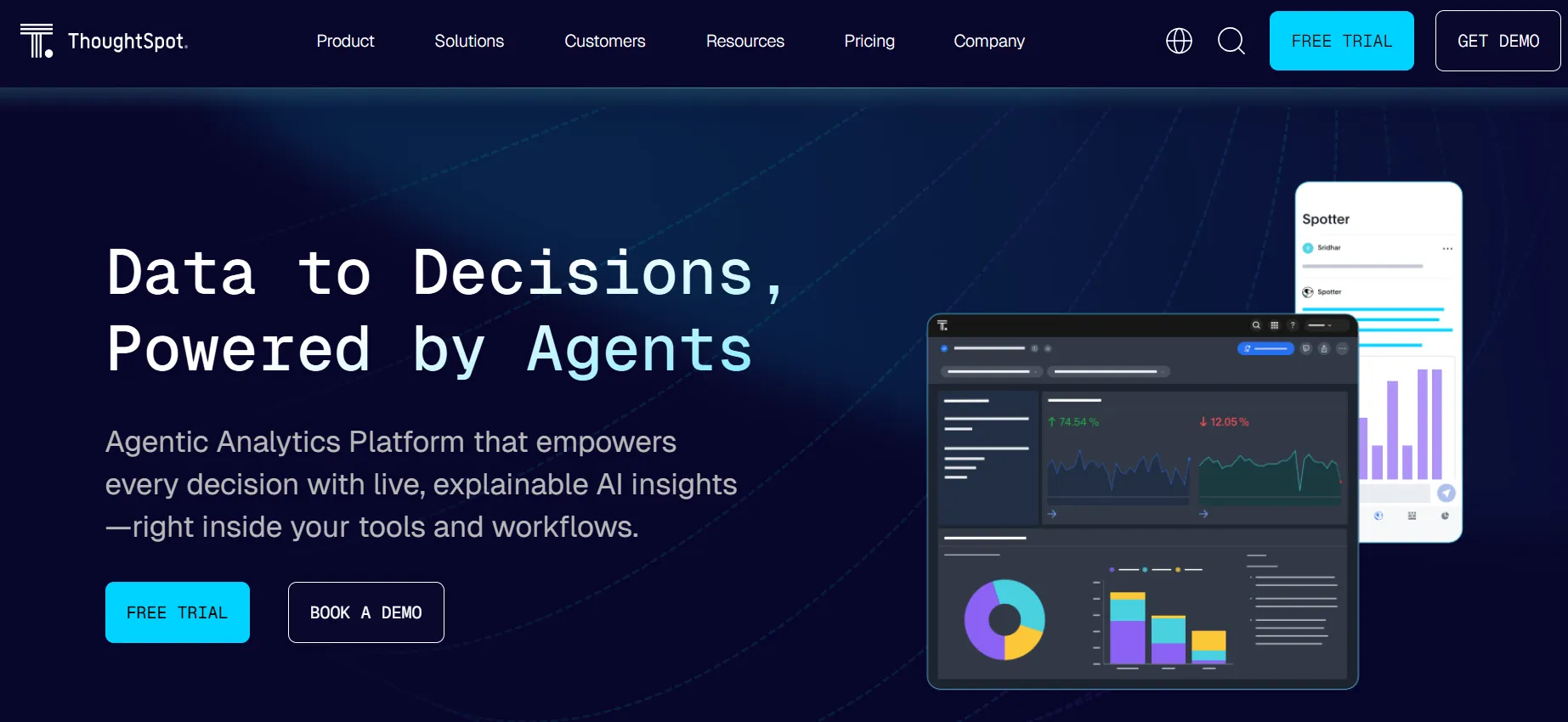
ThoughtSpot positions itself as an Agentic Analytics Platform: an AI-powered analytics product aimed at both data teams and business users. Its stated goal is to turn data into live, explainable insights inside everyday tools and workflows.
At the heart of the platform are AI Agents, including Spotter, which let users ask governed questions in natural language and get answers on live data without writing SQL for each interaction. A user can type, “Which products delivered the highest margin this quarter?” and get a result with visual context and drill-down options. The implementation, semantic modeling and ongoing administration behind that experience are still technical work.
Beyond AI search, ThoughtSpot covers augmented dashboards (Liveboards), Analyst Studio for deeper modeling with SQL, R or Python, and Embedded Analytics for integration into web or SaaS products.
It connects to supported cloud data platforms, including Snowflake, Google BigQuery, Databricks, Amazon Redshift and Azure Synapse, so users can analyze data where it already lives.
In short, ThoughtSpot combines natural-language search, dashboards, AI agents, Analyst Studio and embedded delivery in one self-service BI platform.
ThoughtSpot Analytics pricing plan
ThoughtSpot has updated its pricing structure for 2026 to make its Agentic Analytics Platform more accessible for smaller teams and scaling businesses.
Pricing below was last checked on August 10, 2026 against ThoughtSpot's official pricing page. Always confirm current figures with ThoughtSpot before budgeting.
There are two components: ThoughtSpot Analytics and ThoughtSpot Embedded. Let's start with the first one.
The Essentials plan starts at $25 per user per month (billed annually). It’s designed for small teams looking to find and share insights with AI-powered analytics. You get access to dynamic interactive dashboards, actionable insights, and support for 5 to 50 users, handling up to 25 million rows of data.
Next up, the Pro plan, which is sold two ways. The per-user route starts at $50 per user per month (billed annually) and lists AI-infused dashboards, Spotter AI Agents at 25 queries per user per month, and up to 1,000 users and 250 million rows of data.
The alternative is a usage-based route starting at $0.10 per credit, covering the same user and data ceilings, and listing Spotter AI Agents with unlimited LLM tokens plus Analyst Studio for advanced analytics. ThoughtSpot states that it does not separately meter or charge for LLM tokens under a standard subscription, so AI usage is not a second line item the way it is with some competitors. ThoughtSpot states that it doesn't meter or charge for LLM tokens itself, though if you bring your own LLM provider that provider's fees still apply.
These are two pricing routes to the same Pro plan rather than two different products. Which one costs less depends entirely on your usage profile, so model both. Per-user cost rises predictably with headcount, while a usage-based cost tracks measured platform consumption.
This is where the ThoughtSpot pricing model gets hard to forecast: a credit is a platform-pricing unit, not a synonym for one question. ThoughtSpot's public page gives the starting credit rate but does not publish a complete workload-to-credit calculation on the pricing page. Ask for the current credit schedule and model representative searches, Liveboard views, refreshes, AI use and administrative workloads before comparing the usage option with per-user pricing.
Finally, the Enterprise plan is designed for large organizations that need enterprise-grade AI analytics at scale. Pricing is custom, based on team size, data and deployment needs. This tier lists dynamic AI dashboards, Spotter AI Agent access, unlimited users, and unlimited data capacity.
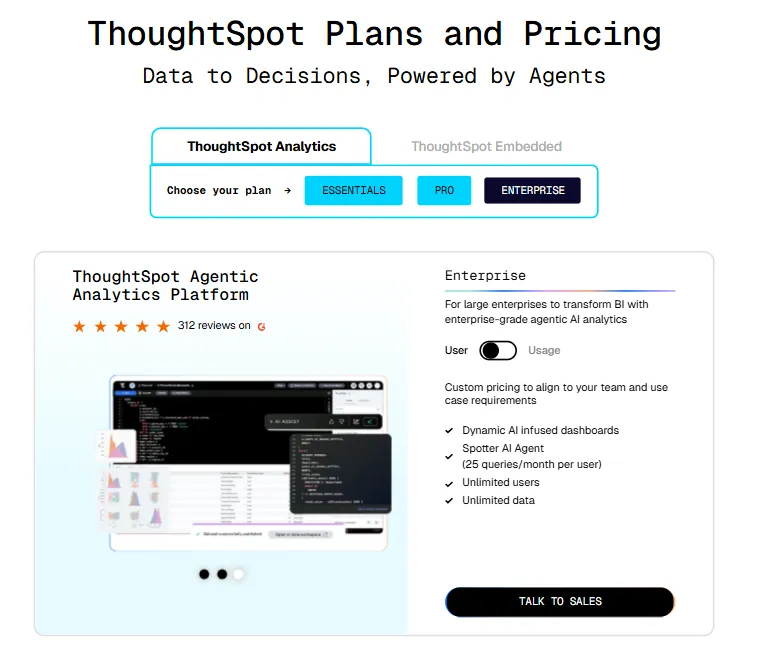
ThoughtSpot's current plan table lists search-driven analytics, natural language queries and AI-generated insights across its Analytics plans, with the differences falling on data limits, user capacity and the level of AI functionality available. Treat plan labels, limits and feature availability as what the public page shows; your final subscription terms come from your quote and contract.
If you want to embed dashboards or create customer-facing analytics, you’ll still need to combine your Analytics plan with ThoughtSpot Embedded, which comes with its own pricing structure.
ThoughtSpot also advertises a startup program at $12,999 per year for eligible early-stage companies, which sits well below the standard Enterprise route. See Luzmo vs ThoughtSpot for how the two compare on embedded delivery.
ThoughtSpot Embedded
If your goal is to embed AI-powered analytics directly into your SaaS product or customer portal, the ThoughtSpot Embedded plans are designed for that use case. ThoughtSpot ships a REST-based API and a Visual Embed SDK, so dashboards, search and visualizations can be integrated into your own application rather than rebuilt from scratch.
When it comes to pricing, there are two tiers: Developer and Enterprise.
The Developer plan is free for the first year (up to 10 users and 25 million rows of data), giving you a hands-on way to test the product and explore embedding workflows. ThoughtSpot's current pricing page renders this offer inconsistently across variants, so confirm the current term before budgeting. It includes:
- AI agents for analytics
- Conversational AI chatbot
- Dynamic dashboards and natural language search
- REST-based API and Visual Embed SDK
- Custom styles and theming
- Up to 25 million rows of data
It’s ideal for proof-of-concept projects, demos, or smaller teams that want to experiment with embedding before scaling.
The Enterprise plan uses flexible pricing aligned with the use case and go-to-market requirements, so you’ll need to contact sales for a custom quote. ThoughtSpot's current Enterprise feature table lists:
- Visual Embed SDK and REST-based API
- Custom styles and embedded SSO
- Row-level security, data encryption and data isolation
- Multi-tenancy by organization
- Unlimited users and unlimited data
- Enterprise support with a one-hour SLA
Several capabilities are sold as add-ons rather than included by default. The current table identifies examples including Analyst Studio, advanced analysis with SQL, R or Python, in-memory cache and the Model Context Protocol (MCP) Server.
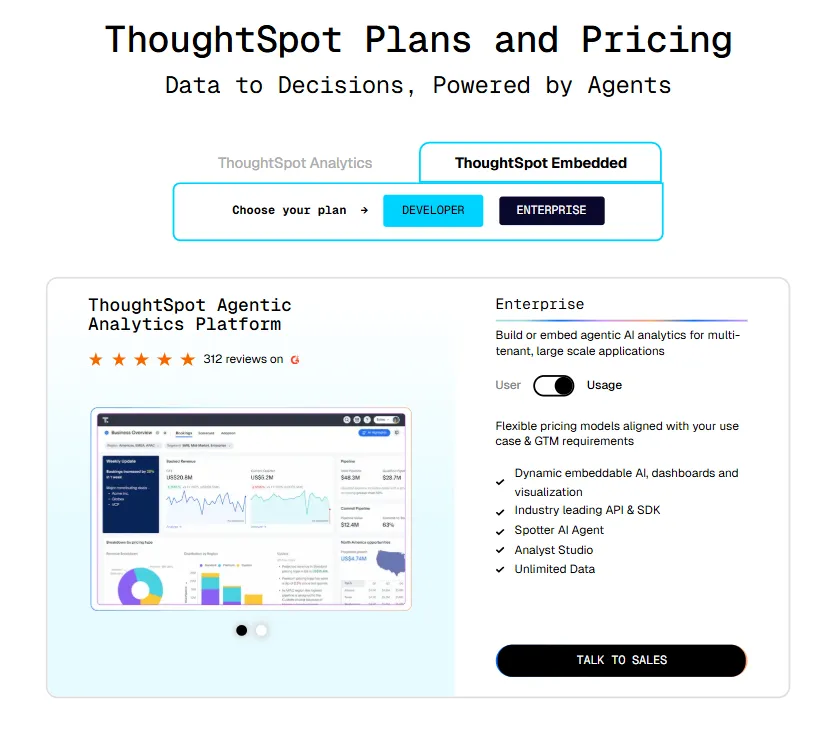
ThoughtSpot publishes enough information to identify the Developer limits and the scope of its Enterprise embedding offer, but it does not publish one universal Enterprise price. Forecasting therefore depends on the commercial model in the quote. If the agreement uses credits or another consumption unit, model realistic customer activity and overages. If it uses a predictable user or customer unit, model audience growth. In both cases, confirm which AI, support and advanced-analysis capabilities are included or sold separately.
What should you learn from ThoughtSpot reviews before comparing alternatives?
ThoughtSpot reviews are most useful when the reviewer shares your use case. An analyst evaluating natural-language exploration, an administrator governing internal BI and a SaaS team embedding analytics for customers are testing different parts of the platform.
Use reviews to turn recurring comments into proof-of-concept scenarios, not into current product or pricing facts. Test a representative data model, natural-language questions, an embedded authentication flow and the expected audience size. Then verify plan limits, security controls and commercial terms against ThoughtSpot's current documentation and your written quote.
How should you evaluate ThoughtSpot pricing and total cost?
Start with the pricing unit, then model the full deployment. ThoughtSpot's public prices make the entry points visible, but the public page cannot determine a buyer's final cost because Enterprise and embedded terms are tailored and some advanced capabilities are add-ons.
Work through this checklist before comparing vendors:
- internal users and external users, modeled separately
- the per-user price or the contracted usage unit
- minimum annual commitment and included allowance
- data-row limits and expected growth
- the Spotter query allowance under the selected user-based offer
- the credit schedule, which workloads are counted and how overages are treated under a usage offer
- add-ons such as Analyst Studio, MCP Server and in-memory cache
- data warehouse compute and storage outside ThoughtSpot
- implementation, semantic modeling, migration and administration
- embedded authentication, tenant governance, theming and product engineering
- support tier, SLA and any professional services
A useful total-cost comparison uses at least three scenarios: today's baseline, expected usage in 12 months and a high-adoption case. Ask every shortlisted vendor to price the same scenarios and identify assumptions, excluded services and overage rules. This produces a defensible comparison without treating a public starting price as a complete quote. If you're running a formal process, an embedded analytics RFI or RFP is the place to make those assumptions explicit.
Two things deserve their own line in that model. Natural-language answers depend on data modeling quality and on the admin team maintaining the semantic layer, so budget for that work rather than assuming the search interface removes it. And security and governance controls are listed per plan, so confirm which ones your contract actually includes rather than reading the full feature list as a baseline.
Which alternatives to ThoughtSpot are worth pricing for a SaaS product?
For a SaaS product, price alternatives that match the same customer-facing job. Luzmo belongs on the shortlist when embedded analytics is a product capability and the team wants SDK-based integration, white-label delivery and pricing organized around deployed solutions and monthly active users. Sisense belongs on the shortlist when the team wants an embedded platform with iframe or Compose SDK options and needs to scope an enterprise deployment with sales. For the wider field, see our roundup of ThoughtSpot competitors.
Broader BI platforms such as Power BI, Tableau and Looker may still be relevant when the company already operates those ecosystems or needs internal BI as well as customer-facing analytics. Do not compare only license prices. Compare the authentication model, tenant governance, product customization, engineering work, support and external-user economics for the same deployment.
How do ThoughtSpot, Luzmo and Sisense compare on pricing and fit?
ThoughtSpot, Luzmo and Sisense can all support customer-facing analytics, but their public pricing signals differ. ThoughtSpot publishes starting prices for internal analytics and a free Developer route for embedding, while its embedded Enterprise offer is tailored. Luzmo publishes a single starting price. Sisense publishes plan scope and a self-serve trial path, but its Enterprise page directs buyers to sales rather than showing a public price.
| Decision factor | ThoughtSpot | Luzmo | Sisense |
|---|---|---|---|
| Primary fit | AI-led analytics for internal teams plus an embedded product | Customer-facing embedded analytics for software products | Embedded analytics with self-serve and tailored enterprise routes |
| Public pricing signal | Essentials from $25 per user per month, Pro from $50 per user per month or $0.10 per credit, billed annually where stated; Embedded Enterprise is tailored | From €1,995/month, billed annually; platform fee plus adoption-based usage; Enterprise is custom | No public Enterprise price on the current plans page; contact sales |
| Developer entry | Embedded Developer is listed as free, with current page variants also stating free for one year, up to 10 users and 25 million rows | Starter includes full API and SDK access; a free trial is available | Self-serve plan offers a free trial path |
| Embedding route | Visual Embed SDK and REST-based API | SDK-based embedding rather than iframe embedding | Iframe or Compose SDK |
| Cost question to verify | Chosen user or usage model, credit schedule, add-ons and Enterprise quote | MAU band, number of live solutions, Enterprise services and any custom terms | Enterprise quote, deployment, support, capacity and implementation terms |
| Best shortlist reason | Search and AI-led exploration are central requirements | Analytics is being shipped as a native customer-facing product capability | Enterprise deployment control or Sisense's existing embedded stack is a priority |
Pricing checked: August 10, 2026. Verify current plan terms and every quote-dependent inclusion before purchasing.
These are public buying signals, not interchangeable quotes. Run the same usage and adoption scenarios through all three vendors. Ask each one to separate recurring platform fees, variable usage, implementation services, support, hosting and add-ons before selecting the lowest total cost for the required product experience.
For how ThoughtSpot's model compares with the rest of the market, see our overview of embedded analytics pricing across 20 vendors.
If ThoughtSpot pricing is not a good fit for your team…
At Luzmo, we offer an embedded analytics setup with transparent pricing you can actually understand. Luzmo starts at €1,995 per month, billed annually, combining a platform fee with adoption-based usage measured through monthly active users, AI conversations or both. Enterprise requirements change the deployment rather than the product feature set, covering larger security, hosting and scale needs, and AI-assisted insights are delivered through Luzmo AI and the Luzmo IQ conversational analyst.
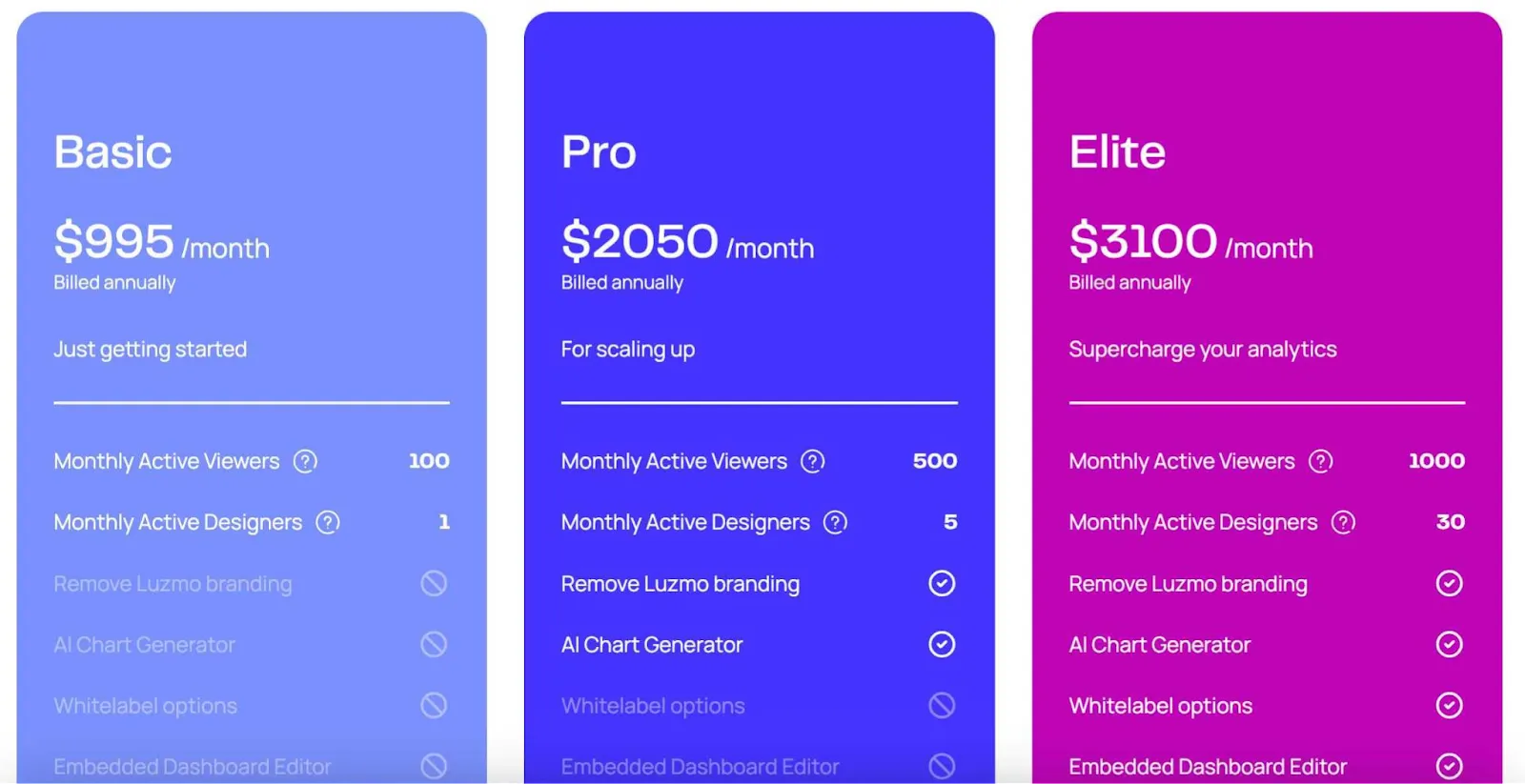
The key difference is that you can work out how much Luzmo will cost each month before you talk to anyone. The plan includes white-label embedded analytics, custom charts and themes, AI, and full API and SDK access. Self-service analytics, Luzmo IQ and AI conversations are included rather than unlocked by a higher tier; onboarding and a dedicated CSM are available as optional services. Enterprise covers dedicated VPC hosting, OIDC, custom SLAs and compliance requirements.
Each plan includes access to Luzmo Studio, where your team can build, test, and refine dashboards in minutes, and Luzmo Flex, which lets you embed analytics seamlessly into any app or workflow. Developers can go deeper using Agent APIs to automate data interactions, control dashboard behavior, and extend analytics functionality across your product.
Luzmo uses SDK-based embedding rather than iframe embedding, so your engineers keep full control of layout, styling and behavior in your own application code. You can adjust dashboard design, widgets, language, currency and time zones per tenant, so every end user gets a personalized analytics experience that fits their context. On top of that, Luzmo AI includes AI-assisted chart creation that turns questions into visual insights instantly, and our developer tooling spans Luzmo Studio, the Flex SDK and a full REST API.
How much does ThoughtSpot really cost?
ThoughtSpot publicly lists Analytics entry prices, but the exact cost depends on the selected route. Essentials starts at $25 per user per month. Pro starts at $50 per user per month or $0.10 per credit. Enterprise is custom. Embedded Developer has a free entry route with limits, while Embedded Enterprise uses tailored commercial terms.
To calculate the likely total, combine the selected pricing unit with users, data limits, AI allowance, add-ons, warehouse costs, implementation and support. For an embedded deployment, request the contracted workload definition and run baseline, 12-month and high-adoption scenarios. That is more reliable than assuming every interaction consumes one credit or that a starting price covers the entire deployment.
If you'd rather use an embedded analytics tool that's easy to set up, powerful to customize, and has fully transparent pricing, check out Luzmo. With Luzmo IQ, Studio, Flex, and Agent APIs, you get AI-powered insights, full creative control, and flexible embedding options for any SaaS product. Visit our pricing page to see exactly how much Luzmo costs, or talk to our sales team to learn how we can help you launch analytics your customers will actually love.
FAQ
All your questions answered.
Is ThoughtSpot pricing predictable for embedded analytics use cases?
Predictability depends on the commercial model in the quote. ThoughtSpot publishes limits for its Embedded Developer offer, while Embedded Enterprise uses flexible pricing aligned with the use case and go-to-market requirements. Ask for the pricing unit, included allowance, minimum commitment, add-ons and overage rules, then model the expected customer activity before signing.
What are the main differences between ThoughtSpot and Luzmo for embedded analytics?
ThoughtSpot combines AI-led internal analytics with an embedded product based on its Visual Embed SDK and REST API. Luzmo is centered on customer-facing embedded analytics for SaaS products, with Luzmo Studio for building dashboards and Luzmo AI, the agentic AI suite that includes the Luzmo IQ conversational analyst, for natural-language exploration. Pricing combines a platform fee with adoption-based usage rather than per-query consumption, so compare the intended audience, AI workflow, developer integration and governance for the same deployment.
When should a company consider an alternative to ThoughtSpot?
Consider alternatives when the use-case fit changes, for example when analytics becomes a customer-facing product capability rather than an internal analyst tool. The other triggers are the pricing unit, how deeply the analytics must integrate into your own product, and how much administrative work the deployment takes. ThoughtSpot does offer embedding and customization, so compare on fit and total cost rather than capability alone.
What kind of security controls does ThoughtSpot include?
ThoughtSpot's plan table lists row-level security, data encryption and data isolation, and its documentation describes roles, groups, privileges, audit logs, SAML and OIDC. Which controls apply depends on the plan and contract, so confirm the specific controls, residency and compliance requirements for your own deployment rather than assuming every control is available on every tier.
Does ThoughtSpot offer enterprise-level protection?
ThoughtSpot's Enterprise offers list row-level security, data encryption, data isolation and enterprise support in the current feature table, alongside documented controls for roles, groups, privileges and audit logs. Confirm which of these are included in your order form, and validate residency, key management and compliance requirements against ThoughtSpot's current Trust Center before signing.
How is data protected during transfer and storage?
ThoughtSpot's Trust Center states that data is encrypted in transit using TLS and at rest using AES-256 encryption. It also describes key management and access controls. Buyers should confirm the architecture, residency, key-management and contractual requirements that apply to their specific deployment.
What kind of support can businesses expect?
Support depends on the plan and contract. ThoughtSpot's current feature table lists Enterprise Support with a one-hour SLA for Enterprise offers. Confirm the severity definition, coverage hours, escalation process and remedies in the order form or support terms rather than applying that response target to every plan.
Is ThoughtSpot suitable for multi-tenant environments?
ThoughtSpot's current Embedded Enterprise feature table lists multitenancy by organization, along with embedded SSO, permission groups and security controls. A SaaS team should still test tenant provisioning, row-level rules, content separation, authentication and administrative workflows against its own architecture before selecting the platform.
How does ThoughtSpot help non-technical users explore data?
Through its search-driven experience, ThoughtSpot lets business users ask questions in natural language without writing SQL for each question. The quality of the answers still depends on the underlying data model and on administration, so governed results are a function of the modeling work behind the search interface rather than of the interface alone.
Can you give an example of how pricing could scale with this analytics platform?
Under per-user pricing, cost scales with the contracted user count and plan. Under a usage model, it scales with the contracted credit schedule and measured workloads. For example, compare a baseline and high-adoption scenario using the same searches, Liveboard activity, AI use and refresh pattern. ThoughtSpot's public page does not provide a universal conversion from each interaction to credits.
Does ThoughtSpot have a free plan or trial?
ThoughtSpot offers free-trial paths, and its current Embedded Developer offer is listed as free with limits of up to 10 users and 25 million rows. One current pricing view says the offer is free for one year. Confirm the current duration, eligibility and post-trial terms before treating it as a permanent free production plan.
Where can I find more details about plans and pricing information?
Plans and published prices are on ThoughtSpot's pricing page, where you can compare listed features across tiers and see the stated user and data limits. The page shows entry points and plan scope rather than a calculated cost, so your final figure still comes from a quote that reflects your users, usage, add-ons and contract terms.
How do AI-powered analytics improve the user experience in ThoughtSpot?
ThoughtSpot's current pricing page describes Spotter AI Agents, conversational analytics, automated insights and natural-language exploration. In practice that means users can ask questions in plain language and get charts and suggested follow-ups instead of filing a report request. Answer quality still depends on how well the underlying data is modeled and governed.
What are the best ThoughtSpot app alternatives?
For a SaaS product, Luzmo and Sisense are relevant ThoughtSpot app alternatives to price for customer-facing embedded analytics. Power BI, Tableau and Looker may be stronger candidates when an existing internal BI ecosystem drives the decision. Compare the same audience, deployment, governance, integration and total-cost assumptions rather than selecting an alternative from feature count alone.
Written by

Ship the future of your data
Let us show you what Luzmo can do for your product.

Book your session with our analytics expert.