2026 GoodData Review: Our Experience With GoodData
Business intelligence tools are nothing new - they’ve been around for decades, with big players such as Tableau, Power BI and Qlik running the game. But lately, a need for a new kind of tool emerged. A business intelligence tool for end users, providing self-service analytics functionality to the average app user.
One of the main competitors in this arena is GoodData - a tool that promises AI-accelerated data visualization and analytics for business app end users. In today’s GoodData review, we take a look if that promise holds up.
What is GoodData - the business intelligence software?
Founded in the Czech Republic in 2004, Good Data has grown into a global business intelligence and data analytics company with over 300 employees, eight data centers, and more than 1.7 million users worldwide.
By 2025, the platform evolved into a data intelligence and agentic AI ecosystem - a shift that helps both developers and business teams design, deploy, and scale intelligent analytics apps faster.
GoodData’s platform is built around a composable architecture that connects seamlessly with your existing data stack. Whether you host on-premise or use GoodData Cloud, it delivers real-time analytics, automation, and AI-powered decision-making across industries like healthcare, finance, retail, and SaaS.
GoodData embed analytics tool features
GoodData is now promoted as a data intelligence platform for building agentic applications. It combines AI agents, advanced analytics, and a flexible data layer so teams can create custom apps and workflows in days, not years.
Its FlexQuery engine - a composable data service layer built on Apache Arrow - remains a core strength. It ingests batch or real-time data, performs in-memory computation, and executes pre- and post-processing transformations. The result: faster queries, optimized caching, and reduced dependency on external data warehouses.
Teams can design and deploy intelligent, embedded dashboards with an intuitive drag-and-drop interface or through code-based customization using SDKs and APIs. The platform’s AI Assistant supports natural language queries, while predictive models and automated workflows help uncover insights with minimal manual setup.
For developers, GoodData’s API-driven, no-black-box architecture allows full control over integrations and UI. Security standards meet HIPAA, SOC 2 Type II, ISO 27001, and GDPR compliance, ensuring safe and compliant analytics at scale.
Its multi-tenant environment still enables business users to embed analytics for individuals or teams, while the semantic and version-control layers make collaboration, rollbacks, and governance simple.
Data sources
GoodData connects to a variety of databases that you can use for internal or embedded analytics. Some of those choices include:
- Snowflake
- BigQuery
- Amazon Redshift
- Azure SQL
- Databricks
- And many others
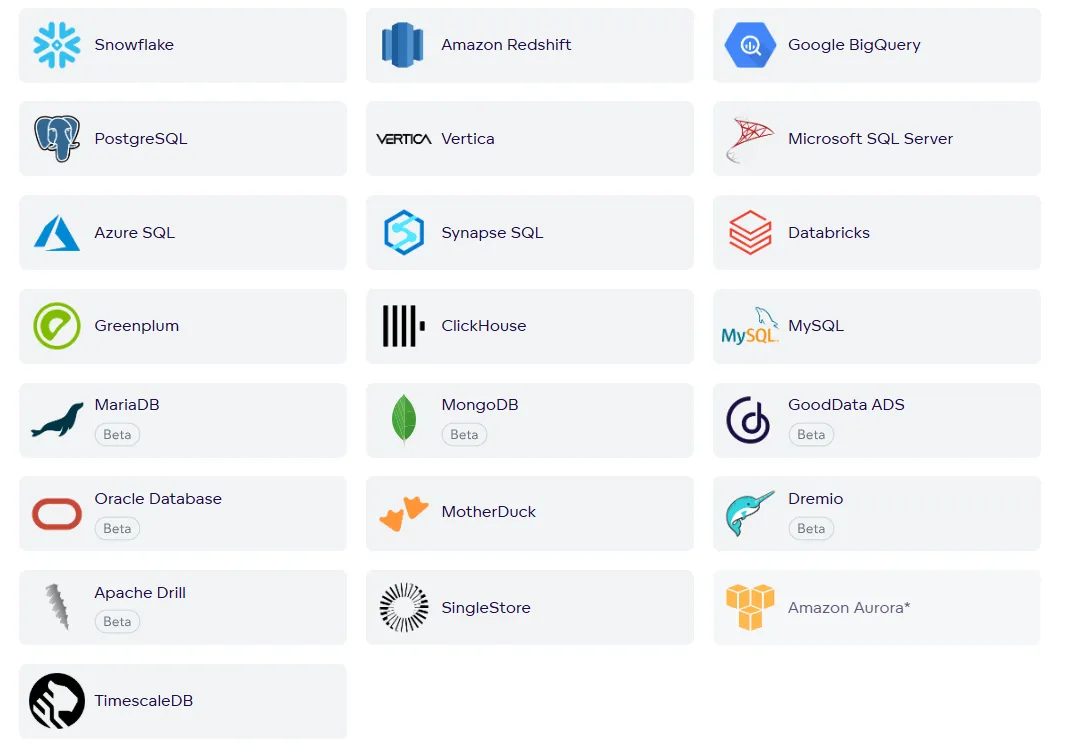
In short, all of the most widely used data sources are there and with a good developer, you’ll be able to connect your data to a self-hosted or embedded system.
User reviews, dashboards and customization
The user interface for the most basic dashboards is pretty good. Creating dashboards and adding metrics and KPIs is no rocket science.
Doing the most basic customizations such as changing colors and folders is pretty straightforward. Even for your end users who want to build their own dashboards, making these edits is easy.
This is where the good news ends. For any kind of extensive customization, you’ll have to go through their documentation (which is reportedly not very good) or have your developer spend a few hours troubleshooting.

One thing that we’ve seen pop up more than once is that GoodData does not perform all that well with big datasets. If you have a large number of records internally or for a specific user, this can cause GoodData’s data model to load very slowly, which results in slow dashboards.

Localization seems to be an issue too, as some users might want to drill down into data with local currencies, time zones, and other details.
The overall rating for GoodData with most users is that for the most basic visualizations and dashboards with not much more than a KPI or two, it’s easy to use. However, advanced customization requires help from customer support, a good developer, lots of time spent on documentation, or all of the above.
The embedding process
There are several different workflows you can use to embed a GoodData dashboard. Their API is pretty decent and with some documentation, your developers should be able to connect it to your app without much fuss.
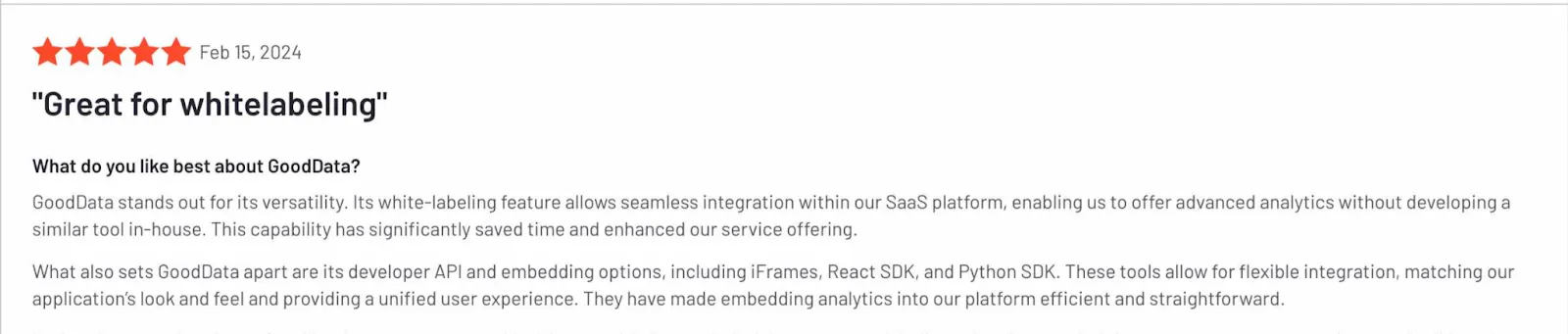
Their embedding options include iframes and web components, and they offer SDKs for major programming languagues, such as their Python SDK and React SDK. According to many GoodData user reviews, this is one of the strongest suits of this tool.
Customer support
Having access to great customer support is crucial for any BI tool, especially if ease of use is not its strong side. The GoodData platform has many user reviews complaining about customer service. The reason for this is that only certain GoodData users have access to a dedicated customer success manager.
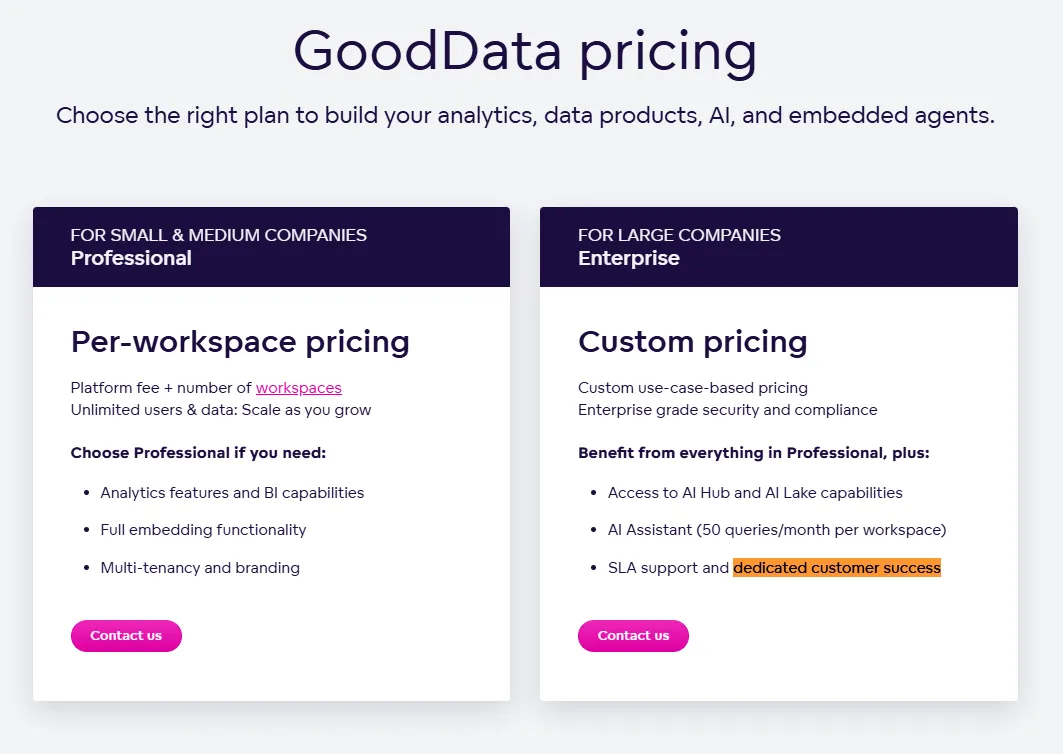
If you take a look at their pricing page (more on that in a second), you’ll see that only the most expensive, Enterprise plan, comes with dedicated customer success managers as a part of the offer. Everyone else has to submit a ticket and wait patiently for someone to troubleshoot their situation.
“Standard support” refers to GoodData’s community forums and your issue may get resolved quickly or take days or weeks on end.

If you have a team of experienced developers and data scientists, ideally with previous GoodData experience, this shouldn’t pose a problem. However, if you’re fairly new to data analysis and visualization, you may get stuck often as the tool is not always intuitive. Account for customer support when you consider GoodData as your next BI tool.
GoodData pricing model
GoodData has evolved its pricing to focus on flexibility and scalability. It's no longer publicly available, and you need to get in touch with their team to get a price.
Professional plan - for small and medium companies
The Professional plan follows a per-workspace pricing model. It includes a platform fee plus the number of workspaces you create, allowing you to scale with unlimited users and real-time data.
This plan is ideal if you need:
- Core analytics tools and BI features
- Full embedding capabilities
- Multi-tenancy, white labeling, and branding options
Professional users also gain access to GoodData Cloud, which supports multiple data sources, advanced data integration, and flexible data storage. It’s a solid choice for teams looking to grow without committing to enterprise-level pricing.
Enterprise plan - for large-scale deployments
For organizations managing complex architectures or larger volumes of data, the Enterprise tier uses custom, use-case-based pricing. It builds on everything in the Professional plan and adds AI-driven features like:
- AI Hub and AI Lake for advanced data processing and governance
- AI Assistant for natural language queries (up to 50 per workspace)
- Custom agents, AI memory, and semantic quality management
- Dedicated customer support and SLA guarantees
Enterprise customers also benefit from GoodData’s scalable infrastructure and strong security compliance standards, making it suitable for industries with strict governance or privacy needs.
All in all, based on verified reviews from real users, GoodData provides a capable, cloud-native BI platform that delivers solid reports and dashboards - but its pricing can feel opaque without a direct quote. Most users praise the intuitive UI, but note that cost grows with the number of workspaces and AI queries.
If you’re comparing tools, it’s worth checking how GoodData vs Looker, Power BI, or Luzmo performs for your use case.
Who is GoodData for?
It fits into a pretty niche market. It’s for businesses of all sizes that need internal reporting but don’t want to deal with the complexity of Salesforce’s Tableau or Microsoft’s Power BI. It has similar features but they are more complex to use.
What is worse is that GoodData’s documentation is not very good (unlike Tableau, for example) and there is not a huge number of specialized developers out there for this tool (unlike Power BI).
For embedded analytics, this can be a good choice if you already have experience with embedded systems and an in-house team to connect the dots. It’s not suited for first-time users of self-service analytics.
Should you use GoodData?
That depends on what you need it for. If you need real-time analytics for a small internal team of users, then it makes sense in terms of pricing and features. If you want to get an embedded analytics platform with great user experience and affordable pricing, GoodData is probably not the best choice.
If you’re looking for a user-friendly embedded analytics platform with easy embedding, plenty of connectors, and fair and transparent pricing - you’ve found it with Luzmo.
With Luzmo Studio, your team can design and customize dashboards that feel like a native part of your product. Luzmo IQ helps surface trends, correlations, and anomalies automatically across your datasets, while Luzmo AI allows users to ask questions in natural language and instantly generate insights and visualizations. Together, these tools help SaaS teams deliver powerful analytics experiences to their users without the complexity of traditional BI platforms.
Luzmo’s pricing is transparent and designed for SaaS growth. Luzmo starts at €1,995 per month, billed annually, with a platform fee plus adoption-based usage and no internal builder seat licences.
Book a free demo with our team so we can tell you how to add customer-facing dashboards to your product in days, not months.
FAQ
All your questions answered.
What is GoodData used for?
GoodData is a cloud-based business intelligence platform designed for building analytics applications and embedded dashboards. Companies use it to analyze data, create reports, and deliver insights directly inside internal tools or customer-facing products.
Does GoodData support embedded analytics?
Yes. GoodData allows companies to embed dashboards and analytics into web applications using APIs, SDKs, and web components such as iframes. This makes it possible to deliver data insights directly to end users within SaaS platforms.
What should you consider before choosing GoodData?
Before choosing GoodData, companies should evaluate factors such as pricing transparency, performance with large datasets, ease of customization, and the availability of developer support. These aspects can influence how easily the platform can be implemented and scaled within a product or analytics workflow.
Written by

Ship the future of your data
Let us show you what Luzmo can do for your product.

Book your session with our analytics expert.