What is AI-Driven Analytics? Pros, Cons and Use Cases
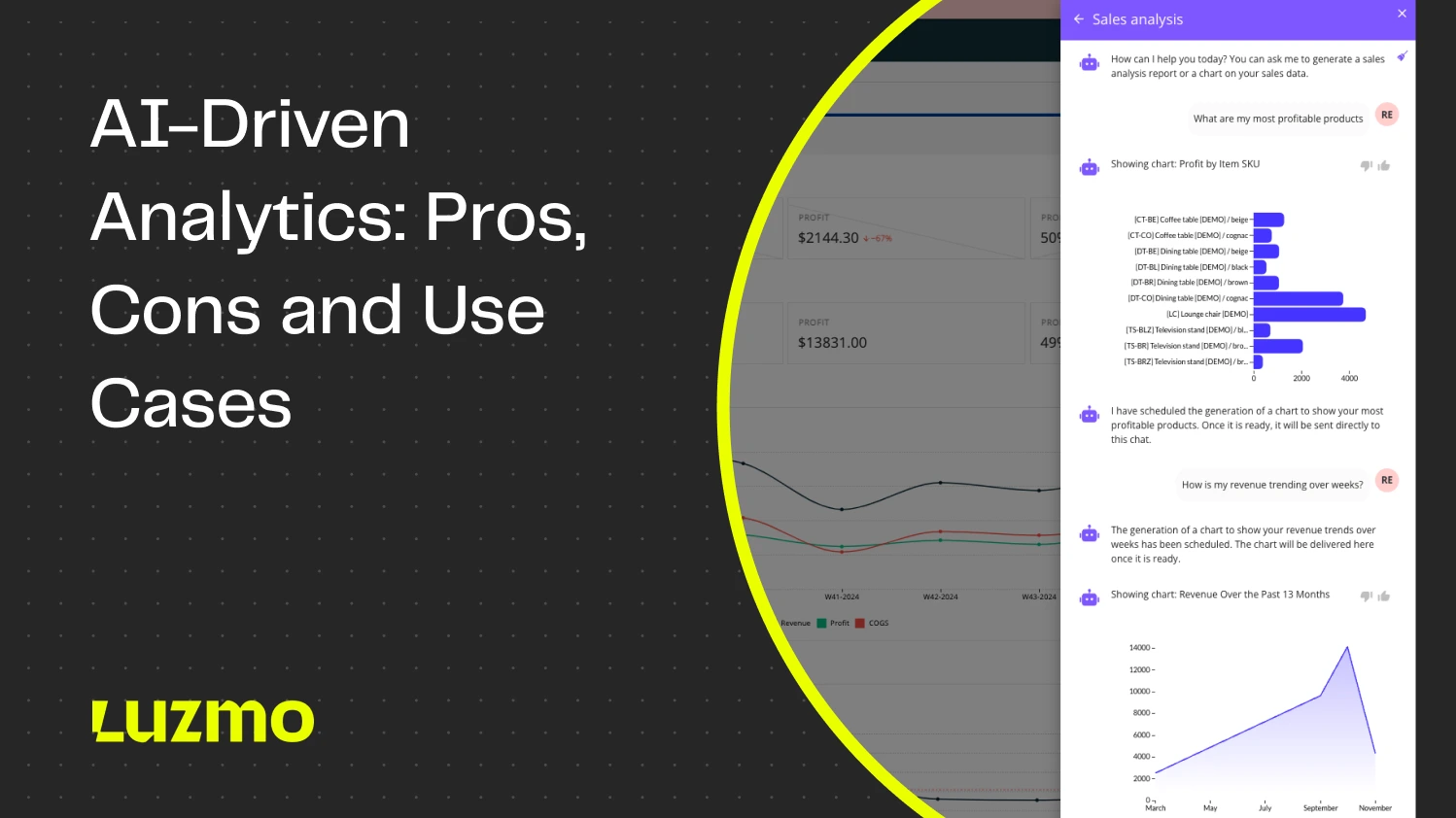
AI-driven analytics makes big promises. Analyzing large amounts of data, normalizing and preparing data for visualization, choosing the best visualization type for your goals… But can artificial intelligence be used safely when dealing with important information? Can you trust algorithms with decision-making?
Today, we take a look at AI-driven analytics and how it can function in the modern workplace.
What is AI-driven analytics?
AI-driven analytics is the use of artificial intelligence and machine learning to analyze data, uncover patterns, generate insights, and create visualizations based on available datasets. For modern businesses, AI-powered analytics helps with task automation and optimization, data preparation, and in general, getting actionable insights from raw data.
Using AI-driven analytics helps:
- Get real-time insights and data analysis instead of waiting for a data analytics team to supply the finished data visualizations or reports
- Make more informed decisions about the future of your product, the customer experience, sales operations, etc.
- Use predictive analytics to determine future outcomes based on historical data
- Use natural language processing (NLP) instead of complex analytics tools to help anyone get business insights, find correlations, and make their own conclusions
There are many advantages of using AI analytics solutions, but by far the biggest one is being able to analyze data and create dashboards without a team of data analysts and data scientists.
Modern embedded analytics platforms combine AI insights with dashboard creation to make analytics accessible to more users. With Luzmo Studio, teams can design and embed dashboards directly into their applications without heavy development work. Luzmo IQ can automatically surface trends, anomalies, and patterns in datasets, while Luzmo AI enables users to ask questions about their data in natural language and instantly generate insights and visualizations.
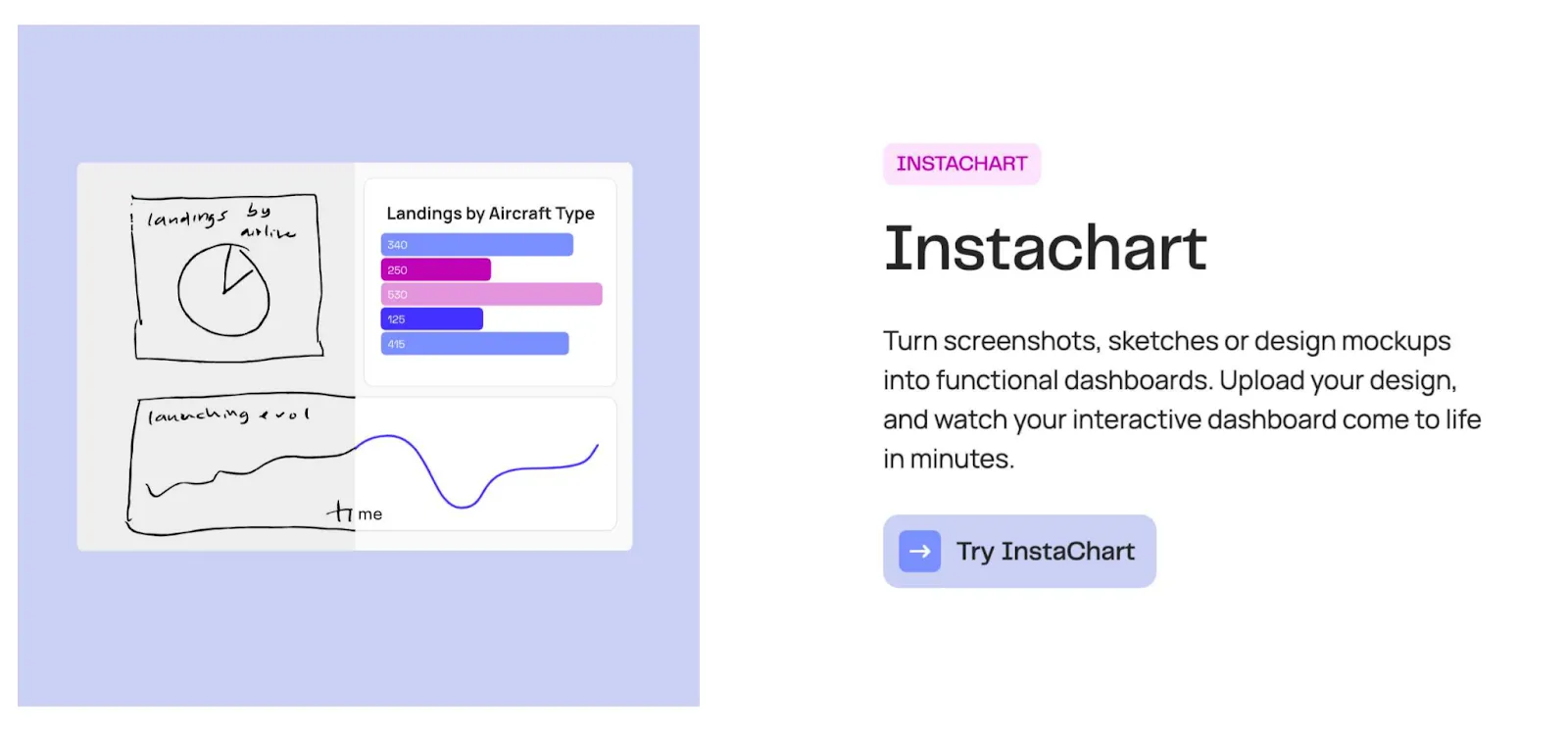
Luzmo's Instachart is an example of using AI to speed up data visualization
AI-driven analytics in 2026: what has actually changed
AI-driven analytics has been a topic of conversation in BI circles for several years, but 2025 and 2026 marked a shift from discussion to deployment. The capabilities that were described as emerging in earlier years — natural language querying, automatic insight generation, anomaly detection — are now standard features in most enterprise analytics platforms and an increasing number of product-facing ones.
The most significant practical change is the accessibility barrier. Two years ago, implementing AI analytics in a product required building a custom LLM integration, managing API keys, and engineering a semantic layer that the AI could query reliably. Today, embedded analytics platforms ship this capability as a configurable feature. The time from decision to deployment has compressed from months to days for teams using purpose-built platforms.
The second significant change is user expectation. End users who have experienced AI querying in one context — whether in a consumer app, a productivity tool, or a competitor's product — arrive at your analytics features with an expectation of conversational interaction. A static dashboard that requires users to navigate filter panels to answer a question they could just ask feels dated in a way that it did not two years ago.
For software product teams, this shift means that AI analytics is increasingly a competitive baseline rather than a differentiator. Teams that have not yet added AI-powered interaction to their embedded analytics features are building a gap that will be harder to close the longer it remains open. Luzmo AI covers this capability for product teams that want to ship AI analytics without building it from scratch — natural language querying, proactive insights, and AI-generated visualizations embedded directly in the product. Packaged as a product capability, this conversational layer is increasingly described as an AI analyst: an assistant that answers questions, explains dashboards, and helps users explore data inside the app.
Pros of AI-driven analytics
Machine learning algorithms are here to stay and for a good reason. Here are some of the biggest benefits of using AI for analytics.
Efficiency and speed: compared to traditional analytics, AI can analyze huge volumes of data more efficiently and quickly
Real-time analytics: AI tools allow stakeholders to analyze data in real-time instead of having to wait for a data scientist to deliver the finished analysis or dashboard
Pattern recognition: AI algorithms can spot patterns in data more quickly, uncovering new patterns that a data analyst may have missed
Risk management: AI models can not only forecast data but also foresee risks that can endanger business outcomes
Natural language processing: makes it possible for anyone to use business intelligence tools just by asking questions in plain English
Cons of AI driven analytics
You can get valuable insights more quickly and easily and eliminate some time-consuming tasks. However, let’s not forget some of the downsides of using generative AI for data analytics.
Technical expertise: AI apps have excellent user experience, once they’re set up and running. To get to this point, you have to get past implementing and setting up the tool, the data sources and the workflows
Dependence on data: for accurate results, you need superior data quality. With poor quality, unstructured data - or GA4 data that hasn’t had ga4 bot filtering applied — your analytics platform won’t produce meaningful results
Bias: AI data analytics models are trained on data from the real world, which can be biased
Data privacy: depending on the AI models and APIs used by the analytics tool, there can be some issues with data privacy, i.e. who has access to customer data and how
Integration: to integrate AI tools in your ecosystem, you’re going to spend some time setting up integrations and data sources
Resistance to change: your team may resist using AI technologies for business analytics
How to use AI-driven analytics: examples and use cases
We could talk about how AI is amazing if you want to streamline your operations and make a data-driven decision more quickly. But what does that look like in practice? Let’s take a look at some practical ways to use AI in the workplace.
Customer segmentation
Let’s say you run an e-commerce business selling a variety of products in one industry. You continuously create marketing campaigns but they’re targeting your entire audience.
You instruct AI to analyze your target audience with deep learning algorithms so the model can investigate who purchases from you and what their traits are. The AI analyzes the sales metrics and customer personas to segment your target audience.
You now have lists of segmented audiences and you can create more targeted campaigns (with paid ads, social media, etc.) that are personalized for specific audiences and pain points.
Predictive maintenance
You run a factory that produces packaging for food and you want to learn more about your operations and performance. You give AI data access to large datasets and let it run in the background as you go about your work.
The AI analyzes all the data points to tell you which equipment you use the most, when it’s likely to fail, and when you should maintain it to prevent critical system downtimes.
Fraud detection
You run a payment gateway that helps online businesses collect payments from their customers. Thanks to AI, you can analyze large data sets without any knowledge of data science.
The AI helps you detect unusual patterns and activities and spot fraud, both with the shops and their customers.
Healthcare diagnostics
You run a healthcare clinic and you want to improve patient and customer satisfaction, all the while ensuring your staff are not overworked. You let AI analyze your data to make sure you’ve optimized your processes as well as to give you a competitive advantage over clinics in the area.
The AI model determines your clinic’s busiest hours, patients who are the most likely to come in during certain seasons, and which staff are frequently needed in peak hours. It also helps set early diagnoses for certain illnesses.
Supply chain optimization
You run a brick-and-mortar store selling tires to businesses and consumers. You upload the data from your supply chain software to an AI algorithm to determine patterns and do prescriptive analytics.
The software determines which types of tires frequently go out of stock, when they are most likely to be in demand, which types of customers purchase them and when you should order them from the supplier.
Churn prediction
You run a SaaS business and you want to improve your customer retention. Without sitting down for customer interviews, you want to understand why customers are leaving and what you can do to prevent that. Enter churn analysis.
The AI tool does sentiment analysis to determine which customers speak of you negatively in reviews and surveys. You also upload your app data to find out at which stage in the lifecycle customers are the most likely to churn. The end result is a list of customers that can be saved and retained before leaving your SaaS product for good.
AI-driven analytics for embedded products: use cases by industry
Software and product analytics
Product teams use AI-driven analytics to give end users the ability to explore their own usage data without needing to understand dashboards or submit data requests. A project management platform can embed AI analytics that lets customers ask questions like "which team members have the most overdue tasks?" or "how has our project completion rate changed over the last quarter?" and receive immediate answers. This replaces a support ticket or a data export with a self-serve interaction that stays inside the product.
Financial services
Financial platforms use AI-driven analytics to surface anomalies in transaction data that would take an analyst hours to find manually. A spend management platform can monitor expense submissions and flag patterns — a vendor with unusual billing frequency, a department whose spend trajectory is tracking significantly above forecast — before the monthly review cycle. The AI does the pattern recognition work; the human makes the decision about what to do with the finding.
Healthcare and life sciences
Healthcare analytics teams use AI-driven analysis for cohort identification and outcome tracking across large patient datasets. Instead of querying a warehouse to find patients with a specific combination of conditions and treatment history, a clinical team can describe the cohort in plain language and receive a filtered dataset. The reduction in query cycle time directly affects how quickly clinical insights reach the people who act on them.
Supply chain and operations
Operations teams use AI-driven analytics to move from reactive reporting to proactive monitoring. Inventory systems that surface stockout risk before it becomes a fulfillment problem, logistics platforms that flag delivery time anomalies as they develop, and capacity planning tools that model scenarios in real time all apply the same underlying principle: AI compresses the distance between data and decision. Luzmo AI brings this capability to embedded analytics products, so that the end users of a supply chain software can access proactive insights without leaving the platform they already use to manage their operations.
The honest limitations of AI-driven analytics
The genuine capabilities of AI analytics are well documented. The limitations are discussed less often, and understanding them is important for setting realistic expectations and designing analytics experiences that work reliably.
AI analytics is as good as the data it operates on. Natural language querying against a poorly modeled data layer produces answers that are technically responsive but analytically wrong — the AI answers the question it was asked based on the data it can see, not necessarily the question the user meant to ask based on business reality. Investing in a clean semantic layer — clear metric definitions, consistent naming, documented relationships — is a prerequisite for AI analytics that users trust, not a nice-to-have.
Hallucination risk is real but manageable in a constrained environment. A general-purpose LLM inventing answers is a different problem from an AI analytics layer that is grounded in your actual data model. Purpose-built embedded analytics AI that queries real data rather than generating from training knowledge is significantly more reliable, but it is not infallible. Building in clear attribution — showing users what data the answer came from — is the most effective way to maintain trust when answers are unexpected.
User adoption does not follow automatically from capability availability. Many analytics features go unused because users do not know the capability exists or do not trust the outputs enough to act on them. Surfacing AI querying prominently, providing example questions, and making the data source for each answer transparent are design decisions that affect adoption as much as the underlying AI capability.
Is AI driven analytics the future?
On its own, AI analytics tools are still not at a point where they can be super useful to any business straight away. You still need to invest significant time in data cleaning, modeling and preparation. Also, you may need a data engineer or scientist on your team to at least set everything up for the rest of the stakeholders.
At the same time, AI tools can enhance your existing data analytics efforts. If you have the basics covered, you can use AI tools to find answers to key questions more quickly and easily. Not only that, but you can navigate your data in new and more engaging ways.
As for the right tool for the job, Luzmo can help. With Luzmo, you can add AI-based analytics to your app and ensure that your end-users can reap the benefits of using AI directly in your app.
Grab a free demo with our team to see what Luzmo AI can do for your software and your customers!
FAQ
All your questions answered.
How does AI-driven analytics differ from traditional analytics?
Traditional analytics typically relies on analysts manually preparing datasets, building dashboards, and interpreting results. AI-driven analytics automates many of these steps by using machine learning to detect patterns, generate insights, and recommend actions based on large datasets.
What are the biggest challenges of implementing AI-driven analytics?
Some of the most common challenges include data quality issues, integration with existing systems, potential algorithmic bias, and ensuring data privacy. Organizations often need clean and well-structured data before AI models can generate reliable insights.
Can non-technical users benefit from AI-driven analytics?
Yes. Modern AI analytics tools allow users to explore data through natural language queries and automated insights. Platforms that combine visualization tools with AI capabilities make it easier for business users to generate dashboards, interpret trends, and make data-driven decisions without advanced technical expertise.
Written by

Ship the future of your data
Let us show you what Luzmo can do for your product.

Book your session with our analytics expert.