AI Predictive Analytics: What it is and How it Works
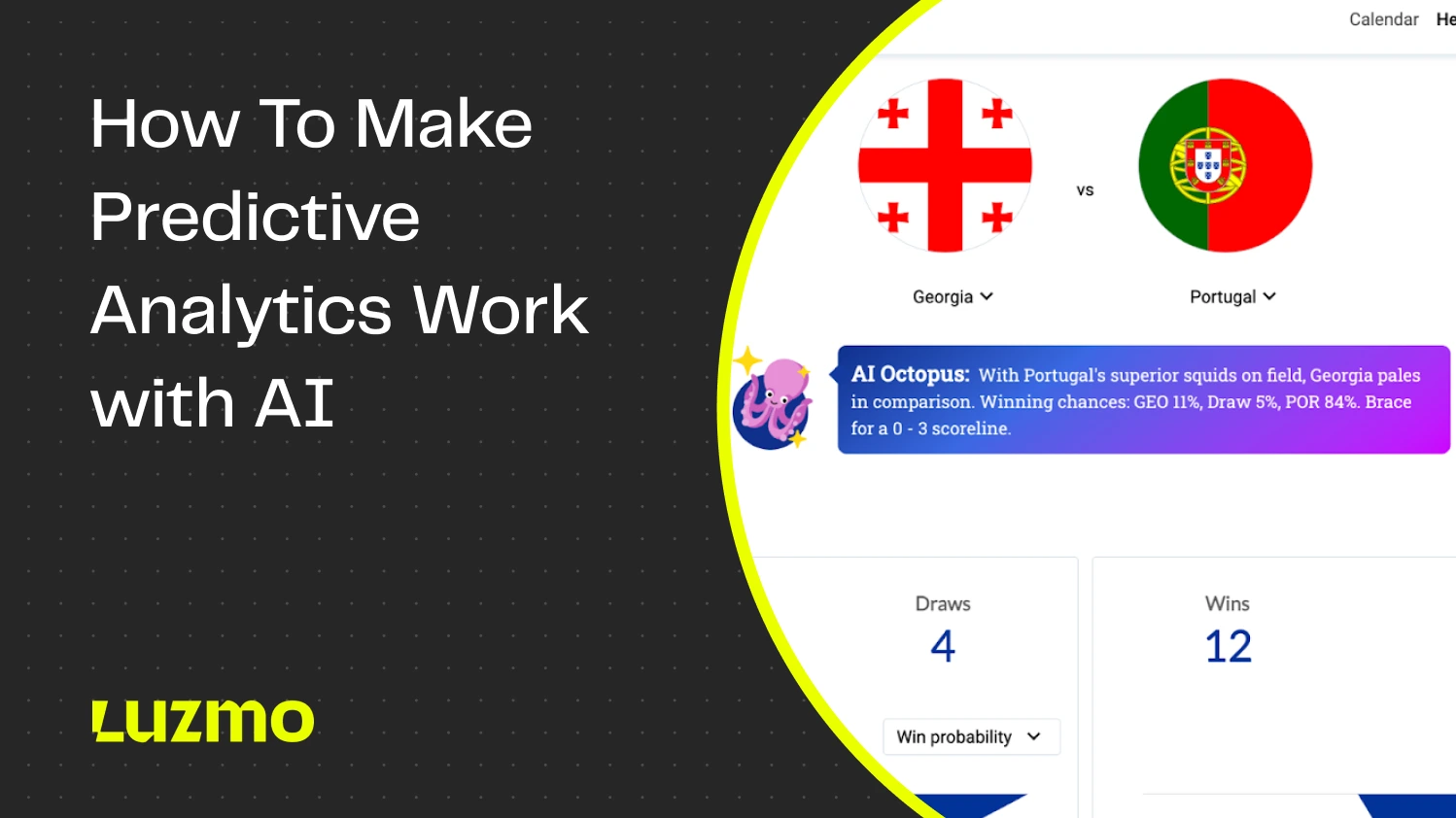
AI can do just about anything and as it turns out, it can tell the future too. AI predictive analytics is a trend in data analytics where you feed historical data into a machine learning algorithm and ask it to predict future outcomes based on that data.
Sounds simple enough, but how does this AI-powered approach really work, and what are the concerns and limitations? Let’s find out.
What is AI predictive analytics?
AI predictive analytics is the use of artificial intelligence and machine learning to look at past datasets and forecast future outcomes. AI algorithms for data analysis take into consideration the data you feed them and then use predictive analytics and automation to determine what the data will look like in the future.
Or, in simple terms: let’s say you have historical data on sales in your business, for the past two years. It takes into account seasonality, sales rep performance, new products added, supply chain issues, and more. You feed that data into AI and it tells you what your sales will look like in the upcoming months.
It’s a way to make more informed decisions about the future of your business without taking hours to do complex data science and data analytics.
Use cases for AI predictive analytics
AI predictive analytics can be used for real-time insights and predictions across different industries.
Healthcare
Predictive models can help healthcare institutions better understand their patients and prepare for the future. For example, AI can consider seasonal trends for illnesses such as flu to predict when outbreaks can happen. This also extends to emergency services, where EMS management software leverages predictive analytics to improve response planning and patient care coordination. It can help with resource allocation, such as preventing how many beds and medical staff should be available. Ultimately, healthcare institutions can reduce wait times and improve patient outcomes.
Finance
AI predictive analytics can be used in finance to spot unusual patterns in transactions. If there are strange patterns, AI can analyze them for fraud detection and risk management. This helps spot risky customer behavior early on before it escalates and hurts your profitability. Incorporating screening for AML can further enhance this process by detecting suspicious activities more efficiently.
Retail
AI predictive analytics in retail can reveal actionable insights by analyzing purchasing history and consumer trends. With AI systems, retailers can determine which products will be in demand and when. This helps them stock the right products at the right time and reduce chances of overstock and stockouts.
Manufacturing
Companies in manufacturing can use machine learning algorithms to monitor their equipment. This will show when the equipment needs maintenance and replacement, based on data points such as temperature, vibration and machine usage.
Energy
Energy companies can use predictive analytics to forecast demand and grid management, as well as do predictive maintenance. Based on factors such as historical usage, weather, and economic indicators, they can determine energy demand and adjust their production levels.
The benefits of AI predictive analytics
Compared to traditional business forecasting, the digital transformation brought by AI has a few advantages.
The speed of insights: feed big data into AI models and you can get fairly accurate predictions within minutes. Traditional predictive analytics with its complex workflows, statistical models, big data sets and a large number of stakeholders can take weeks or even months to get to actionable insights.
Cost reduction: if pricing is your main concern, AI predictive analytics can cut costs significantly because you’ll need fewer hands on deck. However, you’ll need at least one data scientist/analyst/engineer to prepare and model the data before analysis.
Improved customer experience: by anticipating customer needs ahead of time, you can provide better customer experiences. You can use the information obtained from data mining and predictive analytics for process optimization, helping you with both retention and churn.
Risk management: companies across different industries can use AI predictive analytics to reduce risks in operations related to finances, logistic support, customer support and more.
Increased revenue: through statistical models and accurate prediction, these models can help find new ways for upselling, cross-selling and targeting new market segments.
Competitive advantage: businesses and providers can stay ahead of the curve by leveraging AI for predictive analytics instead of taking weeks to analyze data manually.
Predictive analytics limitations: what the models cannot tell you
Predictive models are powerful tools for identifying patterns in historical data and extrapolating them into the future. They are not reliable tools for understanding causation, handling unprecedented events, or making predictions about situations that are structurally different from the data they were trained on.
Correlation is not causation, and this distinction has practical consequences. A churn model may identify that accounts with low login frequency in month three are at high churn risk. Acting on this by sending an email to every low-login account may increase logins without changing the underlying reason those accounts were disengaged, producing a model performance metric that improves without a real change in churn outcome. Distinguishing between leading indicators and causal drivers requires human judgment and experimentation, not more prediction.
Distribution shift is the most common cause of model degradation in production. A model trained on pre-pandemic retail demand patterns performed poorly through 2020 and 2021 because the distribution of inputs had changed in ways the training data did not represent. Any predictive model that is not regularly retrained on recent data will eventually drift from the patterns it was designed to capture. Monitoring prediction confidence intervals alongside model outputs — and flagging when confidence drops — is a basic safeguard that many deployed models lack.
Explainability requirements vary by context and are increasingly a legal consideration. A credit risk model that predicts default probability may be subject to regulations requiring that the model's decision be explainable to the applicant. Healthcare predictions that influence treatment decisions face similar requirements. Building explainability into the model output — not just the prediction but the features that drove it — is both a product quality issue and a regulatory one in regulated industries.
Is AI predictive analytics the future?
Predictive analytics models have come a long way and for some use cases, they can be an invaluable tool for predicting trends. However, just like any AI tool, it has a long way to go before it becomes fully usable for business intelligence.
But, there is hope.
If you use AI for data analysis, you’ll quickly outgrow traditional models and want to make them more specific for your use case. To get the most out of predictive analytics, you'll need someone on your team to iterate on predictive models frequently and you stand a strong chance of getting better, more accurate results.
Second, predictive analytics is just one part of the puzzle. Even though these predictions and forecasts are super powerful, you'll still need data visualization to help the end user understand what is happening behind the data.
Predictive analytics examples: what good looks like in practice
Churn prediction in software
A software platform trains a model on historical usage patterns, support ticket frequency, login trends, and feature adoption rates for accounts that churned versus those that renewed. The model outputs a churn probability score for each active account, updated weekly. Customer success managers see this score on each account record, alongside the usage data that drove it. Accounts above a defined risk threshold are automatically added to a follow-up queue. The result is a shift from reactive churn management — responding after a cancellation request — to proactive intervention when the risk is still reversible.
Demand forecasting in retail and e-commerce
A retail platform applies time series forecasting to historical sales data, seasonality indices, and promotional calendars to predict SKU-level demand four weeks forward. Buyers see the forecast in the procurement dashboard alongside current inventory levels and supplier lead times. The system flags SKUs where the forecast demand exceeds current inventory plus pipeline receipts, triggering early reorder decisions. The predictive layer does not replace human judgment on purchasing decisions, but it compresses the time a buyer needs to identify which decisions are urgent.
Predictive maintenance in industrial IoT
A manufacturing platform collects sensor data from production equipment — temperature, vibration, pressure, cycle counts — and trains models to predict component failure probability over the next 30 days. Maintenance engineers see equipment health scores in the operations dashboard and receive alerts when scores cross a threshold. Planned maintenance is scheduled during low-production windows rather than as emergency responses to unplanned downtime. The ROI from avoiding unplanned downtime typically pays for the predictive analytics infrastructure within the first year of deployment.
AI predictive analytics in embedded products: from model to user
Most coverage of AI predictive analytics focuses on the modeling side: how to build a churn prediction model, how to implement demand forecasting, how to apply anomaly detection to time series data. The step that is less often covered is how those predictions reach the people who need to act on them.
A predictive model that runs in a data warehouse and outputs a score to a database table is technically functional but practically invisible to most users. The people who benefit most from churn predictions are customer success managers. The people who benefit most from demand forecasts are supply chain managers. These users are not querying databases — they are working in the software products they use every day.
This is the integration gap that embedded analytics addresses in the context of AI predictions. Surfacing model outputs inside the product, alongside the operational data the user already acts on, closes the loop between prediction and action. A customer success manager who sees a churn risk score on a customer record can act on it immediately. The same score buried in a BI dashboard they check monthly is less likely to generate timely action.
For software teams that want to surface predictive analytics to their end users, the practical path is to store model outputs in the same data source that feeds the embedded analytics layer, then expose them as metrics alongside standard KPIs. Luzmo AI supports this natively — model outputs in a connected database can be queried conversationally, so a user can ask "which accounts are most likely to churn this quarter?" and receive a sorted list derived from the model, without any additional integration work.
How Luzmo can help with AI predictive analytics
At Luzmo, we offer embedded analytics for software companies that want to provide amazing data-powered software products. You can connect historical and forecasted data to Luzmo and create beautiful, functional dashboards for your product.
When your customers get more control of their data, your product provides more value. As a result, you can upsell your customers more easily, lower your churn, and open up to new markets.
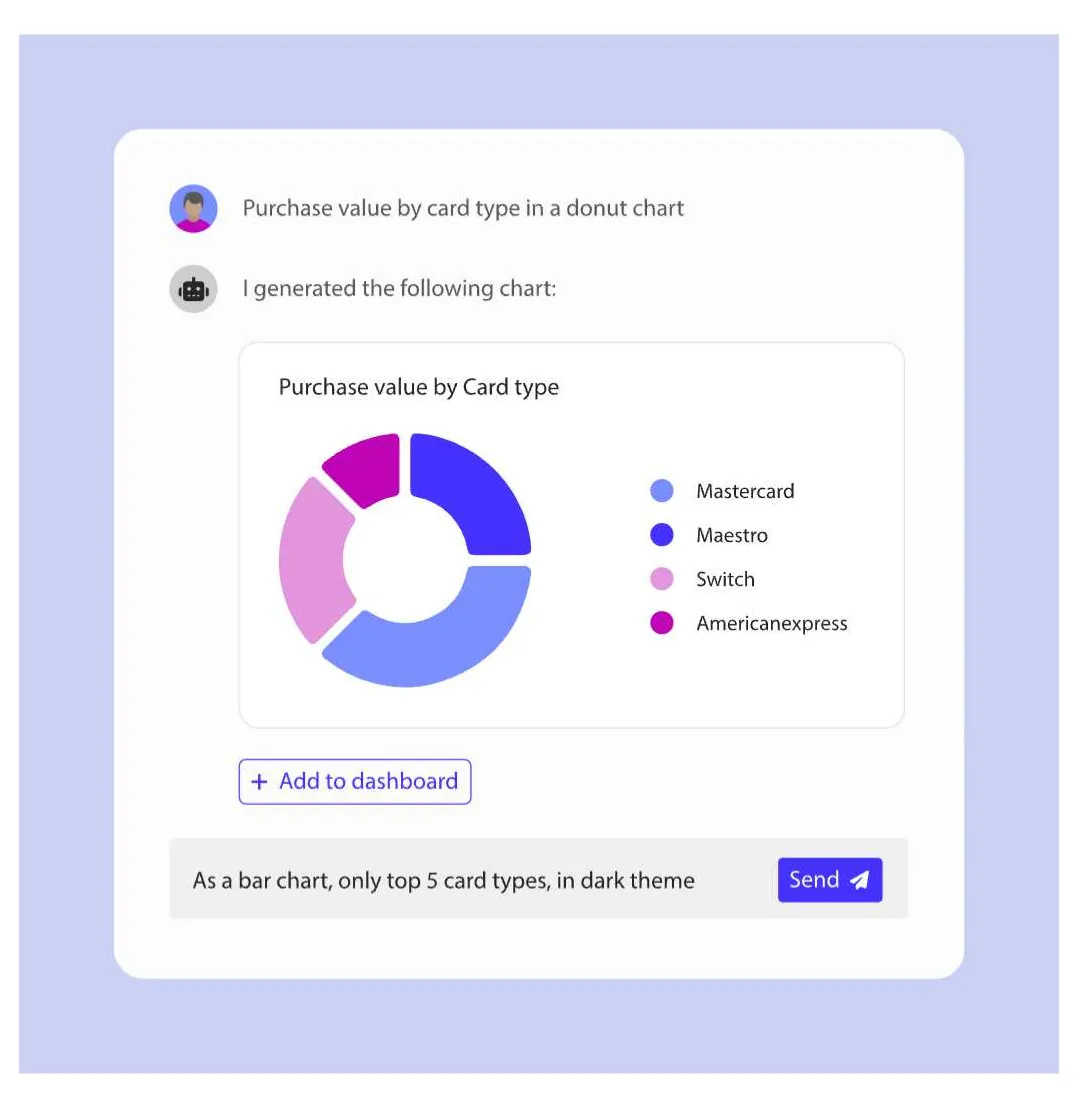
With Luzmo AI, your customers can get insights from their data faster through an intuitive, natural language interface.. They can type in natural language queries and generate dashboards with a single click, allowing them to streamline dashboard creation on top of historical data or predictive analytics.
Luzmo’s AI is API-first, which means that your data is safe with us and never shared with third-party sources.
Want to learn more about how Luzmo can help your business? Book a free demo with us today.
Written by

Ship the future of your data
Let us show you what Luzmo can do for your product.

Book your session with our analytics expert.