Analytics Monetization Maturity: Where Are You and What's Next?

Data monetization isn't a switch you flip. It's the outcome of analytics maturity, and organizations that try to sell insights before they can measure reliably end up with the same results every time: low adoption, credibility problems, and offers that don't renew.
The good news: you don't need a perfect data stack. You need to know where you are now and what the next realistic step looks like.
This scorecard evaluates two things simultaneously.
First, organizational readiness: can you produce trusted, consistent analytics?
Second, product readiness: are users engaging with analytics in ways that signal willingness to pay?
Score yourself honestly. The goal isn't to reach Level 5 before doing anything but to find the move that matters most right now.
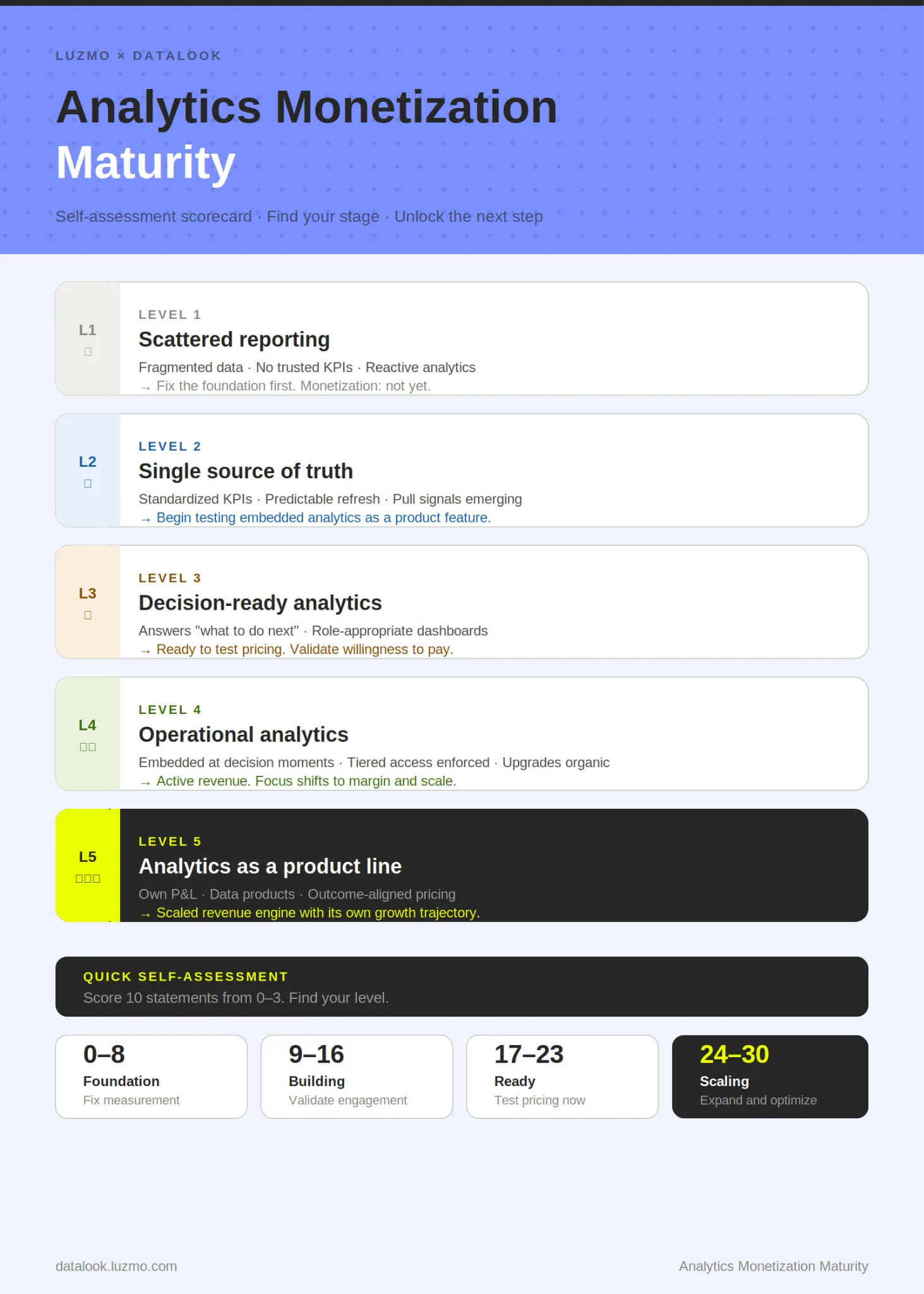
The maturity ladder
Level 1: Scattered reporting
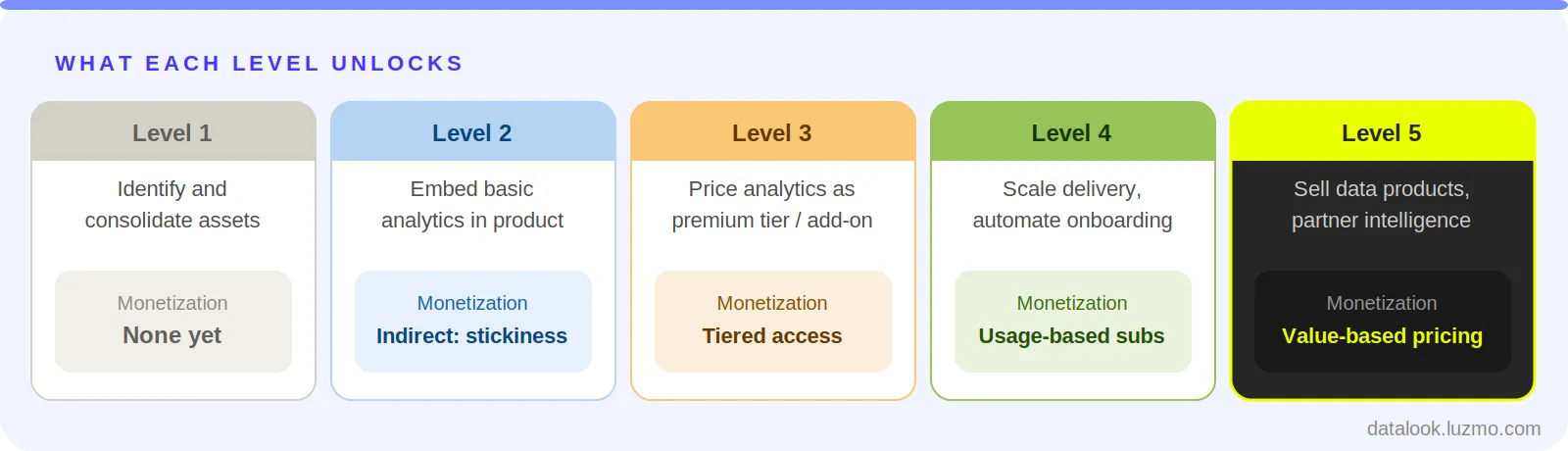
Monetization potential: not yet
You know you're here when dashboards exist but live in five different places, leadership meetings spend more time debating whose numbers are right than making decisions, and analytics is reactive; someone builds a report when asked, then it goes stale.
At this stage, analytics features get low engagement, users don't return to dashboards after first use, and support tickets rarely mention data or reporting needs.
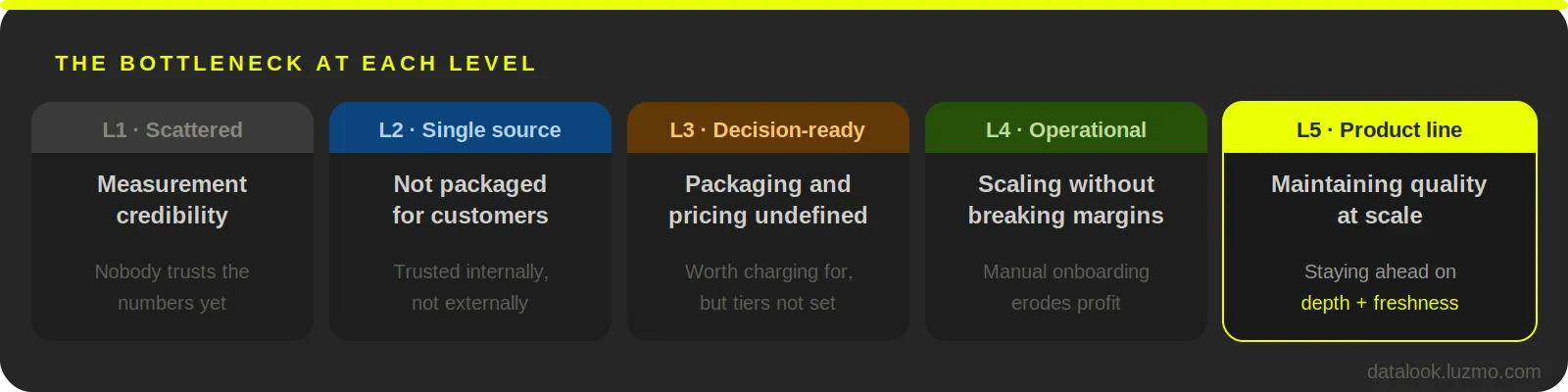
Your bottleneck is measurement credibility. Nothing downstream works if the foundation isn't trusted.
What to do next:
- Establish a short KPI spine → 10 to 20 metrics that actually run the business
- Agree on one definition per KPI, documented, approved, and stable
- Assign a clear owner to each metric
- Consolidate reporting into fewer tools with consistent access
Don't try to monetize yet. Fix the foundation first.
Level 2: Single source of truth
Monetization potential: early
Core KPIs are standardized, documented, and trusted across the organization. There's a predictable refresh cadence; people know when numbers update. Internal teams use the same analytics workspace instead of competing dashboards.
You'll notice early signs of pull: customers occasionally asking about data visibility, requests for exports, someone asking "can I see my own performance?"
Your bottleneck here is that analytics is trusted internally but isn't yet packaged for customers. The data exists. The wrapper doesn't.
What to do next:
- Identify 2 to 3 customer personas who would benefit from seeing this data
- Map their recurring decisions; what insight would make them faster or more confident?
- Prototype a basic embedded analytics view (even read-only) for one persona
- Start tracking engagement: who looks, how often, and what they do after
You can begin testing embedded analytics as a product feature: not priced yet, but building the case.
Level 3: Decision-ready analytics
Monetization potential: ready to test
Analytics here goes beyond "what happened" and answers "what should we do next." Insights include context, comparison, and prioritization. Dashboards are role-appropriate: executives see different views than operators. Teams use analytics to drive actions, not just review performance.
The product signals are telling: repeat analytics engagement is strong (weekly or more), users apply filters and drill into data, and analytics users show measurably better retention or expansion than non-users.
Your bottleneck is that packaging and pricing aren't defined yet, but you have something worth charging for.
What to do next:
- Correlate analytics usage with business outcomes (retention, expansion, NPS) and build the internal case
- Define tier boundaries: what stays free vs. what becomes paid (think outcomes, not feature lists)
- Run a small pricing experiment with a cohort of power users
- Ensure access control and tier enforcement actually work before launch
You have validated engagement. Now validate willingness to pay.
Level 4: Operational analytics
Monetization potential: active
Insights are part of the workflow — alerts, triggers, and recommendations appear where users work. Tiered access is enforced: Basic, Pro, and Enterprise experiences are distinct and controlled. Onboarding new customers onto analytics is repeatable, not a bespoke project each time.
Upgrade requests come organically; users hit tier limits and want more. Analytics usage is embedded at decision moments: pricing changes, reviews, budget allocation. Expansion revenue from analytics is measurable and growing.
Your bottleneck is scaling without breaking margins. Manual onboarding, custom reporting, and support overhead are the hidden cost killers at this stage.
What to do next:
- Automate onboarding and provisioning (multi-tenant, repeatable rollout)
- Reduce cost-to-serve: self-serve discovery, in-product guidance, frictionless tier upgrades
- Expand the analytics surface: more personas, more use cases, more tiers
- Track cost-to-serve per customer alongside revenue per customer
- Consider partner monetization → can strategic partners benefit from controlled data access?
Analytics is generating revenue. The focus shifts to margin, scale, and expansion.
Level 5: Analytics as a product line
Monetization potential: scaled
Analytics has its own P&L, roadmap, and go-to-market motion. The organization sells data products, insight subscriptions, or application-layer analytics as a distinct commercial offering. Buyers include existing customers, new segments, and ecosystem partners.
Pricing is outcome-aligned: customers pay for the value delivered, not the features shipped. Churn on analytics offerings is low, renewals are driven by demonstrated ROI, and partners actively request access or co-branded analytics experiences.
Your bottleneck is maintaining quality, trust, and differentiation at scale. Competing on insight means staying ahead on depth, freshness, and usability.
What to do next:
- Invest in value-based pricing; tie what customers pay to the outcomes they achieve
- Build feedback loops between usage data, product development, and commercial strategy
- Explore new delivery formats: APIs, data feeds, white-labeled experiences for partners
- Continuously audit the competitive moat: what makes your data defensible?
Analytics is a revenue engine with its own growth trajectory.
This is part of a joint content series by Luzmo and Datalook.
Explore the full series at datalook.luzmo.com.
Watch the first webinar in our data monetization series below:

Written by

Ship the future of your data
Let us show you what Luzmo can do for your product.

Book your session with our analytics expert.