Why Companies Choose Luzmo: Lessons From Real Buying Decisions in 2026

Every sales conversation teaches you something. When a prospect signs, you learn what resonated. When they don't, you learn what's missing. Over the past few months, we've taken a close look at the buying decisions behind our new customers – what drove them to evaluate Luzmo, what almost stopped them, and what ultimately made the difference.
Here's what the data actually shows.
The decision isn't always about features
Most buyers who evaluated Luzmo were comparing more than capability lists. They were comparing experiences.
Several of our new customers had shortlisted tools with more brand recognition: established BI platforms, open-source options, enterprise heavyweights. In nearly every case, Luzmo didn't win because it had the longest feature set. It won because the evaluation process itself felt different.
One customer put it plainly: "Ten out of ten. It was very easy, very straightforward. No BS."
That's not a quote about product capabilities. It's a quote about trust – and trust, it turns out, closes deals as reliably as any feature comparison.
For SaaS product teams operating without a dedicated data engineering bench, that matters more than it might seem. The tool you can actually evaluate properly (where you can involve your engineers, run a real trial with your own data, and get a straight answer about pricing) is often the tool that wins, even against stronger competition on paper.
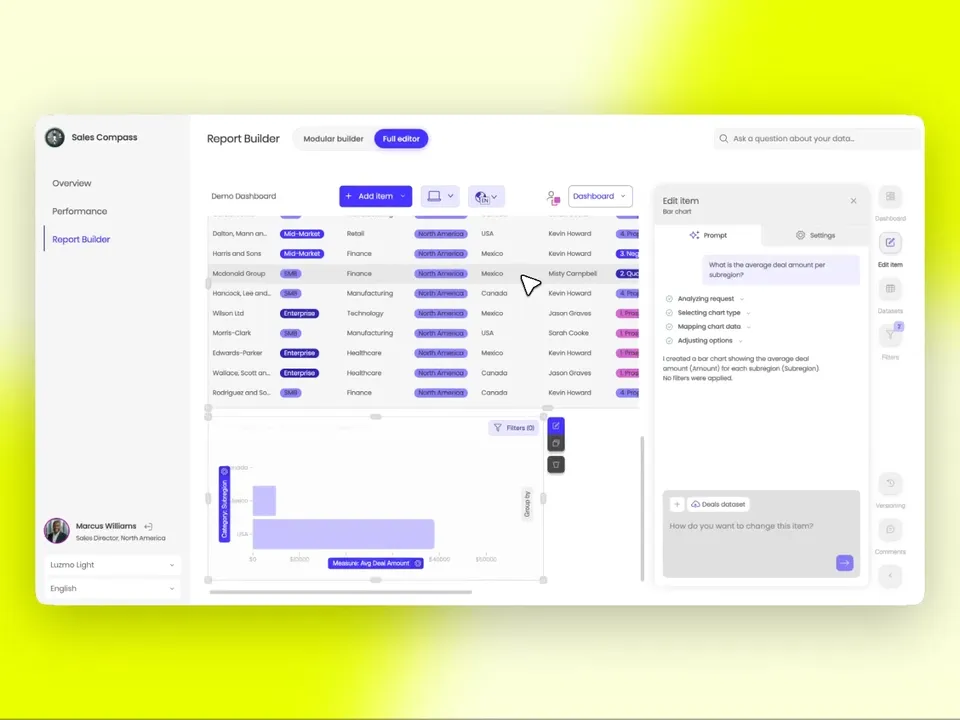
Another customer described something we hear often: "I was glad to see that it's a company that knew exactly what they were selling. You could already see on their website how they understood the customer problems."
Clarity of positioning, it turns out, is a form of customer service.
Pricing transparency is doing more work than we expected
We heard this across multiple conversations: the fact that Luzmo's pricing is upfront and scales predictably was a deciding factor. Not just a nice-to-have – a deciding factor.
One customer explained the math in terms that stuck with us: "The pricing structure actually worked rather nicely for us because it has to do with how many people are using it each month. So if we have 30,000 users but only 5,000 of them touch Luzmo each month, then it's a $5,000 Luzmo bill. That works well for us."
This sounds obvious, but it's genuinely rare in this category. Most embedded analytics platforms require a sales conversation before you can even estimate cost. That creates friction, slows down evaluation, and – for early-stage companies trying to model unit economics – can be a reason to walk away entirely before the conversation starts.
The sentiment we heard most often: "It was immediately upfront. Flexible and transparent pricing." One customer added that a discount during the sales process signaled something beyond the number itself: "That was an act of goodwill, and you could see they wanted us as a customer."
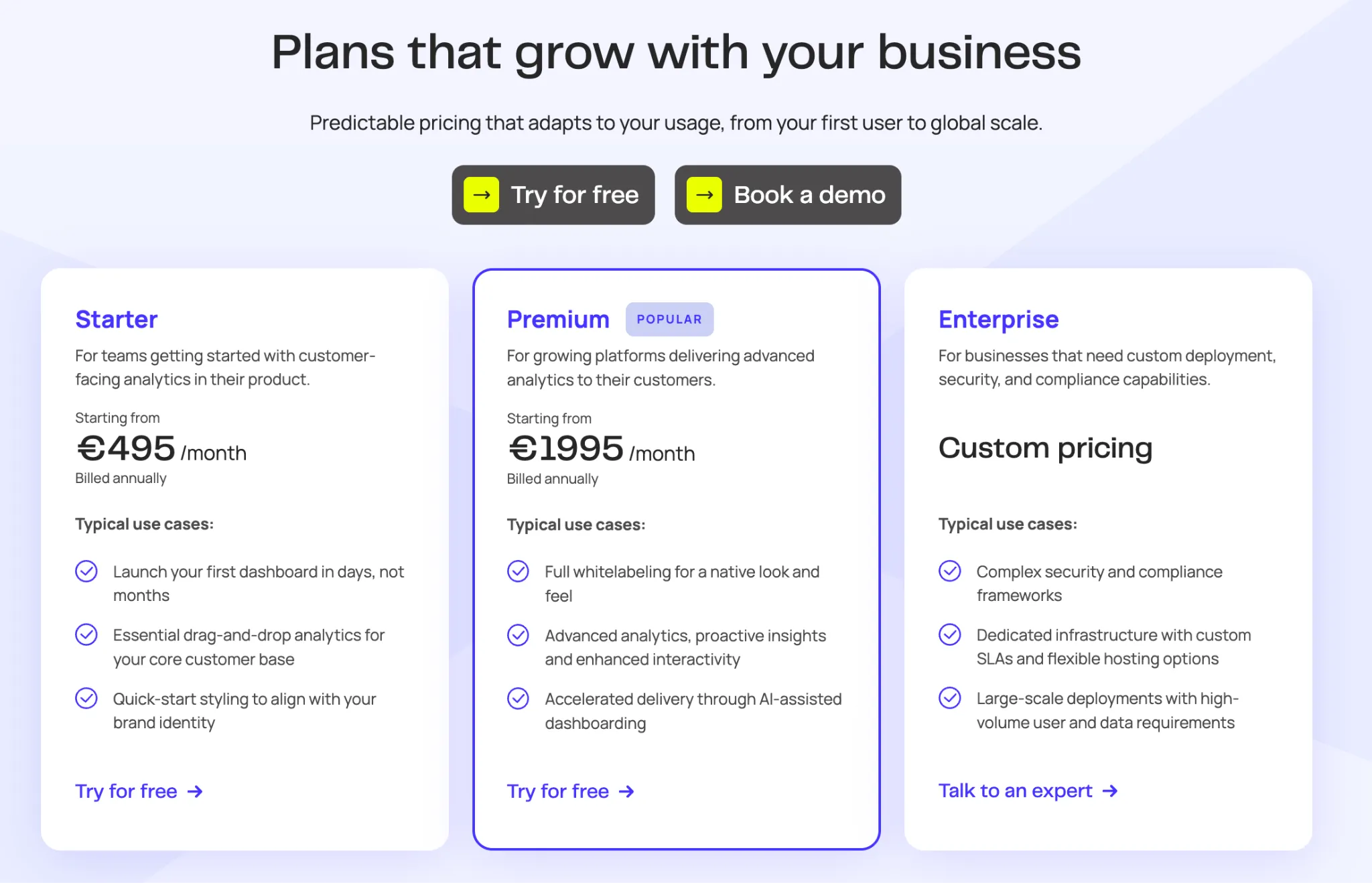
Our per-active-user model resonated particularly with startups and growth-stage companies. You're not paying for 500 potential users on day one. You pay as your product scales. That alignment between vendor pricing and customer growth trajectory turns out to be a meaningful trust signal, separate from the product itself.
Support during implementation is a huge differentiator
The pattern we saw most consistently across successful deals: customers who felt genuinely supported during the trial and early implementation became fast, confident buyers.
"Luzmo was incredibly responsive. They were incredibly helpful as we worked through this initial timeline to get things going. That was really good."
This came from a customer working against a tight delivery deadline – the kind of situation where vendor responsiveness isn't a soft preference but an actual project dependency. They were candid about what it meant to them: "The way they worked with us — I don't know if it was as important as the capabilities of their software, but it was very important. And we felt comfortable that we would get support from them when we needed it to get things going. And they lived up to that."
What stood out across multiple conversations was how the trial period itself functioned as a proof of long-term partnership. One customer noted: "They supported us for free during this discovery period. We even embedded something just to have a proof of concept. The flexibility in their service was very convincing."
For smaller companies especially, this matters in a way that's hard to quantify. As one customer put it: "We're not a big company, and you can feel that with other vendors. Here, we felt that we were valuable and that they were there for us."
In a market where many platforms fall short on consistent, hands-on support – especially during onboarding – this level of responsiveness becomes a decisive advantage rather than a bonus.
The "good enough" trap – and why speed wins
A recurring theme: companies didn't switch to Luzmo because their previous solution was broken. They switched because their previous solution was slow.
One customer described Luzmo's impact on their day-to-day operations with refreshing directness: "We can whip up a dashboard super fast. If someone comes to us and says, 'I want this, that, and the other thing,' we can make that happen super quickly."
For product teams where client-facing turnaround is a competitive advantage, that's not a feature – it's a business model enabler. The ability to respond to a customer's analytics request within hours rather than a sprint cycle changes what's possible commercially.
Several customers also flagged that the sales process itself set accurate expectations about what working with Luzmo would actually be like post-signature. One noted: "Everything we wanted to be answered was answered, and after using it, it was true. There were no surprises."
No surprises. For anyone who's been burned by enterprise software that overpromises and underdelivers, that's a significant statement.
Technical credibility in the sales process made a real difference
One detail came up repeatedly that we hadn't fully appreciated: the involvement of technical team members during sales conversations had a measurable impact on buyer confidence.
"They had someone from technical support showcase the product. Did others have that same strategy of having someone technical in the sales process? Not at all."
For buyers evaluating embedded analytics platforms, the questions that matter most are often deeply technical — data connector behavior, SDK architecture, multi-tenancy implementation. When those questions get answered by someone who actually built the thing, rather than deflected to a follow-up call, it changes the dynamic entirely.
The pattern behind the pattern
Looking across these buying decisions, the clearest signal isn't about any single feature or pricing point. It's about alignment.
The companies that chose Luzmo were building analytics for their users, not for their internal teams. They needed a platform that could disappear into their product – branded, responsive, scalable – without requiring a data engineering team to maintain it. They needed to move fast without compromising on quality. And they needed a vendor that would treat them like a partner during the parts of the process that are inevitably messy.
As one customer summarized the experience: "Their mission aligned with what we needed to do."
That's the profile we're building for. And the more clearly we can describe it, the better we get at finding the customers where that fit is real — and being honest with the ones where it isn't yet.
Interested in seeing how Luzmo fits your product? Start a free trial or book a walkthrough with our team.
Written by

Ship the future of your data
Let us show you what Luzmo can do for your product.

Book your session with our analytics expert.