Embedded Analytics for Cybersecurity Platforms: How MSSPs Reduce Churn with Real-Time Client Visibility
The client calls at 2 AM. Not about a breach; about a dashboard.
"I need to see what you're doing. Real-time. On my screen. Under my brand."
This isn't a one-off request. It's the new table stakes for Managed Security Service Providers. The SIEM market is growing from $10.78 billion in 2025 to $19.13 billion by 2030, and 12.16% CAGR driven by one uncomfortable truth: MSSPs that can't show clients what's happening in real-time lose those clients to platforms that can.
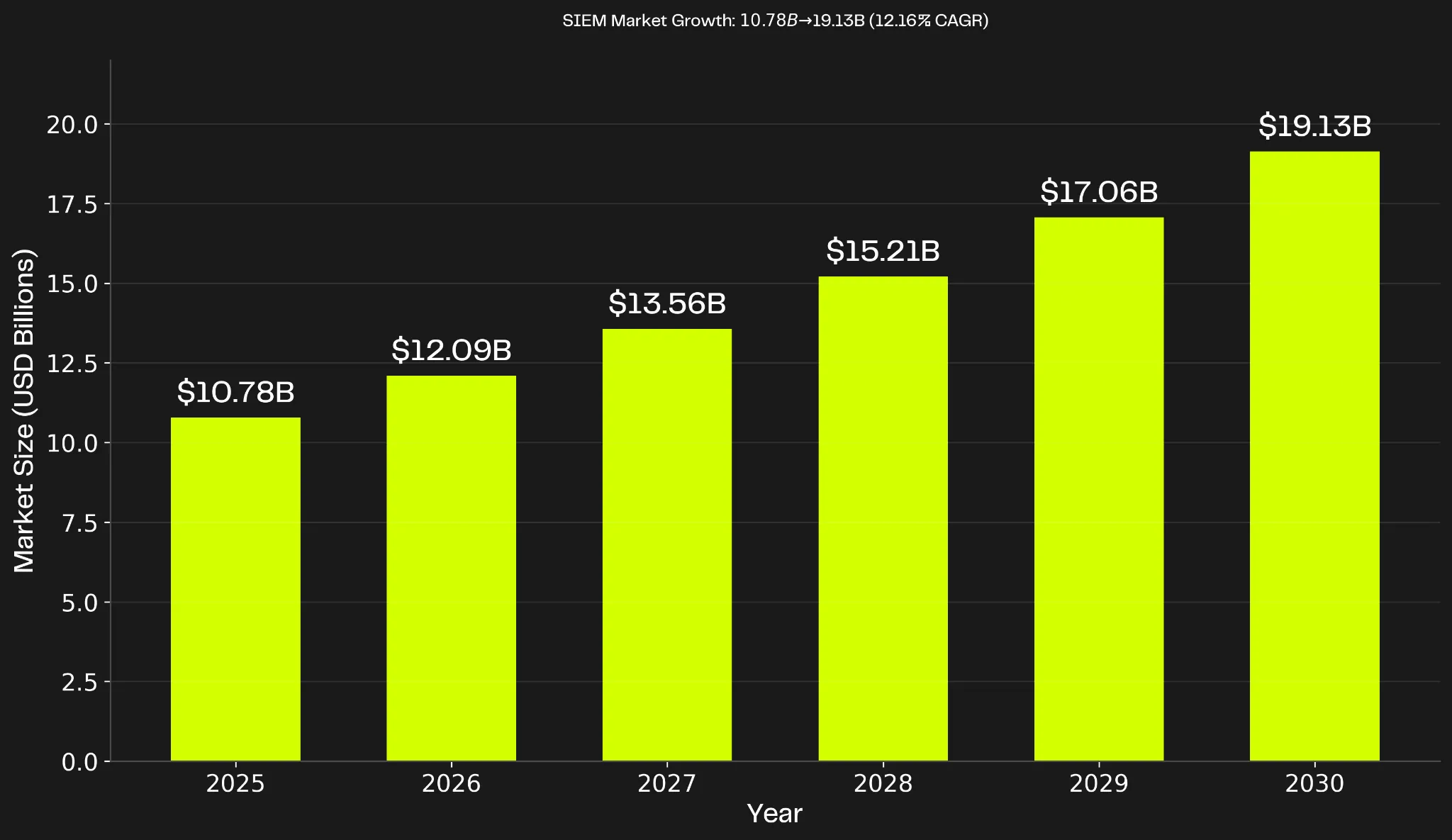
The overall cybersecurity market follows the same trajectory: $227.59 billion to $351.92 billion by 2030. North America alone accounts for 39.2% of global revenue, with enterprise buyers demanding not just security, but visibility into that security through analytics dashboards they can actually use.
MSSPs face a technical dilemma that platform teams at security software companies understand intimately. You're managing 10 to 50+ clients from a single SOC. Each client demands their own branded portal. Each has different compliance frameworks (PCI DSS for payments, HIPAA for healthcare, SOC 2 for SaaS). Each wants real-time threat feeds, executive risk summaries, and audit-ready reports.
Building this yourself takes 12-18 months and costs upward of $1.5 million. Embedding it takes 2-3 weeks and runs $40K-$80K annually.
The analytics gap is killing differentiation.
The Multi-Tenant Dashboard Challenge
MSSPs operate a fundamentally different business model than traditional security vendors. A single SOC analyst might monitor 30 client environments simultaneously. A single SIEM instance ingests millions of events per second across hundreds of tenants. Every alert, every dashboard, every report needs perfect data isolation.
This isn't a minor technical requirement, it's the foundation of the entire business model.
Seceon's aiMSSP platform processes data from endpoints, networks, cloud, and applications in real-time while maintaining strict tenant separation. Tufin's NSPM offering ensures segregation between customers with isolated data, analysis, and reporting per client domain. These platforms weren't adapted for multi-tenancy as an afterthought; they were architected for it from day one.
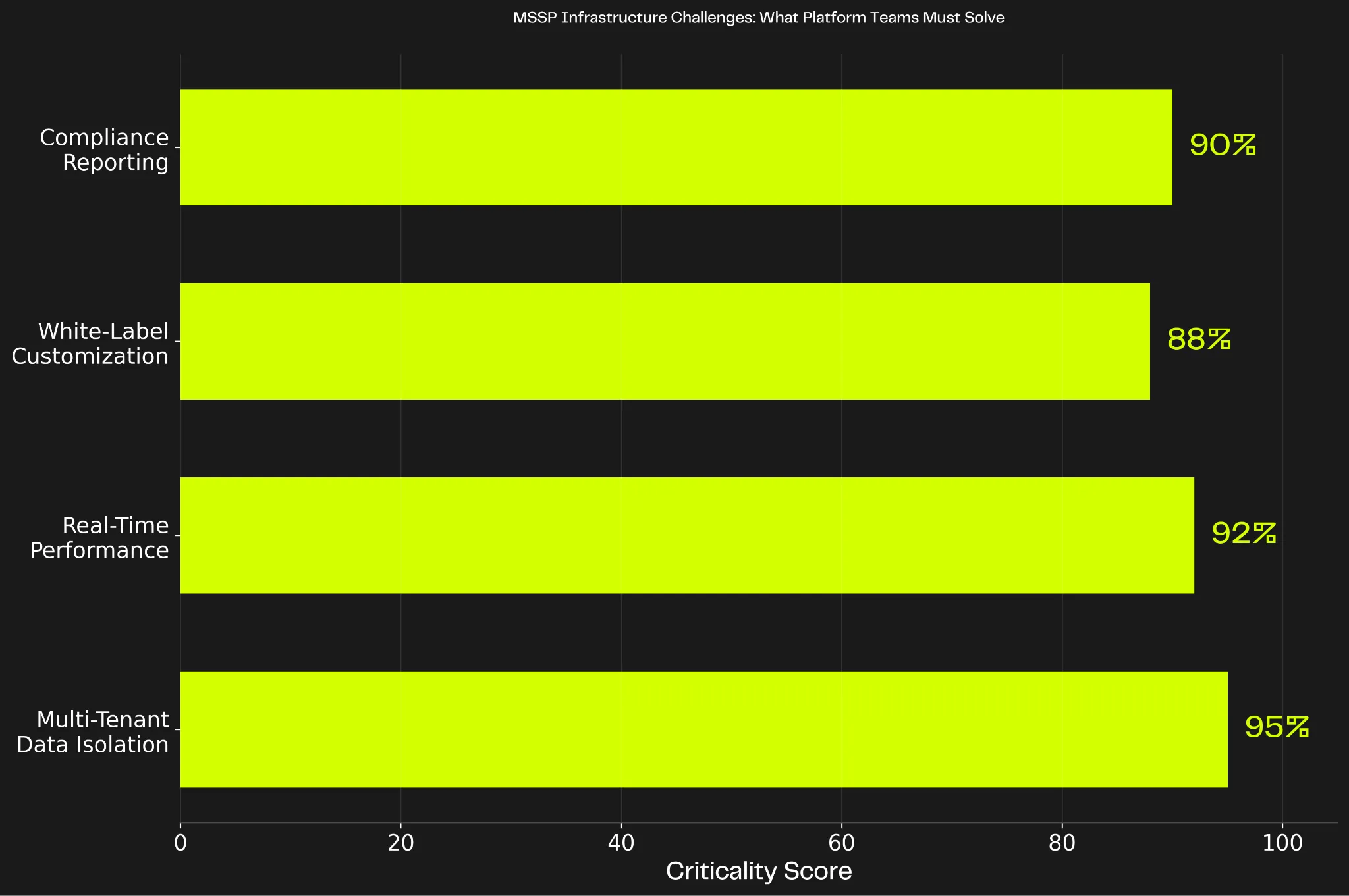
Platform teams at cybersecurity companies building for MSSPs face four infrastructure challenges that determine whether their analytics become a competitive advantage or a support nightmare.
Multi-Tenant Data Isolation
True multi-tenancy requires more than separate database tables. Each client needs isolated dashboards, permissions, templates, and reporting—all managed from a single pane of glass for the MSSP while appearing as a completely independent platform to each end client.
Row-level security becomes critical. When an MSSP analyst pulls up a cross-tenant view to triage alerts, the dashboard must enforce access controls that prevent data leakage between clients. When Client A's CISO logs into their portal, they see only their data, rendered in their branding, with their custom KPIs.
The complexity multiplies with compliance. A healthcare MSSP client needs HIPAA-compliant audit trails. A financial services client needs PCI DSS controls. A SaaS company needs SOC 2 evidence. All three run on the same SIEM instance, but each compliance framework generates different reporting requirements and retention policies.
Real-Time Dashboard Performance
Security data doesn't batch well. SIEM systems process millions of events per second. Alert correlation happens across endpoints, network traffic, cloud logs, and user behavior. Dashboard lag isn't just annoying, it's a missed threat.
Modern cybersecurity platforms use behavior-based analytics powered by machine learning to detect zero-day attacks and stealthy intrusions that signature-based detection misses. These AI models need to feed real-time dashboards that security analysts actually monitor.
A Managed Detection and Response (MDR) team running incident response can't wait 30 seconds for a dashboard to refresh. They need sub-second latency on threat feeds, live attack timelines, and containment status. The difference between a contained intrusion and a data breach is often measured in minutes.
White-Label Customization
Generic dashboards don't work in the MSSP business model. Clients aren't buying "security monitoring". They're buying branded security services that integrate into their existing operations.
White-labeling goes deeper than slapping a logo on a pre-built template. MSSPs need custom domains (app.clientdomain.com), full color scheme control, client-specific KPIs, and dashboards that embed directly into the MSSP's customer portal without visible third-party branding.
The technical implementation matters. Some vendors offer "white-label" capabilities that still expose the underlying platform vendor in API calls, email notifications, or PDF reports. True white-labeling means the MSSP's client never sees anyone's brand but the MSSP's.
Seceon enables MSSPs to deliver white-labeled services with fully customizable dashboards. Risk Cognizance provides white-label GRC compliance software where MSPs can customize with their own logo, colors, and domain. These platforms understand that brand consistency is existential for service providers building long-term client relationships.
Compliance Reporting Automation
Manual compliance reporting doesn't scale across 50 clients with different frameworks. An MSSP might manage PCI DSS compliance for five retail clients, HIPAA for three healthcare organizations, SOC 2 for a dozen SaaS companies, and GDPR for their European expansion.
Each framework requires different evidence collection, different control mappings, and different report formats. Audit season means generating hundreds of pages of documentation across dozens of clients, all based on the same underlying security event data, but formatted for different frameworks and delivered to different auditors.
Automated compliance reporting transforms this operational burden into a differentiator. Platforms that map security events to compliance controls in real-time can generate audit-ready reports on demand. The MSSP analyst clicks one button; the client gets a 50-page SOC 2 evidence package.
The Revenue Model
MSSPs compete on four dimensions: technology sophistication, response time (MTTD/MTTR), client experience, and price. Analytics dashboards impact all four.
Premium Tier Revenue
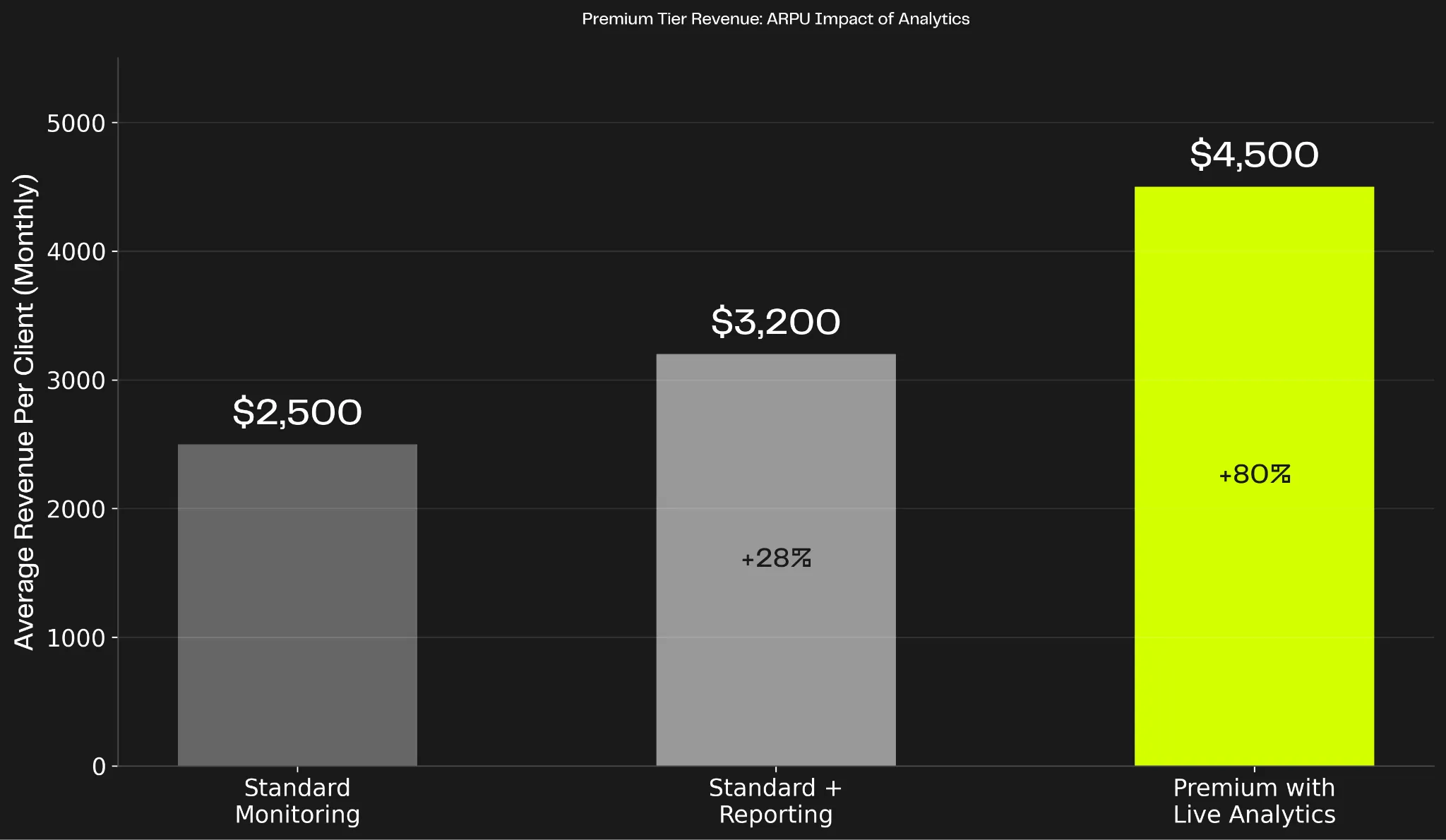
Basic MSSP services provide 24/7 monitoring and alert escalation. Premium tiers add real-time analytics, custom dashboards, and client self-service portals. The price difference is substantial.
Standard monitoring: $2,500/month per client. Standard plus reporting: $3,200/month. Premium with live analytics: $4,500/month—an 80% revenue increase over basic service for capabilities that cost the MSSP minimally more to deliver once the infrastructure is in place.
The analytics tier creates natural upsell paths. A client starts with basic monitoring, experiences an incident, and realizes they need better visibility. The MSSP doesn't lose them to a competitor. They upgrade to premium analytics within the existing relationship.
White-label dashboards also enable competitive differentiation in crowded markets. When every MSSP offers similar SOC monitoring and threat intelligence, the client-facing experience becomes the deciding factor. Live dashboards beat static PDF reports every time.
Client Retention Through Analytics
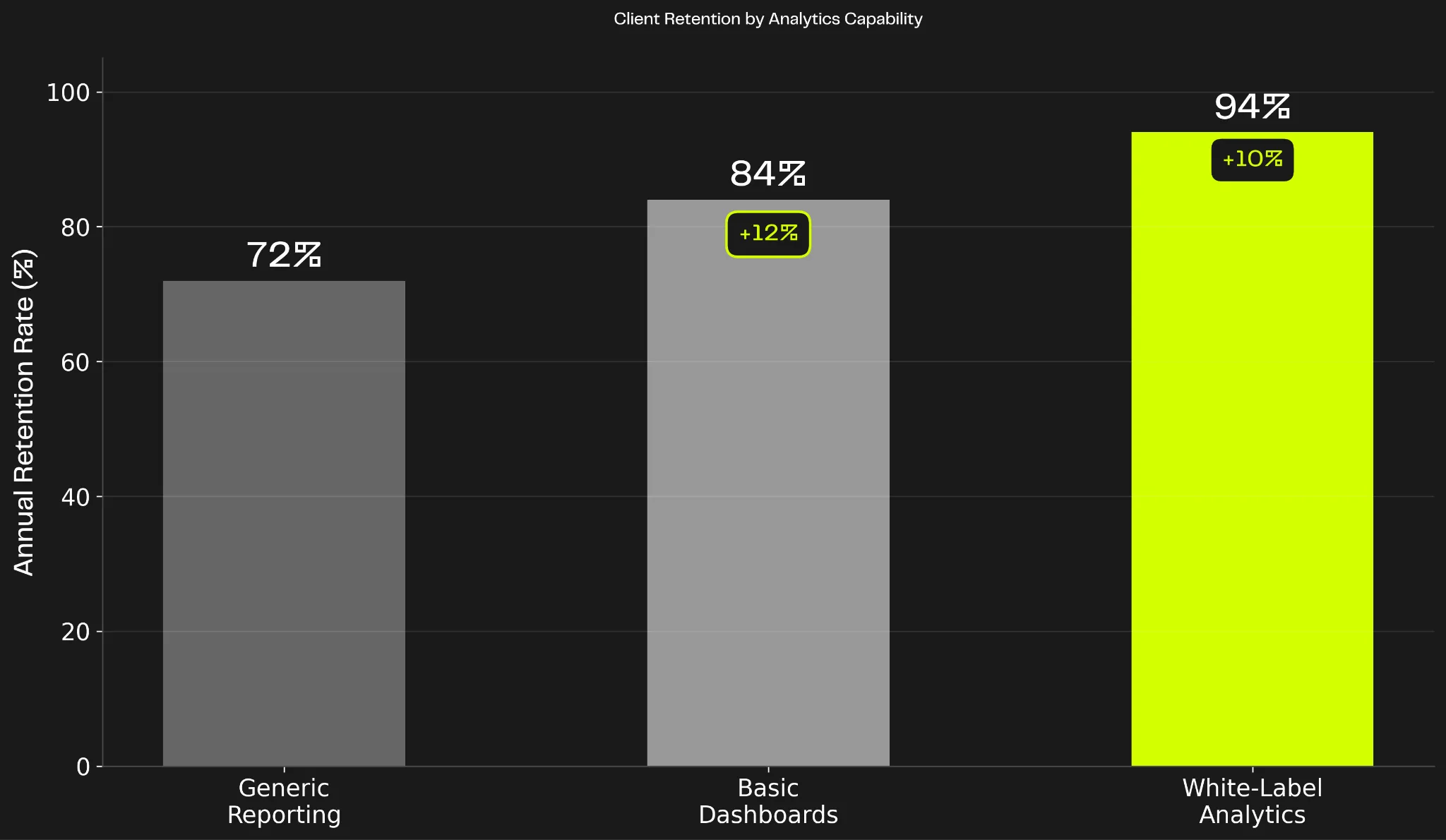
Poor reporting is a top churn driver for MSSPs. Clients who feel like they're paying for security services they can't see or measure are clients actively evaluating alternatives.
Real-time visibility builds trust. When a client can log into their branded portal at 3 PM on a Wednesday and see their current security posture, active threats, and incident timeline, they're not wondering what the MSSP is doing but simply seeing it.
The retention data is stark. MSSPs relying on generic reporting see 72% annual retention. Those offering basic dashboards improve to 84%. Premium white-label analytics platforms achieve 94% retention. Each 10-point improvement in retention dramatically changes the economics of customer acquisition.
Branded experiences create stickiness. Switching costs are operational. A client whose security team has learned to rely on custom dashboards, automated compliance reports, and real-time threat feeds faces significant friction in moving to a competitor with inferior analytics.
Operational Margin Expansion
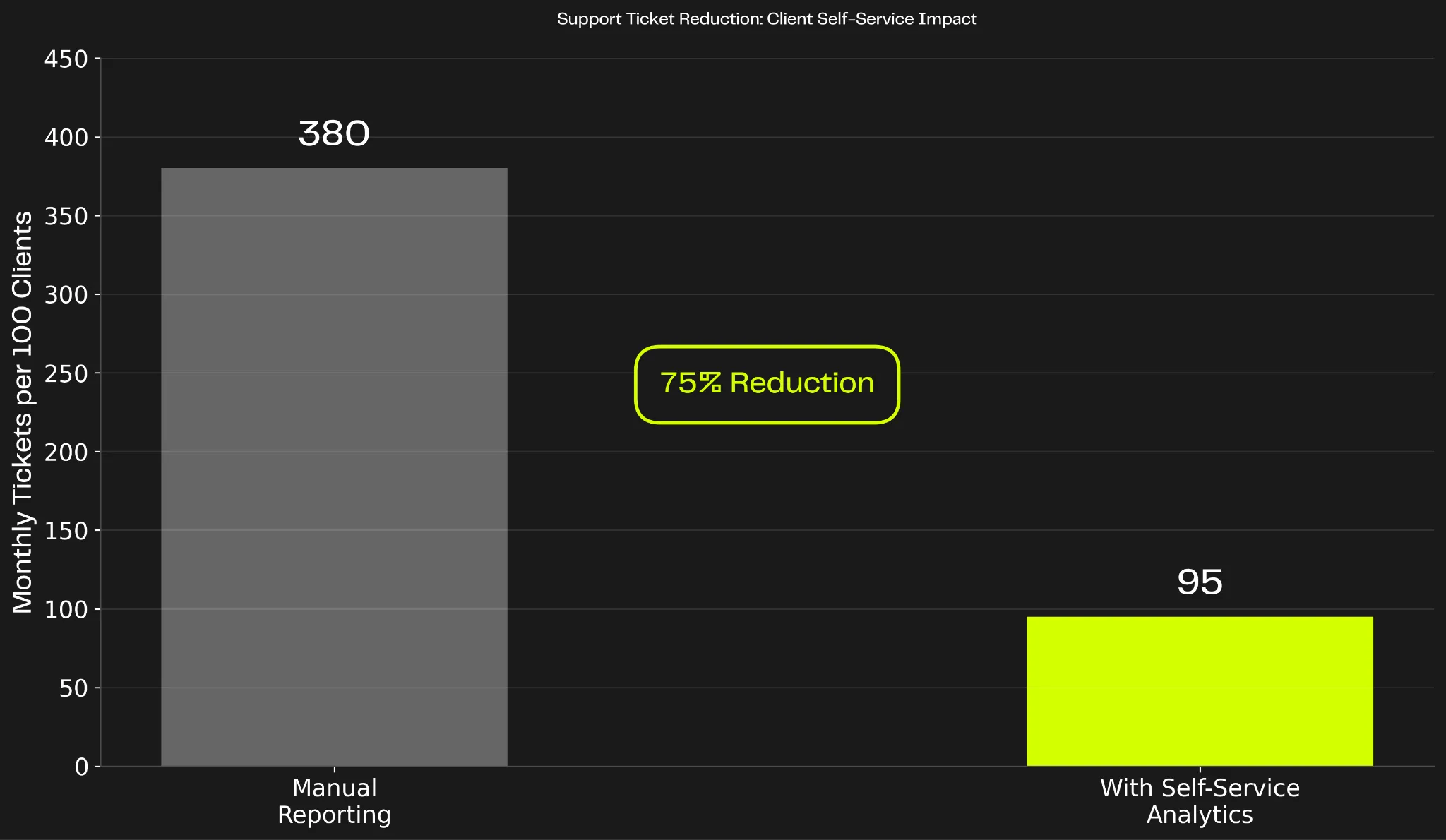
Analytics protects revenue AND expands margin. One analyst can manage more clients when dashboards surface the right information automatically. Automated reporting eliminates manual work. Client self-service reduces support tickets.
The support impact is measurable. MSSPs handling 100 clients with manual reporting see roughly 380 tickets per month requesting status updates, compliance documentation, or incident clarification. Those same clients with self-service analytics generate 95 monthly tickets—a 75% reduction.
Each eliminated ticket saves analyst time. More importantly, it shifts the analyst's focus from explaining what happened to preventing what's next. The SOC team moves from reactive reporting to proactive threat hunting.
Five Analytics Use Cases That Matter
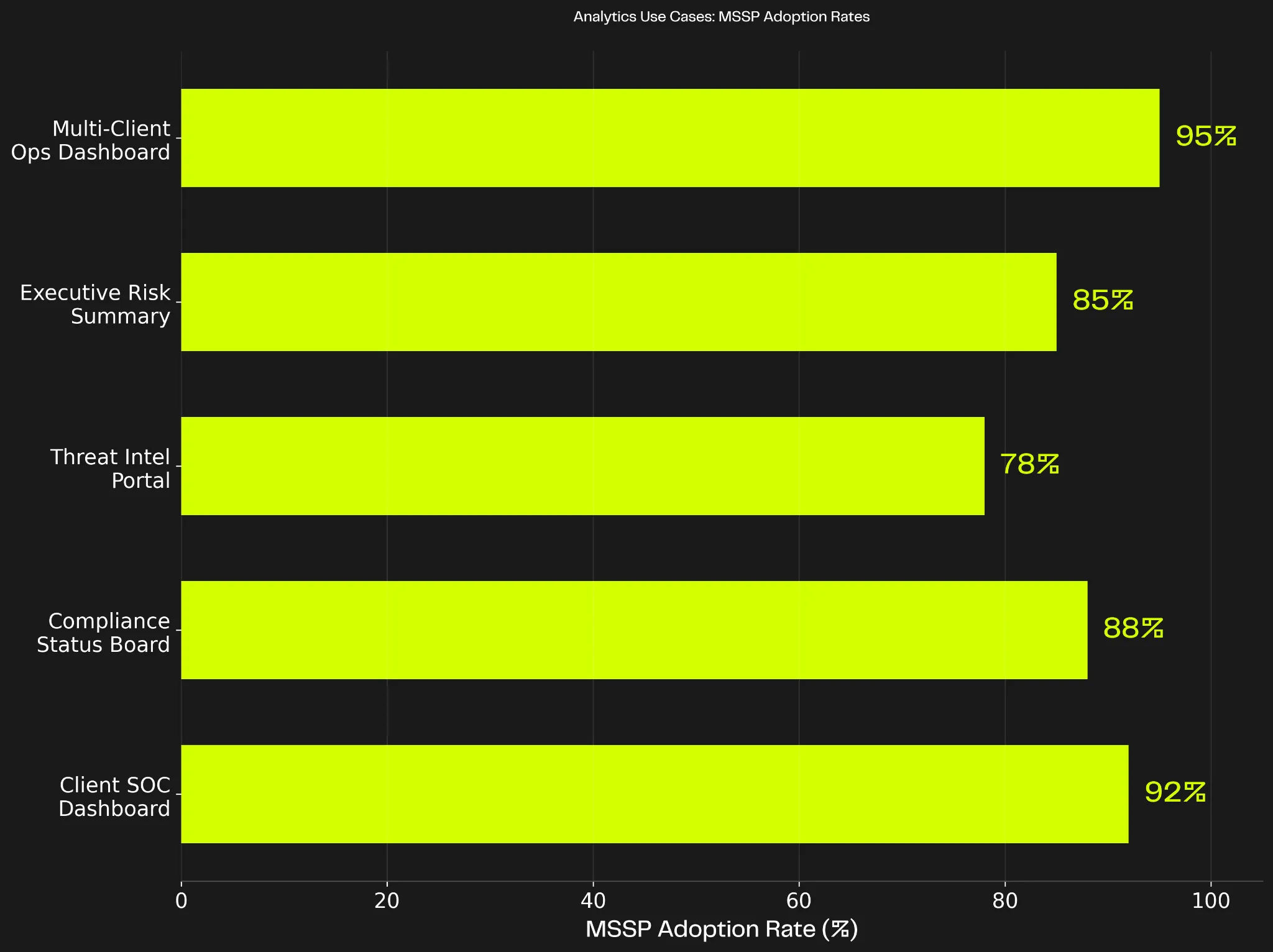
Platform teams building for MSSPs should focus on five core use cases that drive adoption and retention.
Client SOC Dashboard
This is the primary interface where MSSP clients interact with their security data. It needs real-time threat feeds showing active alerts, historical threat trends, and threat classification by severity. A security posture score provides at-a-glance health monitoring. An incident timeline with remediation status shows what happened, when, and what the MSSP did about it.
The dashboard should be role-appropriate. A CISO sees high-level risk metrics and business impact. An IT director sees technical indicators and remediation queues. A compliance officer sees control effectiveness and audit readiness.
Compliance Status Board
Clients in regulated industries live and die by compliance. The dashboard needs framework-specific views: PCI DSS compliance for payment processors, HIPAA for healthcare, SOC 2 for SaaS platforms, GDPR for European operations.
Control effectiveness metrics show which security controls are operating as designed and which need attention. Automated evidence collection means audit-ready reports generate on demand rather than requiring weeks of manual compilation.
The value proposition is simple: instead of asking "Can we prove we're compliant?", the client can instantly show auditors real-time compliance status backed by automatically collected evidence.
Threat Intelligence Portal
Industry-specific threat briefings provide context clients can't get from generic vendor feeds. If the MSSP serves healthcare clients, the threat intelligence portal highlights healthcare-targeted ransomware campaigns. Financial services clients see fraud trends and account takeover techniques.
Indicators of compromise (IOCs) tied directly to the client's environment make threat intelligence actionable. Generic threat intel says "APT29 is targeting SaaS companies." Actionable threat intel says "We've detected three IOCs associated with APT29 in your environment and have initiated containment."
Attack surface visibility shows what the attacker sees: internet-exposed services, unpatched vulnerabilities, credential leaks on the dark web. This transforms threat intelligence from interesting reading to immediate action items.
Executive Risk Summary
C-suite executives don't want SIEM logs. They want risk scores trending over time, business impact analysis of potential incidents, and investment prioritization guidance for security spending.
The dashboard needs to translate technical security metrics into business language. Instead of "342 critical vulnerabilities detected," show "Estimated exposure: $2.4M based on industry breach data." Instead of "MTTD improved 23%," show "Reduced average breach cost by $180K."
Executives also need this data for board reporting. A clean, professional executive summary dashboard generates board-ready slides without manual reformatting.
Multi-Client Ops Dashboard
This is the MSSP-facing view that SOC analysts actually use. It provides cross-tenant visibility for alert triage, client health scoring, and resource allocation metrics.
The analyst sees all active alerts across all clients, sorted by severity and enriched with threat intelligence. They can drill into any client environment with one click while maintaining strict data isolation. The dashboard tracks MTTD (mean time to detect) and MTTR (mean time to respond) across the client portfolio.
Resource allocation metrics help MSSP leadership make staffing decisions. Which clients generate the most alerts? Which compliance frameworks require the most analyst time? Where should they invest in automation to improve margin?
Build vs Buy: The TCO Reality
Platform teams at cybersecurity companies face a fundamental question: build analytics infrastructure internally or embed a specialized analytics platform?
The Build Path
Building internal analytics for MSSP clients means assembling a comprehensive stack: a modern BI layer that can handle millions of security events, multi-tenant architecture with row-level security, white-label customization allowing full branding control, real-time data pipelines with sub-second latency, and compliance framework templates for major standards.
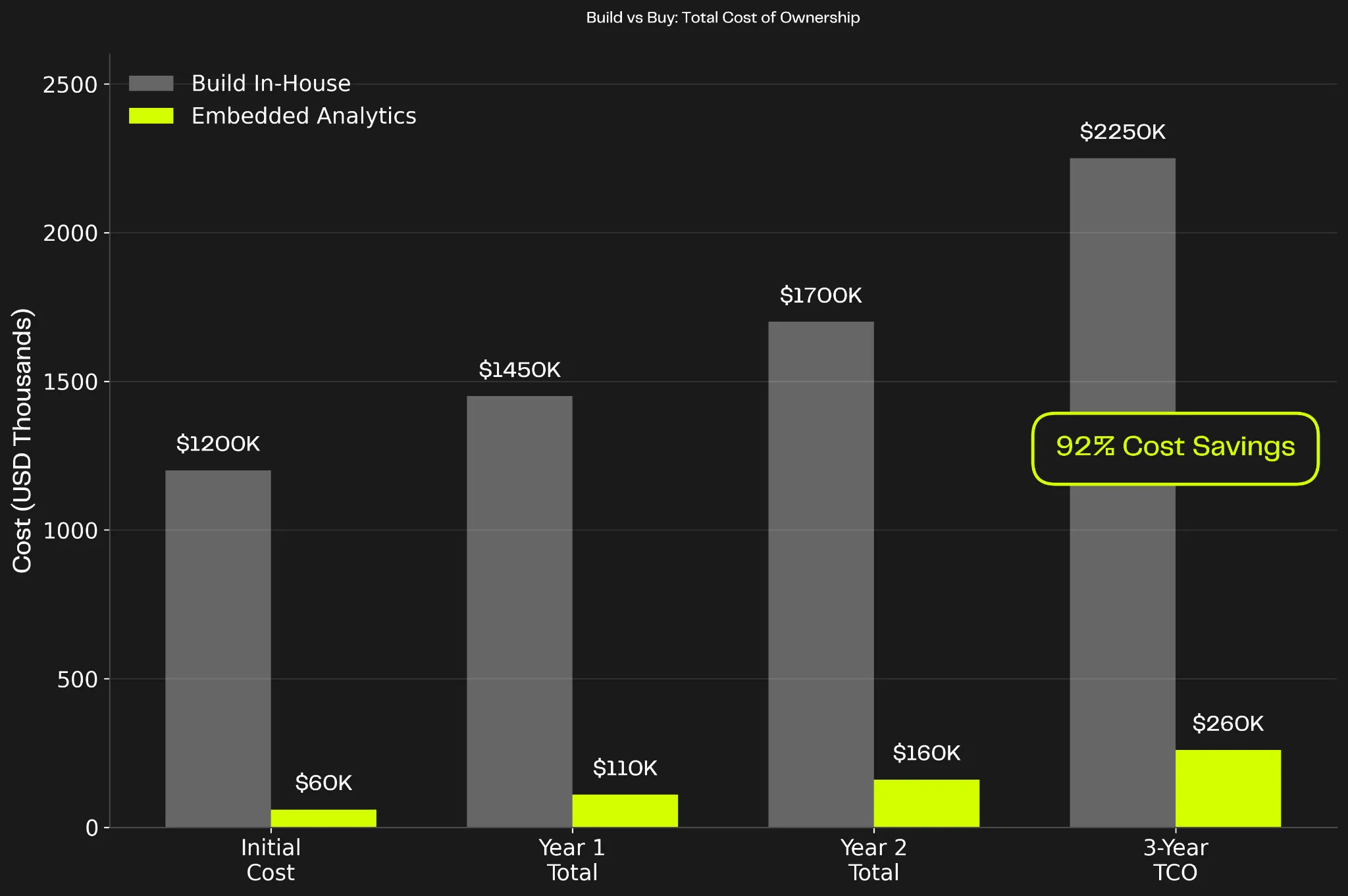
The timeline stretches 12-18 months from concept to production-ready. Initial development costs run $800K to $1.5 million in engineering time. The team needs specialized skills: security domain expertise, real-time data engineering, multi-tenant architecture design, and frontend dashboarding.
Ongoing costs compound. You need a dedicated team for maintenance, updates, and new feature development. Every new compliance framework requires custom development. Performance optimization is continuous as data volumes grow.
Opportunity cost hits hard. Those 12-18 months could have been spent on core security features, expanding threat detection capabilities, or improving SOAR automation. The engineering team building dashboards isn't building the security platform that actually differentiates your offering.
The Embed Path
Embedding specialized analytics platforms like Luzmo offers a dramatically different timeline and cost structure.
- Week 1-2 covers integration: API connections to your SIEM/XDR data sources, data pipeline setup, and multi-tenant configuration.
- Week 3-4 handles customization: white-label branding with logos and color schemes, dashboard templates for common use cases, and role-based access controls.
- Week 5-6 runs pilot launches with 3-5 beta clients, feedback iteration, and documentation.
- Week 7-8 completes full rollout: all clients migrated to new analytics, training for MSSP analysts, and client enablement.
Total time: 2-3 weeks to production-ready analytics. Total cost: $40K-$80K annually depending on data volumes and feature requirements.
The vendor handles updates, performance optimization, compliance certifications, and new feature development. Your team focuses on security features while the analytics platform handles data visualization, multi-tenant management, and reporting automation.
The cost comparison is stark. Build in-house: $1.2M initial + $250K annual maintenance. Embed specialized platform: $60K annually. The embedded solution achieves 92% cost savings while delivering 4-6X faster time-to-market.
Why Luzmo Wins for Security Platforms
Luzmo was built for exactly this use case: product teams at B2B software companies that need to embed analytics without becoming analytics companies themselves.
True Multi-Tenancy
Row-level security ensures strict data isolation between MSSP clients. Each tenant gets isolated dashboards, custom permissions, and separate reporting—all managed from a single deployment. The MSSP never worries about data leakage between client environments.
White-Label Everything
Full branding control includes custom domains, complete color scheme customization, logo replacement across all touchpoints, and embedded widgets that integrate directly into MSSP portals. Clients see the MSSP's brand, not Luzmo's.
Real-Time Performance
Sub-second query latency handles millions of security events without dashboard lag. Pre-built connectors integrate with major SIEM platforms (Splunk, Microsoft Sentinel, LogRhythm), XDR solutions (Cortex, SentinelOne, CrowdStrike), and cloud security tools (AWS Security Hub, Azure Defender, Google Security Command Center).
No-Code Dashboard Builder
MSSP analysts build custom dashboards without writing code. Drag-and-drop interface handles complex queries, filtered views, and custom metrics. Updates deploy instantly across all relevant tenants.
Security and Compliance
SOC 2 Type II certified infrastructure means Luzmo meets the same compliance standards MSSPs must deliver to their clients. 99.9% uptime SLA ensures dashboards stay available during critical incidents.
Developer-Friendly Integration
REST API and webhooks enable deep customization. React and Angular components embed dashboards directly into existing security portals. SSO integration maintains consistent authentication across the MSSP's entire platform.
The Competitive Reality for Cybersecurity Platforms
Security platforms compete in a market where technology alone no longer differentiates. Palo Alto Networks, Fortinet, Microsoft, CrowdStrike: they all offer sophisticated threat detection. They all integrate with major cloud providers. They all provide AI-powered analytics.
The differentiation comes from the experience layer. Can clients see what's happening? Can they prove compliance? Can they generate board reports without manual data compilation?
MSSPs face the same competitive pressure. Without embedded analytics, they offer commoditized services: 24/7 monitoring that clients can't verify, threat detection that's invisible until incidents occur, and compliance support that produces PDFs instead of live dashboards.
With embedded analytics, they transform the value proposition. Clients get 24/7 self-service visibility into their security posture, trust through transparency via real-time threat feeds, operational leverage where one analyst manages more clients, and premium positioning that justifies higher prices.
The platform choice matters because it determines which business model the MSSP can pursue. Generic tools support commodity pricing. Sophisticated analytics enable premium positioning.
The Path Forward
Platform teams at cybersecurity companies building for MSSPs face a decision point. The MSSP market is growing: SOCaaS projected to reach $14.66 billion by 2030 at 12.2% CAGR. Client demand for visibility is accelerating. Compliance requirements are tightening.
You can build analytics infrastructure over 18 months for $1.5 million, absorbing opportunity cost as engineering capacity diverts from core security features. Or you can embed proven analytics infrastructure in 3 weeks for $60K/year, maintaining engineering focus on threat detection, incident response, and security automation that actually differentiate your platform.
The question isn't whether cybersecurity platforms need embedded analytics for MSSP clients. The market has answered that: they do. The question is whether product teams will build it themselves or embed it from specialists who've solved multi-tenancy, real-time performance, white-labeling, and compliance reporting across hundreds of security implementations.
MSSPs switching between platforms cite analytics capabilities as a top factor. Not threat detection sophistication: analytics. Because sophisticated threat detection that clients can't see or measure looks identical to basic monitoring from the client's perspective.
The winner in cybersecurity platforms will be whoever makes client visibility frictionless, compliance reporting automatic, and real-time analytics available without 18-month build timelines.
The technical foundation is available. The business case is clear. The only question is whether platform teams will use it before competitors do.
Written by

Ship the future of your data
Let us show you what Luzmo can do for your product.

Book your session with our analytics expert.