Embedded Analytics for POS Systems: Build vs Buy for Multi-Location Platforms
It's 11 PM on a Friday night. Your customer's 200-location restaurant chain just processed 47,000 transactions today, and the CEO wants to see real-time sales performance across every location before tomorrow's board meeting. The analytics dashboard loads instantly—revenue by location, top-performing menu items, labor costs as a percentage of sales, inventory levels across the entire chain. Your POS platform delivers enterprise-grade insights without requiring customers to export CSVs, log into separate BI tools, or wait for tomorrow's batch reports.
This is what embedded analytics enables for POS platform builders. The alternative is telling enterprise customers to piece together their own reporting infrastructure—a guaranteed path to losing deals to competitors who ship analytics out of the box.
The Multi-Location Problem POS Platforms Must Solve
Building a POS system for a single coffee shop is straightforward. Building a platform that serves 50-location restaurant chains, retail franchises, and hospitality groups is an entirely different challenge.
Multi-location operators don't just need transaction processing. They need centralized visibility across every location, real-time inventory sync, franchise performance comparison, employee analytics across sites, and the ability to identify underperforming locations before they become liabilities. When a regional manager oversees 15 locations, logging into 15 separate dashboards isn't an option.
POS platforms that treat analytics as an afterthought lose to competitors who make it a core differentiator. Research shows customer retention improves by 24 percentage points when POS platforms provide advanced analytics capabilities versus basic reporting. The platforms that win enterprise contracts are those that answer: "Can your system show me which locations are bleeding inventory?" and "Can I compare labor costs across franchises in real time?"
The gap between basic reporting and enterprise analytics is the difference between a $59/month tool and a $449/month platform that chains can't afford to leave.
Four Infrastructure Challenges POS Platform Builders Face
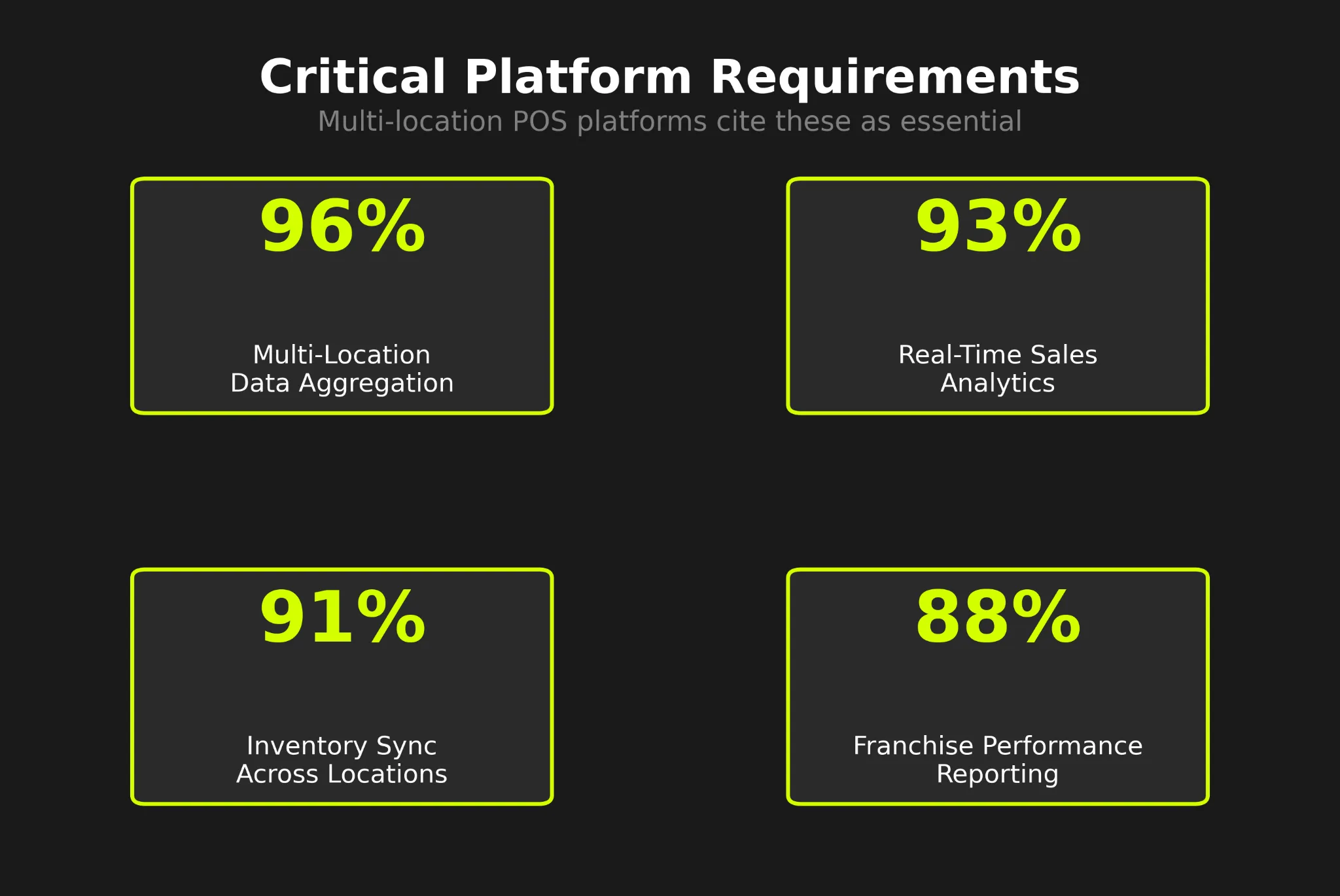
1. Multi-Location Data Aggregation at Scale
Every location generates its own stream of transaction data, inventory movements, employee clock-ins, and customer interactions. Aggregating this data across dozens or hundreds of locations in real time requires infrastructure that most POS platform teams don't have bandwidth to build.
The technical challenge isn't just collecting data—it's normalizing it. Location A uses different menu configurations than Location B. Franchises customize pricing. Corporate-owned stores track metrics that franchisees don't. Building a reporting layer that handles this variability without breaking is a six-month engineering project at minimum.
Platforms that embed analytics skip this entirely. The analytics layer handles multi-tenancy, data normalization, and cross-location aggregation out of the box. Your engineering team focuses on POS features that differentiate your product—not rebuilding reporting infrastructure that every analytics vendor already solved.
2. Real-Time Sales Analytics Without Performance Degradation
Restaurant chains need to see sales performance as it happens. When a location processes 500 transactions during lunch rush, the corporate dashboard should reflect that revenue immediately—not after tonight's batch sync.
Building real-time analytics means maintaining separate read replicas, implementing event streaming, handling cache invalidation, and ensuring dashboard queries don't slow down transaction processing. One POS platform we spoke with spent eight months building real-time dashboards, only to discover that peak-time reporting queries degraded checkout performance by 200ms. They had to rebuild the entire analytics pipeline with materialized views and pre-aggregated metrics.
Embedded analytics platforms handle this complexity behind the API. Real-time data flows into dashboards without touching your production database. Your POS system keeps processing transactions at full speed while customers query analytics as aggressively as they want.
3. Inventory Sync Across Locations
Multi-location inventory management is where most POS platforms fall apart. A 50-location restaurant chain needs to know: which locations are running low on ingredients, how inventory moves between central warehouses and individual sites, which menu items are creating inventory bottlenecks, and where waste is happening across the chain.
Building this visibility requires tracking inventory at the SKU level across every location, maintaining transfer records between sites, calculating theoretical vs actual usage, and surfacing anomalies before they become stockouts. POS platforms that attempt to build this from scratch typically spend 12-18 months on inventory analytics alone.
The platforms that ship inventory analytics quickly embed purpose-built dashboards that handle multi-location inventory as a solved problem. Corporate teams see inventory levels across all locations in a single view, receive alerts when locations drop below reorder points, and identify locations with unusually high waste or theft.
4. Franchise Performance Reporting
Franchise-based restaurant chains have unique reporting requirements that single-location POS systems never encounter. Franchisors need to track royalty calculations based on location revenue, compare performance across franchise owners, identify franchises that need operational support, and provide franchisees with analytics that don't expose other franchises' data.
This creates a multi-tenant analytics challenge: every franchise owner should see their own locations' performance in detail, but the franchisor needs aggregated visibility across all franchises with the ability to drill down into specific locations.
Building this permission model from scratch means implementing row-level security, building separate dashboard views for franchisors and franchisees, and maintaining audit logs to prove data isolation. Embedded analytics platforms solve this with built-in multi-tenancy that lets you define exactly who sees which locations' data.
The POS Platform Revenue Model: Why Analytics Drives Expansion
POS platforms monetize through tiered subscription models where analytics capabilities separate basic plans from enterprise pricing.
The typical structure looks like this:
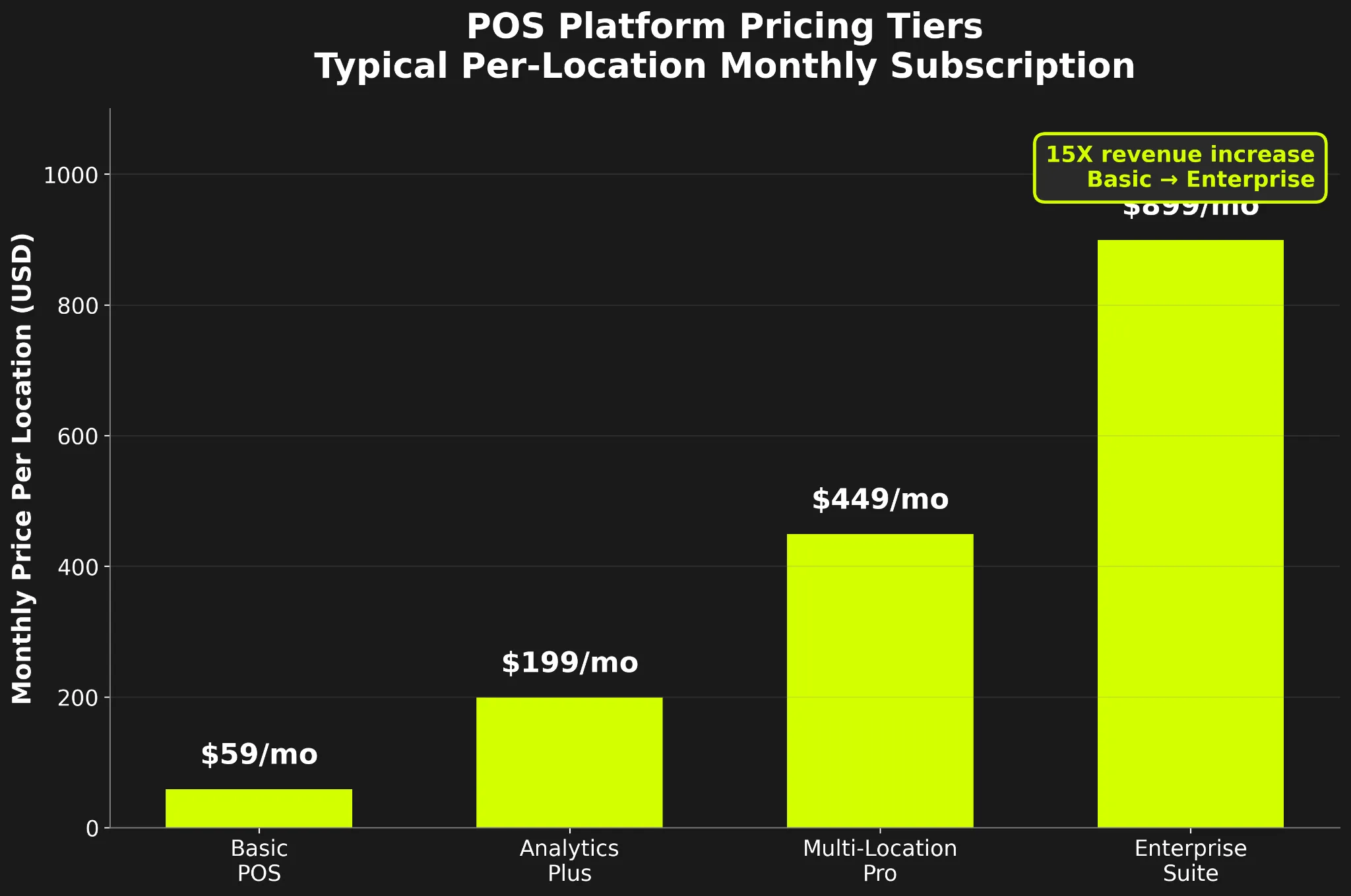
Basic POS ($59-99/location/month): Transaction processing, basic sales reports, single-location visibility. Suitable for independent restaurants and small retail stores.
Analytics Plus ($199-299/location/month): Multi-location dashboards, inventory tracking, employee performance metrics. Targets growing chains with 5-15 locations.
Multi-Location Pro ($449-699/location/month): Real-time cross-location analytics, franchise management, predictive insights, custom reporting. Built for chains with 20+ locations.
Enterprise Suite ($899+/location/month): White-label analytics, API access, dedicated support, advanced integrations. Serves national chains and franchise systems.
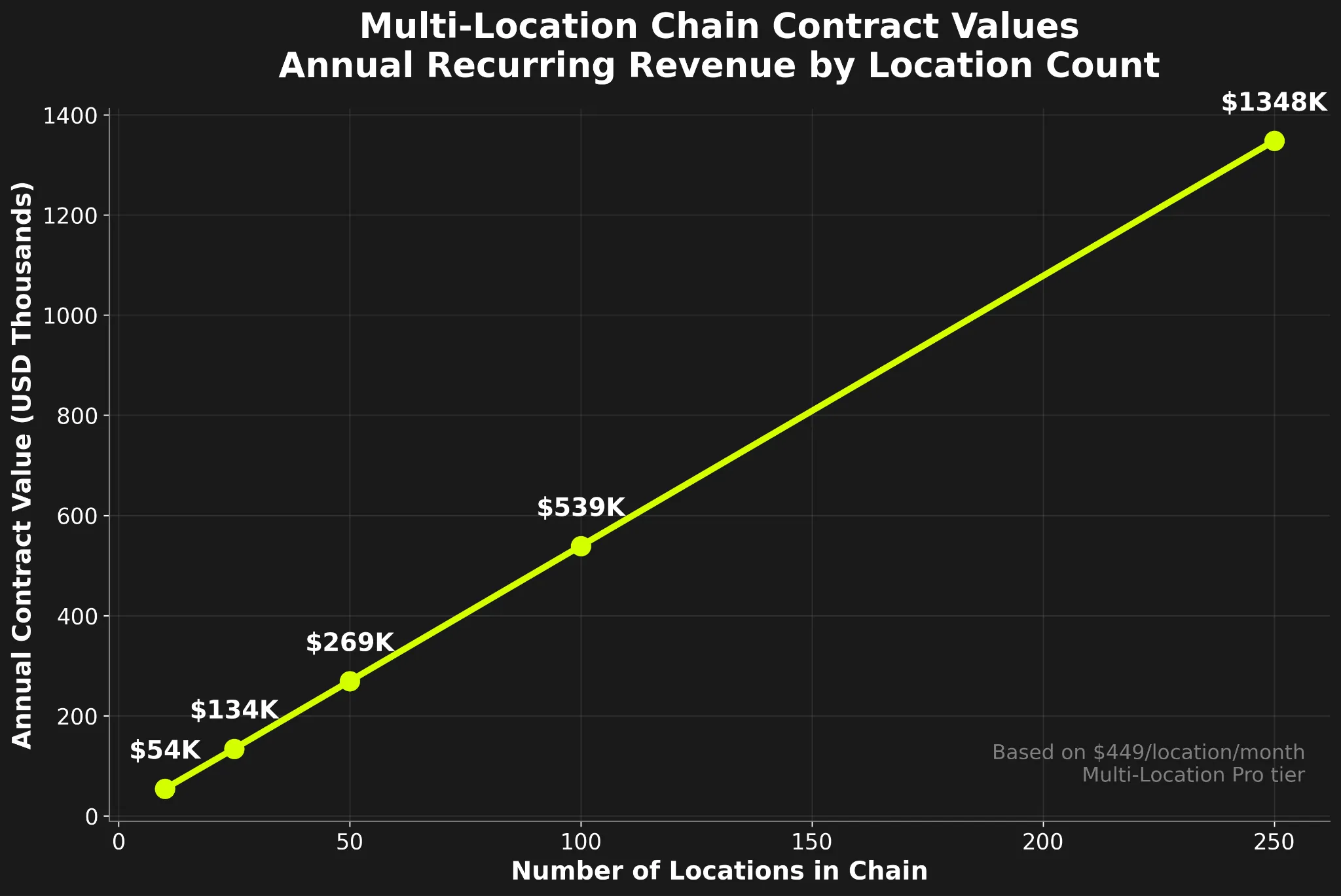
The economic reality is clear: analytics capabilities create 15X revenue expansion from basic to enterprise tiers. A POS platform serving a 50-location chain generates $22,450/month on the Pro tier versus $4,950/month if that chain stayed on Basic. The platform that can't deliver multi-location analytics never gets the Pro-tier deal.
Multi-location chains also sign longer contracts. A single-location restaurant might churn after six months if they find a cheaper alternative. A 50-location chain that has embedded your analytics into their operational workflow isn't switching unless you fundamentally break something. The switching cost of retraining 50 location managers and rebuilding all their reports creates natural retention.
Analytics also drives net expansion through additional locations. When a 10-location chain grows to 20 locations, they don't downgrade their analytics tier—they add 10 more locations at the same per-location rate. Every new location represents pure expansion revenue because the analytics infrastructure you built for 10 locations scales effortlessly to 100.
POS platforms that treat analytics as "just reporting" cap their revenue potential at Basic tier pricing. The platforms that make analytics a core value proposition unlock enterprise contract values that justify the infrastructure investment.
Five Use Cases That Define Enterprise POS Analytics
1. Multi-Location Sales Dashboard
The foundational use case for any multi-location POS platform: executives need one screen that shows sales performance across every location. Revenue by location, today vs yesterday, sales trends by hour, top-performing and underperforming locations, and the ability to drill from chain-level down to individual transactions.
This dashboard needs to answer: which locations are hitting sales targets, where is revenue trending down compared to last week, which locations need operational intervention, and how does weekend performance compare across the chain. Building this from scratch means aggregating transaction data across locations, calculating comparisons across time periods, handling timezone differences, and building the UI layer that makes it all comprehensible.
Embedded analytics platforms ship with pre-built multi-location dashboards that POS platforms can customize with their own branding and metrics. The dashboard infrastructure—filtering, drill-downs, exports—comes standard. Your team focuses on surfacing the POS-specific metrics that matter to your customers.
2. Real-Time Inventory Sync
Restaurant chains waste 4-6% of food costs on inventory issues that could be prevented with better visibility. The analytics that prevent this waste: which locations are running low on high-velocity items, where inventory levels are unusually high (indicating potential theft or waste), how much inventory is in transit between locations, and which menu items create consistent stockout situations.
POS platforms that provide this visibility help customers reduce food waste, prevent stockouts that cost sales, identify theft before it becomes material, and optimize ordering across locations. The ROI is immediate and quantifiable—customers can point to specific inventory losses that your analytics prevented.
Building real-time inventory dashboards means connecting to inventory databases across locations, calculating theoretical usage based on sales, surfacing variances that indicate waste or theft, and alerting location managers when reorder points are hit. Embedded analytics handles the infrastructure; you configure which inventory metrics matter for your POS platform's specific workflows.
3. Franchise Performance Comparison
National franchise chains need to answer: which franchise owners are outperforming the system average, which franchises need operational support, how franchise performance correlates with training participation, and where royalty payments should be flagged for audit.
This creates sensitive data access requirements. Franchise owners should see their own locations' performance compared to system benchmarks, but they shouldn't see other franchises' specific numbers. The franchisor needs full visibility across all franchises with the ability to drill into specific locations.
Building this multi-tenant analytics infrastructure from scratch is a 9-12 month project. Embedded platforms solve it with row-level security and role-based dashboards that show the right data to the right users. Your POS platform configures the permission model; the analytics infrastructure enforces it automatically.
4. Employee Analytics Across Locations
Multi-location chains need labor analytics that single-location systems never required: labor cost as a percentage of sales by location, which locations consistently run over on labor hours, employee performance comparison across locations (without violating privacy), and how employee scheduling impacts sales during peak periods.
These insights help chains optimize staffing, identify managers who need scheduling training, reduce overtime costs, and ensure adequate coverage during high-traffic periods. The analytics become part of how district managers evaluate location performance.
Building employee analytics means aggregating time-tracking data across locations, calculating labor metrics in real time, handling different wage rates and overtime rules, and presenting insights that drive action without overwhelming managers with data. Embedded analytics platforms provide the calculation engine; your POS platform decides which employee metrics matter most.
5. Customer Loyalty Tracking
POS platforms that serve retail and hospitality chains need loyalty analytics that answer: which customers visit multiple locations, how location affects purchasing behavior, which loyalty promotions drive repeat visits, and where customer lifetime value is highest.
Multi-location loyalty creates data challenges that single-location systems don't face. Customers should earn points at Location A and redeem them at Location B. Corporate teams need to see loyalty program ROI across all locations. Individual location managers need visibility into their location's loyalty performance.
Building this cross-location loyalty tracking means maintaining centralized customer profiles, tracking transactions across locations, calculating points balances in real time, and providing location-specific loyalty dashboards. Restaurant and food retail operators may also connect product data from tools such as a nutrition label generator, so ingredient and allergen detail sits alongside the sales and loyalty metrics rather than in a separate system. Embedded analytics platforms handle the customer data aggregation; your POS system determines which loyalty metrics drive retention.
Build vs Buy: The Real Cost of Analytics Infrastructure
Here's what building multi-location analytics from scratch actually costs for a POS platform:
Year 1: Two full-stack engineers for 18 months ($900,000 in fully-loaded costs), cloud infrastructure for data warehousing and real-time processing ($120,000), BI tool licenses during development ($15,000), dashboard UI framework and components ($50,000), and project delays that push revenue by 6 months ($300,000 in opportunity cost). Total: $1.85M
Year 2: One dedicated analytics engineer for maintenance and feature requests ($180,000), infrastructure costs as customer base grows ($150,000), chart library licensing ($20,000), plus technical debt from the initial build that requires ongoing refactoring ($100,000). Total: $450,000
Year 3: Continued maintenance and scaling costs ($500,000).
Three-year total: $2.8M
Embedding analytics instead: $80,000 annual subscription that covers unlimited embedded dashboards, real-time data processing, multi-location support, enterprise SSO and security, automatic scaling as customers grow, and regular feature updates without engineering work.
Three-year total: $240,000
The savings are 91% over three years, and that's before accounting for the opportunity cost of diverting engineering resources away from POS features that differentiate your platform.
The build approach also assumes everything goes according to plan. In practice, POS platforms that attempt to build analytics infrastructure encounter: scope creep as customers request more dashboard features, performance issues that require architecture rewrites, security vulnerabilities that require penetration testing, and compliance requirements (SOC 2, GDPR) that demand additional engineering effort.
POS platforms that embed analytics skip these detours entirely. The analytics vendor handles infrastructure scaling, security compliance, and feature development. Your engineering team ships POS features that competitors can't copy—not reporting infrastructure that every analytics vendor already built.
Why Luzmo Wins for POS Platform Analytics
Luzmo is embedded analytics built specifically for software platforms that need to ship customer-facing dashboards without building analytics infrastructure from scratch.
- Multi-location support out of the box: Luzmo handles data aggregation across unlimited locations, role-based access control for franchise systems, and real-time syncing without performance degradation. Your POS platform connects data sources; Luzmo handles the rest.
- Four weeks to production: Luzmo's SDK lets you embed fully-functional analytics dashboards in your POS platform in a month. No six-month data warehouse projects. No hiring analytics engineers. Your team focuses on configuring which metrics matter for POS operators; Luzmo provides the dashboard infrastructure.
- White-label customization: Dashboards carry your POS platform's branding, not Luzmo's. Your enterprise customers see analytics that look like a native part of your product. The embedded experience is seamless—customers don't know they're using a third-party analytics tool.
- Built for real-time data: POS systems generate transaction data constantly. Luzmo's infrastructure handles real-time data streams without requiring you to build event processing pipelines. Sales dashboards update as transactions happen, not after tonight's batch job.
- Scales from 1 to 1,000 locations: Whether your customer is a single coffee shop or a 500-location franchise system, Luzmo's infrastructure scales automatically. You don't re-architect analytics when customers grow—the platform handles increased data volume transparently.
POS platforms choose Luzmo because it solves the analytics problem completely. You don't build reporting infrastructure. You don't maintain dashboards. You don't scale data processing. Luzmo handles the entire analytics stack; your POS platform adds multi-location insights that close enterprise deals.
The Competitive Reality: Analytics as a Table-Stakes Feature
Five years ago, POS platforms could differentiate on analytics capabilities. Today, analytics is table stakes for winning multi-location contracts. When a 50-location restaurant chain evaluates POS platforms, they're not asking "Do you have analytics?" They're asking "Can I see labor costs as a percentage of sales across all locations in real time?"
The platforms that win these deals are those where analytics is a native, first-class feature. The platforms that lose are those where analytics feels bolted on, limited, or separate from the core POS experience.
This creates a build vs buy decision for every POS platform builder. Build analytics infrastructure and delay product launches by 18 months, or embed analytics and start closing enterprise deals this quarter.
The POS platforms that chose to build are now 12 months behind schedule, fighting technical debt, and realizing that analytics infrastructure is a never-ending engineering commitment. The platforms that embedded analytics are shipping new POS features monthly because they're not maintaining reporting infrastructure.
The market has decided: multi-location analytics is too complex and too undifferentiated to build from scratch. The platforms that recognized this early are now market leaders. The platforms still building custom analytics are explaining to investors why they're not gaining traction with enterprise customers.
Path Forward: Embedding Analytics in Your POS Platform
If you're building a POS platform and haven't shipped enterprise-grade analytics yet, you're competing with platforms that did. The question isn't whether to add analytics—it's whether to build or embed.
Building makes sense if: analytics is your core differentiator and you're competing on analytics capabilities specifically, you have 3+ engineers who can dedicate 18 months to analytics infrastructure, you have the capital to invest $2M+ in analytics before generating revenue, and your roadmap can absorb an 18-month delay for other POS features.
Embedding makes sense if: analytics needs to exist but isn't your primary differentiator, you need to ship multi-location dashboards this quarter, not in 18 months, your engineering resources are better spent on POS features that competitors can't copy, and you want enterprise customers using your platform now, not eventually.
For most POS platform builders, embedding is the obvious choice. You're building a POS system, not an analytics platform. The faster you ship analytics, the faster you close enterprise deals. The less engineering time you spend on reporting infrastructure, the more time you have for the POS features that actually differentiate your product.
Luzmo lets you embed production-ready analytics in four weeks. Your POS platform gains the multi-location dashboards that enterprise customers demand without building analytics infrastructure from scratch. You start closing deals with 50-location chains this quarter instead of explaining why analytics won't be ready until next year.
Written by

Ship the future of your data
Let us show you what Luzmo can do for your product.

Book your session with our analytics expert.