From Data Asset to Revenue Line: The Decision Checklist
Most data monetization efforts don't fail because the data isn't valuable. They fail because teams skip steps — jumping to dashboards before aligning on value, or building a product before knowing who'll pay for it.
This checklist connects two sides of the same problem: the strategy side (what to monetize, for whom, and why it's defensible) and the product side (how to embed, package, and ship so customers actually adopt and pay).
Use it as a sequential walkthrough, or as a diagnostic to find where your current effort is stuck.
Phase 1: Identify the asset
Before anything gets built or priced, get honest about what you actually have.
Audit your data footprint. What data does your platform generate, collect, or aggregate that others don't easily have? Think: usage patterns, transaction volumes, behavioral signals, market coverage, benchmarks. The goal isn't to list everything — it's to find the things that are genuinely hard to replicate.
Separate commodity from unique. Commodity data (basic firmographics, public pricing) won't sustain a paid product. Unique data — proprietary signals, aggregated benchmarks, cross-customer patterns — will. If someone else can buy the same thing on the open market, it's not your moat.
Check freshness and reliability. Can you deliver this data consistently, at a predictable cadence? If the answer is "sometimes" or "manually," you're not ready to monetize externally yet. Inconsistent delivery kills trust faster than bad data.
Confirm you have a single source of truth. If internal teams still argue about whose numbers are right, external buyers won't trust them either. Standardize KPIs, definitions, and ownership first — before a single external user sees a single chart.
Gut check: Could a customer make a better decision — faster — with this data than without it? If yes, keep going.

Phase 2: Choose where value lands
Not all monetization looks like a new invoice. Clarify where value shows up before you pick a model.
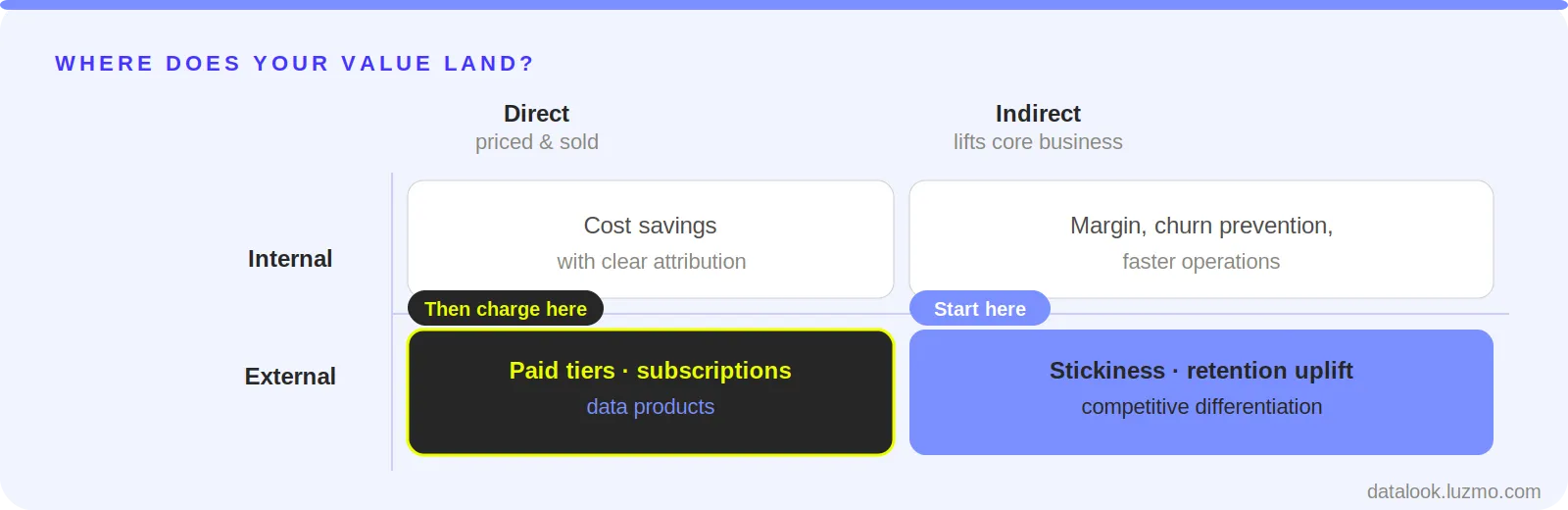
There are four quadrants to consider:
Direct (priced & sold)
Indirect (lifts core business)
Internal
Rare — typically cost savings with clear attribution
Margin improvement, churn prevention, faster operations
External
Paid analytics tiers, insight subscriptions, data products
Product stickiness, retention uplift, differentiation
Align stakeholders on the quadrant first. Finance expecting new ARR while Product is optimizing retention? That's the number one source of friction in data monetization projects. Name the intended outcome explicitly, get agreement, and write it down.
Pick your first quadrant. For most SaaS companies, the right starting point is external + indirect: embed analytics to boost retention. Once usage proves value, move to external + direct (charging for premium insights). Skipping the first step is how you end up with a product nobody adopted.
Phase 3: Define the first buyer and the first offer
The biggest cost in data monetization is building the wrong thing first. A clear buyer definition prevents that.
Default to existing customers. They reduce acquisition cost, shorten sales cycles, and already trust you. A premium analytics layer for current users is almost always the fastest path to proving value. New segments and net-new buyers come later, once you've validated the offer.
Identify the persona and their recurring decision. Not "everyone who logs in," but the specific role making a specific decision weekly or monthly. What do they need to see to act faster or more confidently? The more specific the answer, the easier the product and pricing decisions become.
Choose the right value layer:
- Dataset — the buyer has their own analytics capability and needs your coverage or signals
- Insight (dashboards/reports) — the buyer needs speed and business clarity
- Application (workflow) — decisions repeat, ROI is measurable, action matters more than observation
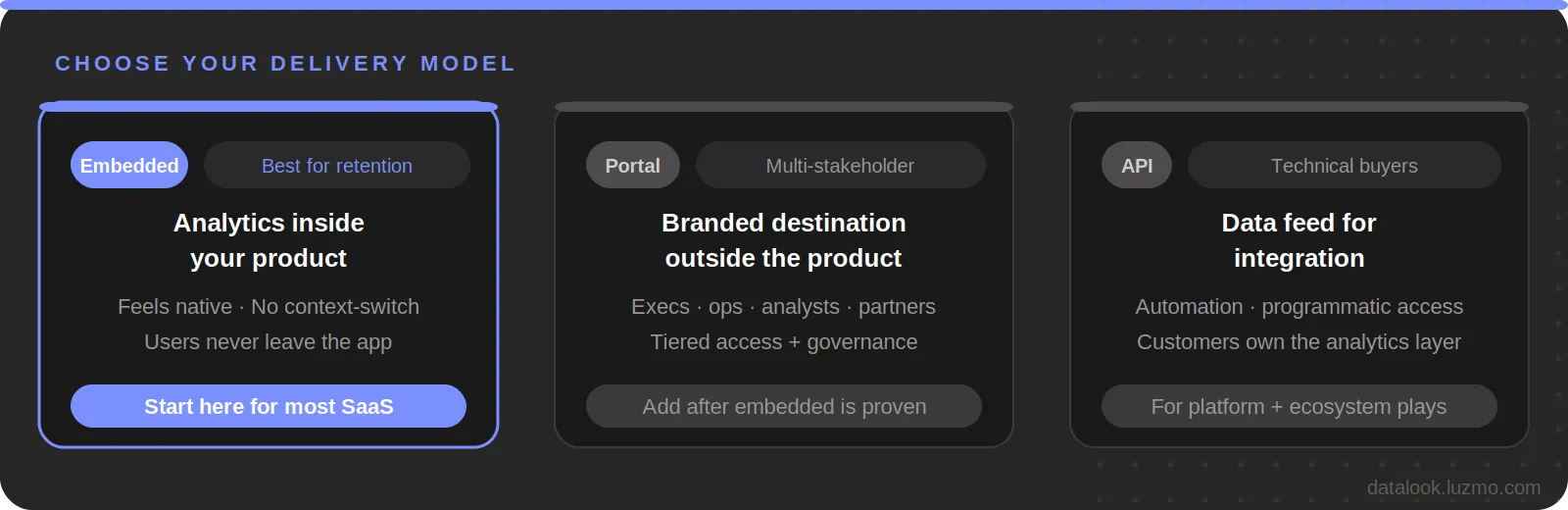
Choose the delivery model that fits:
- Embedded — analytics feels like part of your product (best for retention and stickiness)
- Portal — a shared destination for multiple stakeholders (best for multi-persona accounts)
- API/feed — customers want automation and integration (best for technical buyers)
Gut check: Can you describe the offer in one sentence a buyer would nod at? If not, narrow the scope.
Phase 4: Validate before you price
Monetization works when customers already rely on the insight. Charging too early kills adoption — and kills the eventual monetization opportunity along with it.
- Track repeat engagement. Users returning to dashboards, reports, or analytics views multiple times per week signal real value — not curiosity. First-time visits are interesting. Return visits mean something.
- Listen for pull signals. Support tickets asking for reports, feature requests for exports or filters, and users building workarounds around your data are all buying signals in disguise. When users want more of something you didn't fully build yet, pay attention.
- Correlate analytics usage with outcomes. Do active analytics users retain longer, expand faster, or engage more deeply? If yes, you have a monetizable workflow. This correlation is also your internal business case for investment.
- Check for decision-moment embedding. Is the insight showing up where users actually make choices — pricing decisions, budgeting, performance reviews? That's where willingness to pay is highest.
When to test pricing
Go for it when:
- Usage is consistent and repeatable
- Engagement metrics (sessions, filters, exports) are strong
- Users explicitly ask for more depth or control
- Analytics usage correlates with retention or revenue
Hold off when:
- Usage is sporadic or exploratory
- Most engagement is first-time or shallow
- Users rely on external tools instead of your in-app analytics
- The feature is mostly used internally, not by end customers
Phase 5: Package, ship, and measure
This is where strategy meets product execution.
Start with one packaged use case. Not a "kitchen sink" dashboard. One insight surface, one persona, one decision improved. Scope creep kills adoption at launch — you can always expand after the first use case proves its value.
Make it feel native. White-label the experience, match your product's UI, and embed it where users already work. Bolt-on analytics that requires context-switching won't drive adoption or renewals, no matter how good the underlying data is.
Enforce tiers cleanly. If you're offering Basic vs. Pro vs. Enterprise analytics, access control and feature gating need to actually work. Leaky tiers erode pricing credibility — and once users expect a free ride, charging for access becomes a fight.
Choose your GTM motion:
- Low-touch — self-serve upgrade paths, in-product prompts, clear tier differentiation
- High-touch — strategic accounts, custom onboarding, high-ACV positioning
Measure what matters:
Metric
Why it matters
Repeat engagement rate
Proves analytics is relied on, not just seen
Retention: analytics users vs. non-users
Quantifies the stickiness lift
ARPU before vs. after
Shows revenue impact of monetization
Upgrade velocity
How fast users move to paid tiers
Churn post-monetization
Confirms pricing isn't hurting adoption
Then iterate. Adjust packaging, pricing, and messaging based on what real usage data tells you. Bring those learnings back into the roadmap.
The shortcut version
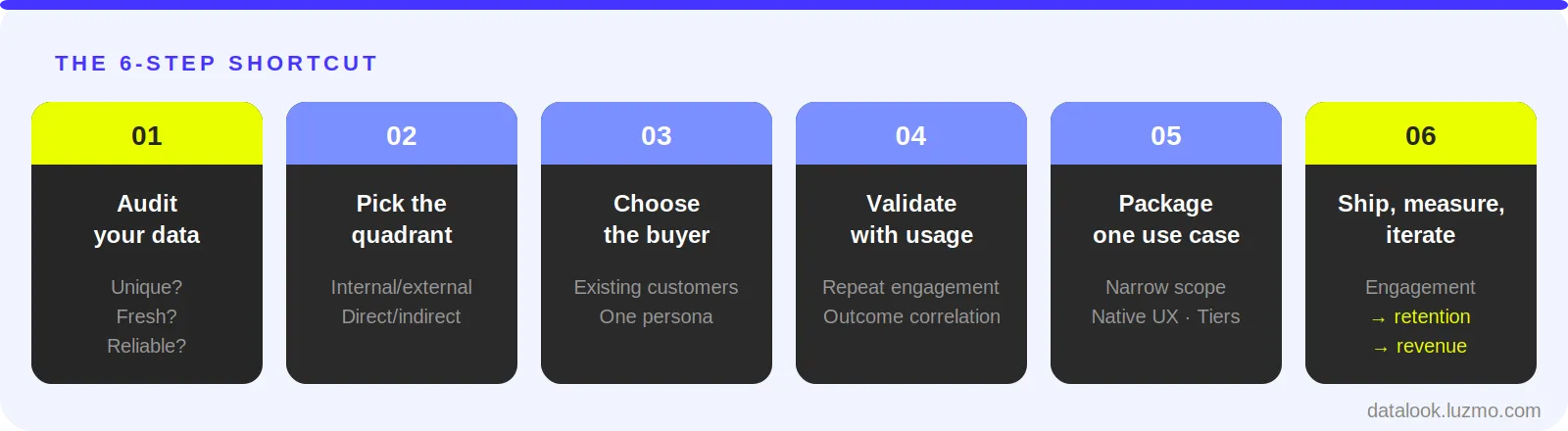
For the time-pressed:
- Audit your data → Is it unique, fresh, and reliable?
- Pick the quadrant → Internal/external × direct/indirect
- Choose the buyer → Existing customers, specific persona, recurring decision
- Validate with usage → Repeat engagement + outcome correlation
- Package one use case → Narrow scope, native UX, clean tiers
- Ship, measure, iterate → Engagement → retention → revenue
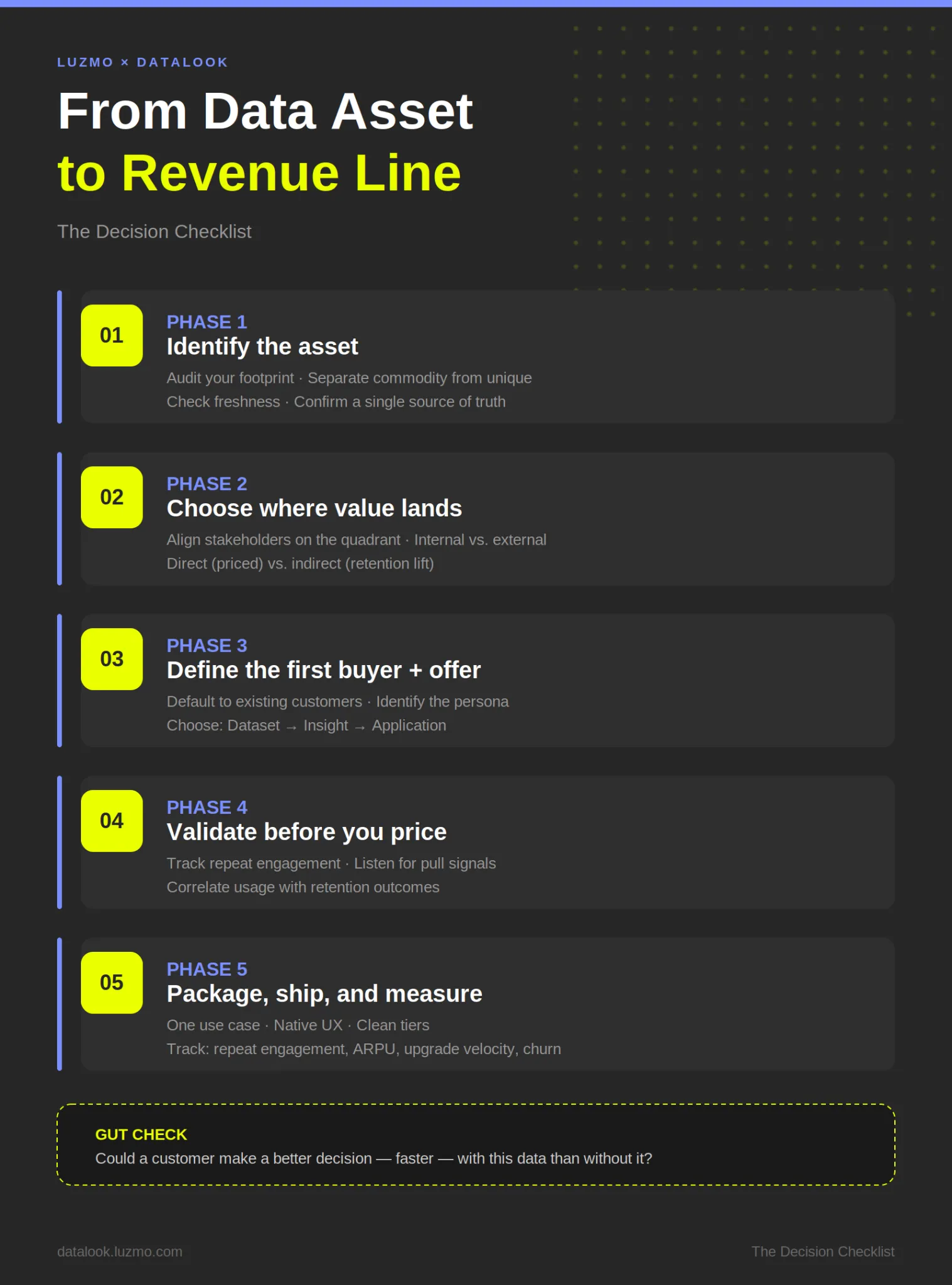
This is part of a joint content series by Luzmo and Datalook. Explore the full series and sign up for free webinas at datalook.luzmo.com.
Written by

Ship the future of your data
Let us show you what Luzmo can do for your product.

Book your session with our analytics expert.