How to Find What to Charge for in a Data-Heavy Product
Most SaaS teams approach analytics monetization the wrong way around. They open the data catalog, look at what they have, and try to build a pricing tier from there. That's the wrong starting point.
The data catalog tells you what exists. It says nothing about what anyone would pay for.
Start With Customer Behavior, Not Your Data Model
The right question isn't "what data do we have?" It's a different one entirely: what are customers already doing with your analytics that takes them meaningful time, creates risk when it goes wrong, or that they've asked you to make easier — repeatedly?
Those three signals are the map. Everything else is noise.
When Karel Callens at Luzmo reviews a customer's analytics setup before they start charging for it, the first thing he looks at isn't the tech stack. It's whether the customer can actually stand behind what they're about to sell — whether the data is trusted internally, whether there's one person who can make decisions and move the work forward, and whether anyone has actually asked buyers if they'd pay. The governance question comes before the pricing question. If the answer to any of those is no, the pricing conversation is premature.
Assuming the foundation is there, here's where to look.
Three Signals Worth Charging For
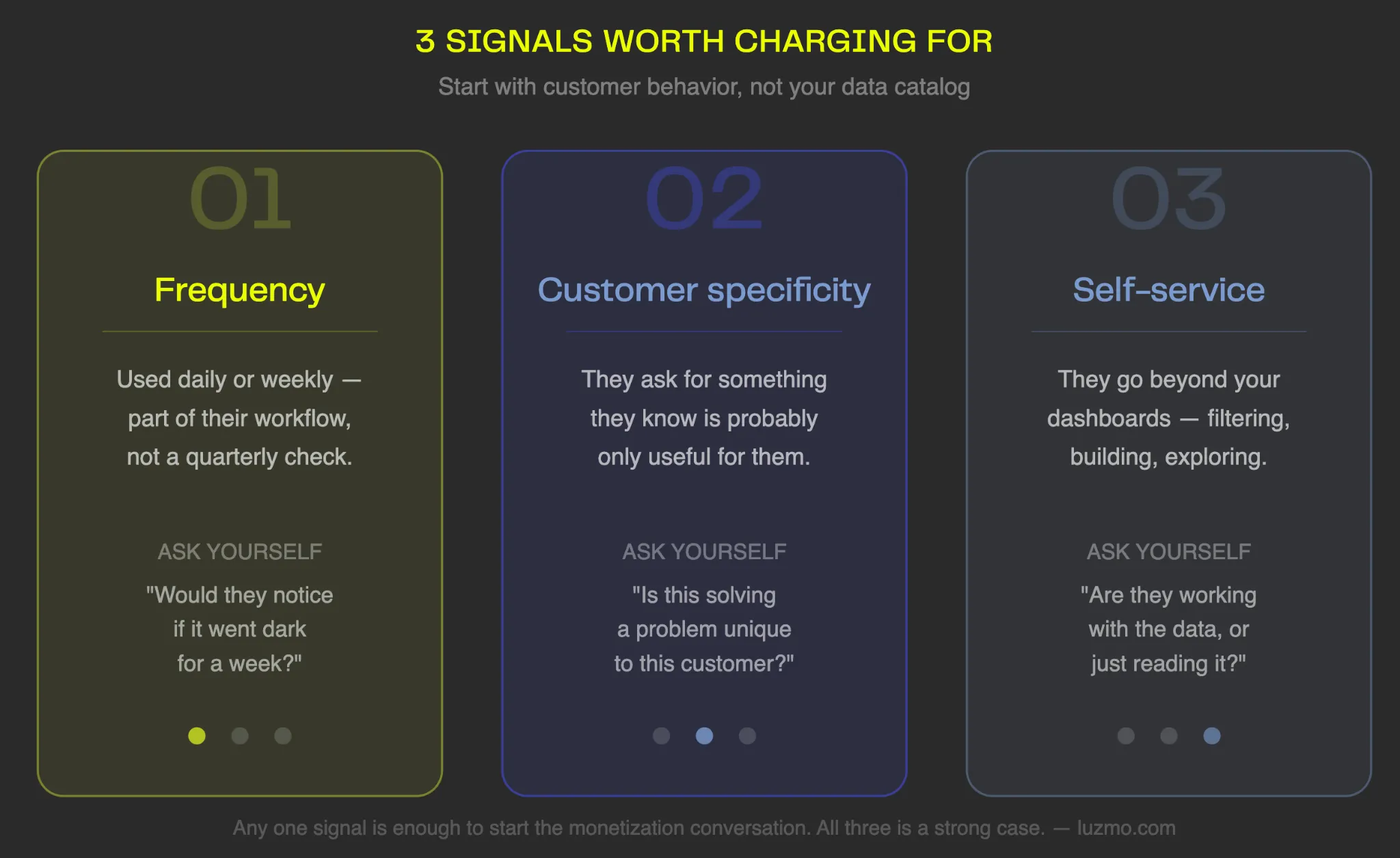
Not all usage is equal. The goal is to find the usage that has weight — the kind that would genuinely hurt if it went away.
- Frequency is the first signal. If customers use a specific analytics capability constantly — it's part of their daily or weekly workflow, not something they check quarterly — that's meaningful. Push vs. pull doesn't matter much here. What matters is dependency on the rhythm of it.
- Customer specificity is the second. This one comes directly from Luzmo's experience with its own customers: when a customer comes to you with "we need this, and we know it's probably only useful for us" — that's a signal of genuine, differentiated value. They're asking for something that solves a problem specific to their context. That's worth money, and they know it.
- Self-service exploration is the third. When customers want to go beyond the dashboards you've given them — drag and drop, filter, build their own views, ask questions without waiting for a report — that's a strong indicator of engagement depth. They're not just consuming; they're working. That's a different relationship with the product, and it supports a different price point.
These three signals aren't the only way to identify chargeable value. But they're reliable starting points because they point to analytics that has already become functional, not just decorative.
The Low-Hanging Fruit Almost Always Exists
Before building elaborate pricing structures, it's worth looking at what's already there. In most software products with embedded analytics, there's almost always a short list of capabilities that customers are already gravitating toward — and that represent a natural first paid tier.
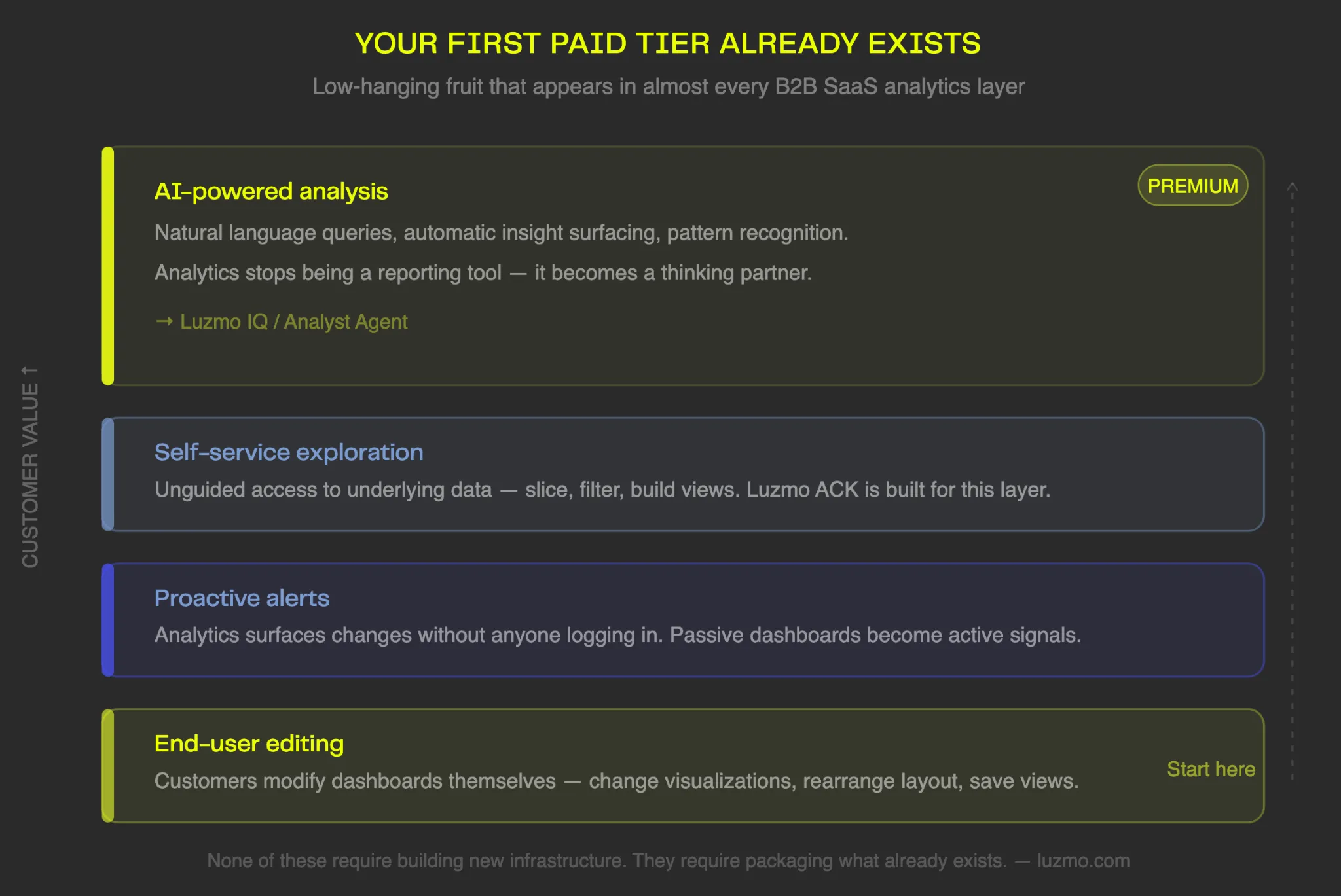
- End-user editing — the ability for customers to modify dashboards themselves, change visualizations, rearrange what they see. This one appears on nearly every customer's wish list.
- Self-service exploration — unguided access to underlying data, the ability to slice it, filter it, and ask questions without a report template. Luzmo's ACK (Analytics Component Kit) is built specifically for this layer.
- Proactive alerts — instead of a customer having to log in and check, the analytics surface tells them something changed. That's a different product from a passive dashboard, and customers treat it differently.
- AI-powered analysis — Luzmo IQ and similar analyst agent capabilities fall into this bucket. Natural language queries, automatic insight surfacing, pattern recognition. This is the tier where analytics stops being a reporting tool and starts being a thinking partner.
Any of these can anchor a first paid tier. They don't require building new infrastructure from scratch — they require packaging what already exists in a way that reflects the value it creates.
The Question Most Teams Skip
There's a step that gets missed more often than it should: asking customers.
Not in a survey. In a real conversation, with a specific number attached.
The standard advice — price relative to the value of the outcome your analytics enables, not the infrastructure cost — is correct as far as it goes. If your analytics helps a customer close 20% more deals, the right comparison point isn't server costs. It's what 20% more deals is worth to them.
But the more useful move is to test a price that feels uncomfortably high. Karel's framing is direct: shoot at least one number significantly higher than you think is reasonable. You learn where the ceiling is. As long as you haven't hit it, you don't know where it is. Two customer conversations at a price that surprises you will tell you more about your analytics' actual value than any amount of internal analysis.
The customers who go quiet aren't necessarily saying no. They're often saying "we hadn't thought about it that way." That's the conversation you want to be having.
What This Looks Like in Practice
The CultureTech case is a useful one. Their analytics layer went from a passive reporting module to a differentiated product — and the shift happened not because they built something radically new, but because they got specific about what customers were already using most, packaged it clearly, and attached a price that reflected its actual function in their customers' workflows.
That's the pattern. Not a complete rebuild. Not a new pricing strategy document. A clear answer to the question: what are customers already treating as valuable, and are we pricing accordingly?
The data catalog doesn't answer that question. Your customers do.
Luzmo is an embedded analytics platform for software teams ready to turn their analytics layer into a revenue line. From self-service exploration to AI-powered analysis, Luzmo helps product teams build and price analytics that customers actually pay for. See how it works →
Written by

Ship the future of your data
Let us show you what Luzmo can do for your product.

Book your session with our analytics expert.