How to Move Existing Free-Analytics Customers to a Paid Tier
There's a specific version of this conversation that happens in almost every SaaS company that decides to monetize analytics for the first time. It goes something like this: leadership agrees it's time to charge. The product is ready. The pricing is figured out. And then someone in the room says: "But what do we do about all the customers who've been getting this for free?"
That question tends to stall things. It shouldn't.
Moving existing customers from free to paid analytics isn't a trust problem. It's a sequencing problem. Get the sequence right and most customers either accept the change, or they tell you something valuable in the process of not accepting it.
The Default Move: Grandfather Them — But Clearly
The standard playbook here exists for good reason. Grandfathering existing customers for a defined period protects the relationship, acknowledges their history with you, and gives them time to adjust their own budget processes. Done well, it doesn't feel like a bait-and-switch. It feels like respect for loyalty.
The critical detail is clarity from day one. "You're grandfathered for 12 months" is a fundamentally different message from "you're grandfathered for now." The first is a schedule. The second is a vague promise that will eventually feel like a betrayal when you finally enforce it.
Set the end date. Communicate it clearly. Then hold to it.
Before you announce
- Improve the product before changing the price — add at least one meaningful capability (self-service, alerts, or AI layer) so customers aren't comparing the new price to the old experience
- Identify your top 20% users in the affected segment — these are the accounts most likely to push back, and most likely to convert
- Decide on the exact end date of the grandfather period before any communication goes out
The announcement
- Lead with what's new, not what's changing in price — frame the message around the improved product first, then the new pricing structure
- State the end date in the first communication — don't bury it; customers need time to adjust budget cycles and get internal approvals
- Provide a direct contact, not just a help center link — someone who can answer questions and escalate if needed
After you announce
- Follow up personally with loudest objectors — they're your most engaged users; treat their pushback as free customer development
- Send a reminder 60 days before the grandfather period ends, then again at 30 days — no surprises at renewal
- Track conversion rate by customer segment — customers who don't convert are telling you something about fit
The Noise Is a Signal
There's a counterintuitive thing that happens when you start charging for analytics that was previously free. The customers who complain loudest are almost never the ones to worry about. They're usually the ones using it most.
That's not a problem. It's the best possible confirmation that you priced something worth paying for.
When a customer objects loudly to a charge, they're implicitly telling you: this feature matters to us, we depend on it, and losing it would create real disruption. That's the signal you were hoping to find when you went looking for what to price in the first place. The customer who says nothing when you add a charge for an analytics feature is the one who was barely using it.
Use the objections. Follow up with the loudest complainers. Understand exactly what they're using, why it matters to them, and what a reasonable price looks like from their side. That's free customer development.
The Better Move: Change the Product, Then Change the Price
The most effective transitions don't just reprice the existing feature. They improve it first.
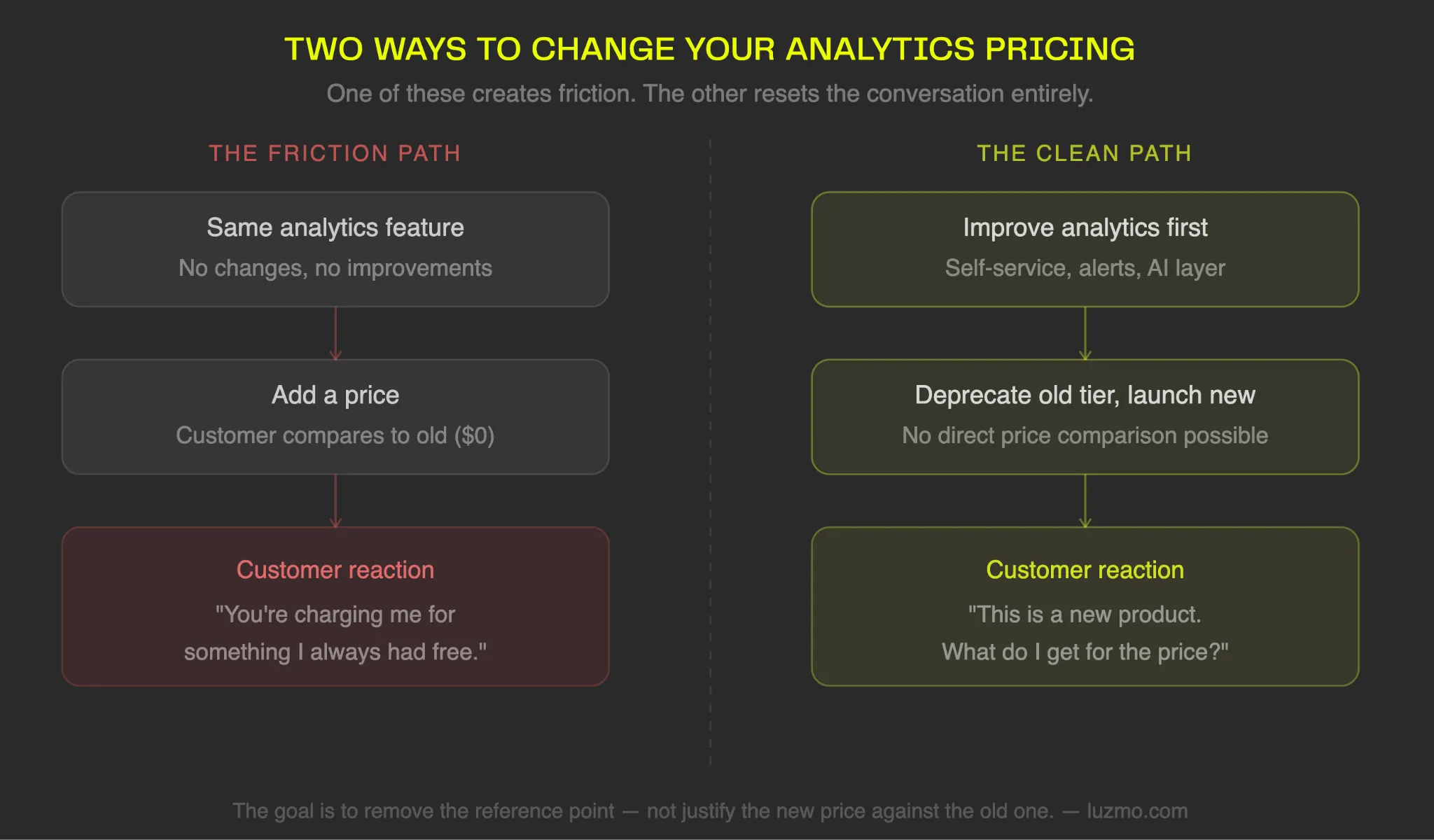
The logic is simple: if you charge more for the exact same thing, customers are comparing the new price to the old experience. If you improve the analytics alongside the pricing change, you're introducing something new — and customers don't have a reference point for the old price anymore.
Karel Callens frames it directly: deprecate the old tier, release the new one. Not as a repackaged version of what existed, but as a genuinely better product. The new pricing comes with new capability. Customers aren't being charged more for the same thing. They're being given the option to move to something better — and you're phasing out the old thing over a defined timeline.
This approach does a few things at once. It resets the conversation from "you're charging me for something I used to get free" to "this is a product update with a new pricing structure." It gives customers who are happy with the old tier a clear window to adjust. And it gives you a forcing function to actually improve the analytics layer rather than just repricing it.
The analogy that tends to land: a new iPhone. It's faster, more capable, and costs more than the old one. Nobody expects the old price just because a previous version existed at that price.
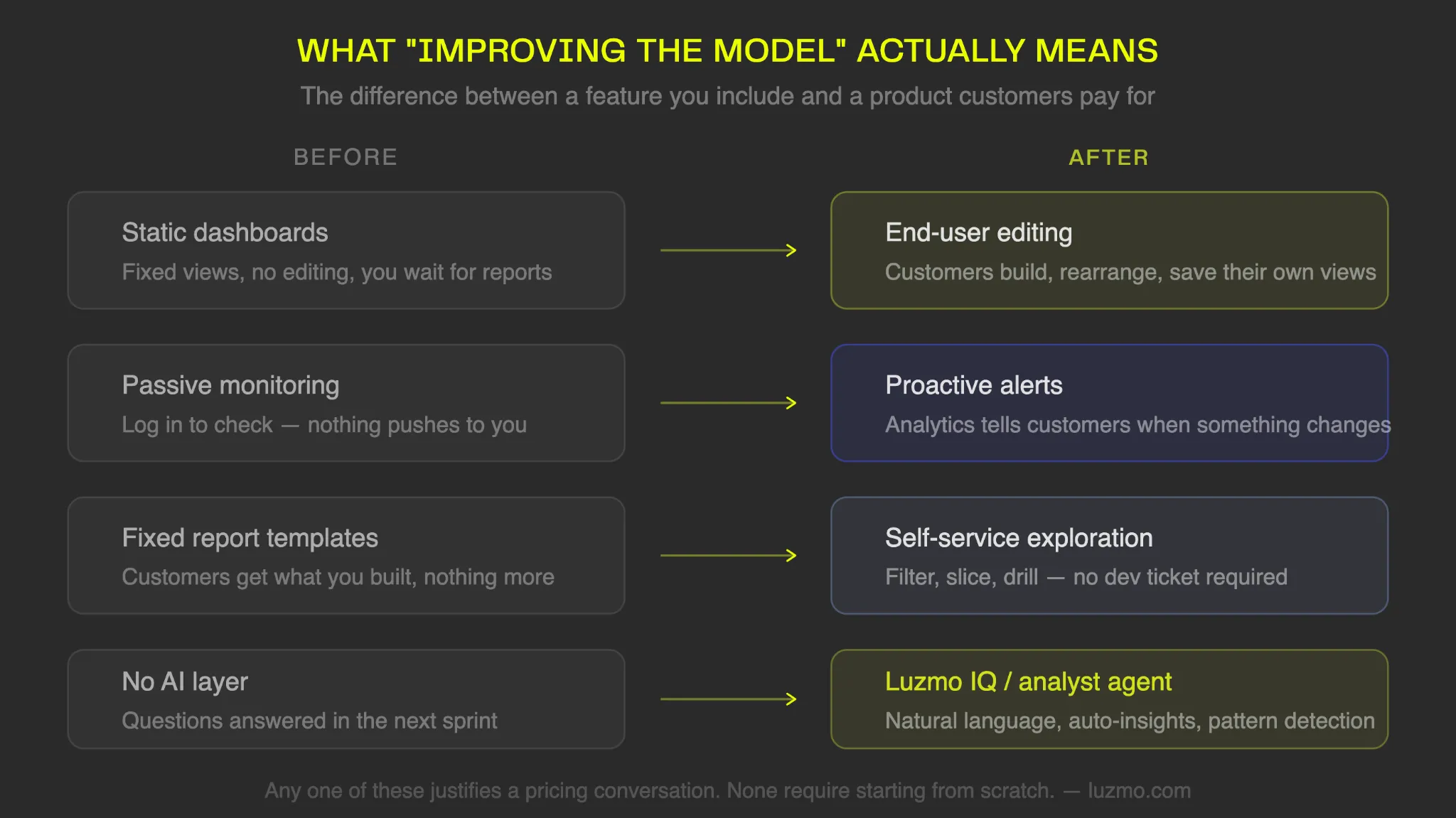
What "Improving the Model" Actually Means
This isn't abstract. There are specific things that move the needle between "the same analytics we've always had" and "an analytics offering worth a new price."
[INFOGRAPHIC 2: What a Better Analytics Model Looks Like]
The practical list is shorter than most teams expect. Self-service exploration — the ability for end users to build their own views rather than waiting for a report — changes the product meaningfully. Proactive alerting changes the relationship with it. AI-assisted analysis (natural language queries, automatic insight surfacing) crosses into a different category entirely.
Any one of these justifies a conversation about new pricing. None of them require starting over.
The Customers Who Won't Move
Some customers will refuse the transition. That's fine, and it's worth planning for.
The ones who push back hardest on pricing are usually in one of two situations: they're using the analytics heavily and the price feels disproportionate to what they're getting, or they're barely using it and can't justify any price at all.
The first group is worth a conversation. They might need a different tier, a longer grandfather period, or a discount that reflects their tenure. The second group is telling you something useful: they're not the customer your paid analytics tier is built for. That's information, not a failure.
A clean, time-limited offer — "here's what you get at the new price, here's what changes when the grandfathering ends, here's who to talk to if you have questions" — handles most situations. What doesn't work is leaving things open-ended in an attempt to avoid friction. Open-ended creates more friction, just later.
The Sequence That Works
Get the analytics better before you change the price. Set the grandfather period and communicate the end date clearly. Follow up personally with the loudest objectors — they're your best source of information about what the feature is worth. And don't leave the transition timeline vague.
Most customers who've been getting analytics for free will move to a paid tier if the value is clear, the timeline is fair, and the product they're being asked to pay for is genuinely better than what they had.
The ones who don't will tell you something useful in the process.
Luzmo helps software teams build analytics worth paying for — from self-service exploration to AI-powered analysis. If you're planning a move from free to paid analytics, we can help you make sure it's a success →
Written by

Ship the future of your data
Let us show you what Luzmo can do for your product.

Book your session with our analytics expert.