How to Price Your First Analytics Tier When You Have Zero Benchmark Data
"We'd love to start charging for our analytics. We just have no idea what to charge."
This is the point where most teams stall. No pricing history. No comparable in the market that maps cleanly to their product. No idea whether customers would pay $19 or $199 – or anything at all.
So they do one of two things: they either delay the decision indefinitely ("let's revisit this next quarter"), or they anchor on cost – what it costs them to run the analytics – and price from there.
Both are mistakes.
Here's a better starting point.
The fundamental rule: price on value, not on cost
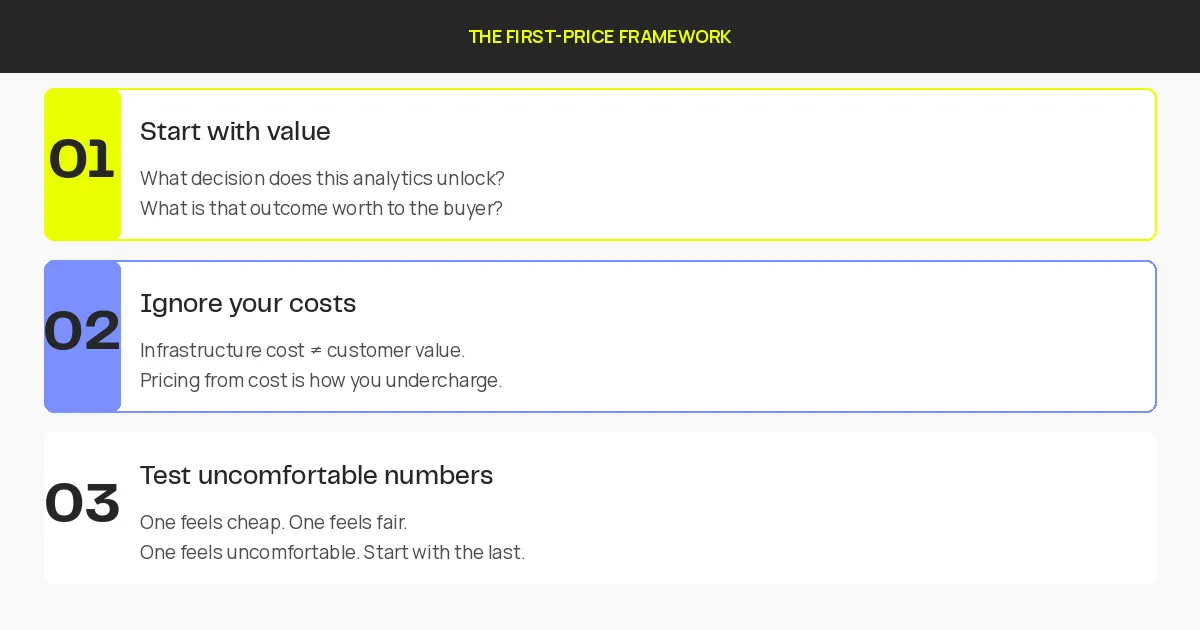
Your infrastructure cost is irrelevant to what your customer should pay. It tells you your floor – below this, you lose money – but it tells you nothing about what a customer would actually put on a card.
What matters is this: what decision does your analytics enable, and what is that decision worth?
- If your embedded analytics helps a customer's team catch a compliance error before it becomes an incident – that's not a "dashboard." That's insurance. Price it like insurance.
- If your analytics helps a supply chain manager spot a delay 48 hours earlier than they would have otherwise… that's not a report. That's operational leverage. Price it like leverage.
- The moment you stop asking "what does it cost us to provide this?" and start asking "what does it cost the customer if they don't have this?", the number looks very different.
The three-conversation method
You don't need a survey. You don't need a pricing consultant. You need three conversations.
Pick three or five customers who use your analytics most heavily. These are the users you'd be most nervous about upsetting. Have a direct conversation:
"We're thinking about introducing a paid analytics tier. Here's roughly what it would include. We're considering [X] per month. Does that feel right, low, or completely off?"
Watch the reaction; not just what they say, but how quickly they respond.
- Immediate "that seems fair": You're probably too low. A price that feels instantly acceptable usually means there's more room.
- Slight pause, then "yeah, I think we could do that": You're in the right range. Keep exploring.
- Visible discomfort, questions about what's included: You're approaching the ceiling. Note where it is – but don't retreat immediately. The ceiling is data.
- Strong objection or "we'd have to cancel": You've gone too far. Pull back – but save this conversation. The objection often contains the real insight about what they'd actually pay for.
Start higher than feels comfortable
This is the advice most teams never follow, and the one that would change their pricing the fastest.
Most founders and product teams anchor their first number around what feels "safe" – low enough that no one will say no. That instinct is understandable. It's also how you end up underpriced for years.
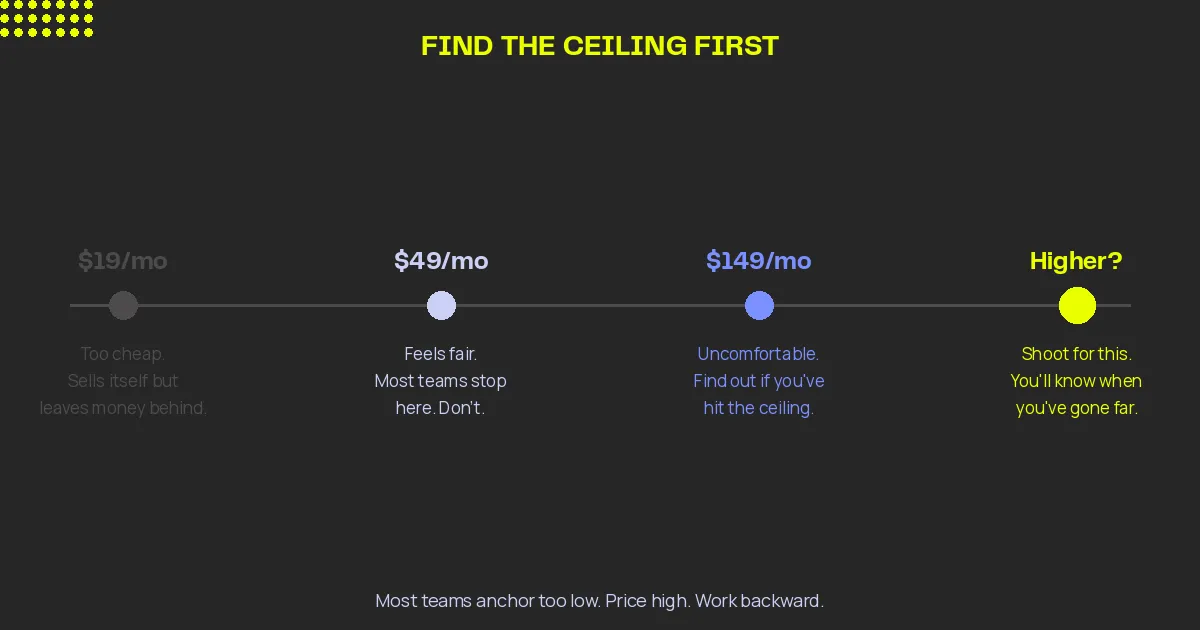
The correct approach is to shoot one test price substantially higher than your instinct, even if it makes you nervous. Why?
Because you can always come down. You cannot easily go up.
And more importantly: you won't know where the ceiling is until you've hit it. The customer who says "that's too much" is giving you a gift; they're telling you exactly where your boundary is, and often they'll tell you what they'd pay instead.
A rough framework to start with:
- "Feels cheap"; this is where most teams want to start. Resist it.
- "Feels fair"; this is where most teams end up. It's fine. But you left money on the table.
- "Feels uncomfortable"; this is where you should run your first test. You'll be surprised how often the reaction is "yes."
- "Feels impossible"; test this too, at least once. The market is often less price-sensitive than product teams assume.
What you're actually looking for in the data
After your first three to five conversations, you're not looking for consensus. You're looking for signals:
- Where does the hesitation appear? That's your ceiling. Everything below it is potential margin.
- What do they ask about when the price lands? The questions tell you what the value prop isn't landing yet, what you haven't communicated well enough to justify the number.
- Who says yes quickly? This is your beachhead segment, the customers for whom the value is clearest. Price for them first, then expand the story.
- Who pushes back hardest, and why? This is often the most useful conversation in the set. The pushback almost always contains a clue about what would make the price feel justified.
A practical first tier to test
If you're genuinely starting from nothing, here's a structure that tends to work for embedded analytics in B2B SaaS:
Starter / add-on tier:
- Standard dashboards included in base plan (what you already have)
- Self-service exploration unlocked in paid tier
- Custom alerts and scheduled reports
- Data export and API access
This structure works because it doesn't take anything away, it adds meaningful capability above the baseline. Customers don't feel like they're being charged for something they already had. They're upgrading to something new.
The exact price depends entirely on your market, your ACV, and your conversations. But a number between 15% and 25% of your average contract value for the analytics add-on is a reasonable place to test.
Start there. Talk to customers. Adjust.
The worst thing you can do is spend six months building a pricing model in a spreadsheet when three customer conversations would tell you everything you need to know.
Written by

Ship the future of your data
Let us show you what Luzmo can do for your product.

Book your session with our analytics expert.