How to Scale Analytics Without Burning Engineering Time?

Imagine a marathon where the finish line keeps moving.
That’s life for a data team when every new dashboard or report means another request.
Each small ask chops up an engineer’s attention. Many data workers spend half their week untangling data issues or chasing definitions, and some one‑off reports drag on for a week or more.
Every time someone asks, “How did last month’s numbers look in Europe?” the treadmill speeds up.
Adding more developers seems like an easy fix, but it’s like pouring water into a bucket with holes.
The real bottleneck isn’t the size of your tables or the tools you use – it’s the shortage of focused minds.
When engineers spend their hours answering the same questions, they can’t build the structure that stops those questions from popping up.
This piece is about swapping the treadmill for a flywheel: building a system where analytics demand can grow without draining your team.
Why “just hiring more data engineers” fails at scale
At first glance, adding headcount seems like the simplest fix. But ad‑hoc analytics doesn’t amortise.
Each one‑off query is like adding another straw to the camel’s back. Data folks report spending upwards of 20% of their day on data issues and reactive tasks, and those tasks grow with team size. Before long, analytics and BI engineers become ticket handlers instead of builders.
Leaders see dashboards shipped and believe progress is being made, yet they miss the unseen cost: lost strategic capacity.
A short‑term fix to get numbers to a meeting means less time for testing new models or building a reusable dataset.
Over time, the system becomes harder to maintain, and adding more people only multiplies the complexity. Throwing bodies at the problem creates a treadmill, not a flywheel.
Self‑service analytics: leverage, not liberation
There’s a popular myth that self‑service means giving everyone SQL access and walking away. In reality, it’s an operating model.
A good self‑service platform offloads routine questions from engineers and makes it easy for business users to explore trusted data.
Self‑service analytics lets people with basic data literacy create their own dashboards instead of waiting for a data expert.
This approach reduces the need for dozens of analysts and can be scaled from five users to hundreds just as easily.
With the right tool, a marketer or salesperson can build a report as easily as working in a spreadsheet.
Luzmo shows what real self‑service looks like. Instead of duplicating dashboards for each client, one dynamic layout can serve personalised views.
Customer‑facing teams can edit dashboards with a drag‑and‑drop editor without touching code, and different groups get the right level of access. This shift cuts turnaround times, frees up developers and makes ad‑hoc work the exception rather than the norm.
Self‑service isn’t about sidelining the data team. It’s about protecting their time.
When 60-80 % of routine questions are answered through a simple interface, data engineers can focus on higher‑value work.
“SQL for everyone” isn’t self‑service. True self‑service means carefully curating data models, guardrails and governance so users have freedom with guidance.
From self-service to embedded analytics in daily work
Self-service works best when insights live where decisions happen. Instead of sending people to a separate BI tool, teams can bring analytics into their own product or workflow.
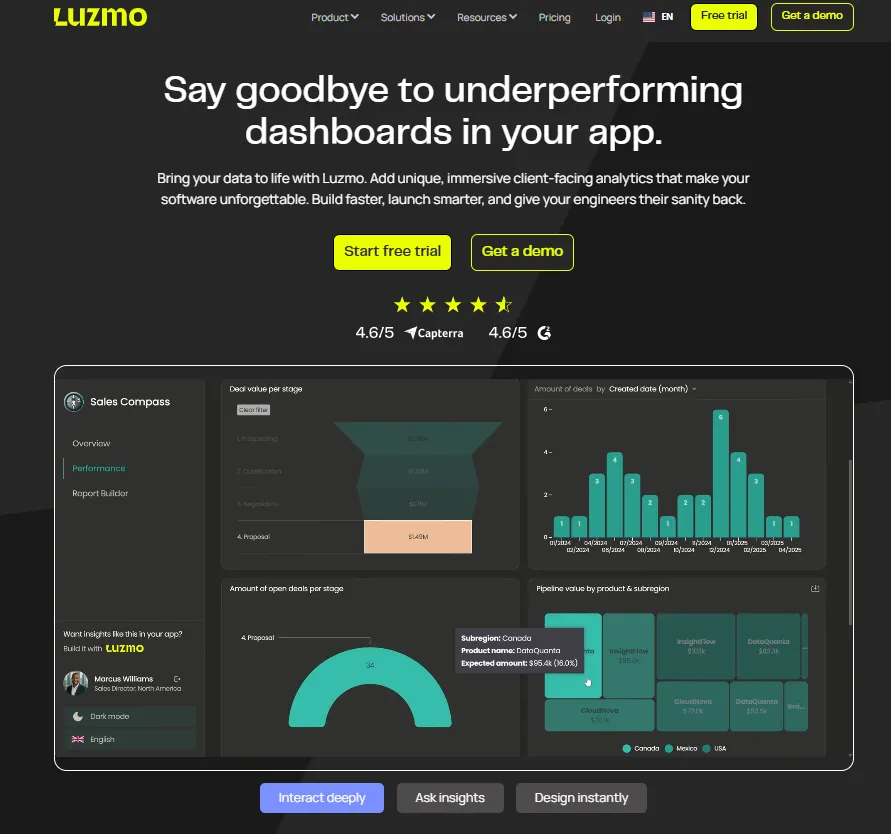
This is where platforms like Luzmo change the game. By embedding interactive dashboards directly inside customer portals or internal apps, business users explore data in context, not in another tab.
One model, one set of metrics, many audiences. Engineers build the data layer once, then reuse it across teams, clients, and use cases.
The result? Fewer “can you pull this for me?” messages, and more decisions made without breaking anyone’s focus.
The governance trap: when self‑service backfires
Handing the keys to business users without rules can create chaos. Without a single source of truth, teams risk metric drift, conflicting reports and erosion of trust in the data platform.
If multiple definitions of “monthly active user” live in different dashboards, meetings devolve into arguments about whose number is right. Dashboard sprawl grows, and the backlog you hoped to eliminate returns in the form of reconciliation work.
A healthy self‑service environment needs central metric definitions and version control.
A semantic layer or modelling layer lets the data team publish reusable definitions while enabling business users to build on top of them.
Governance isn’t red tape - it’s a safety net that keeps freedom from turning into chaos. Self‑service without standards increases engineering load over time, not less.
Reusable data products as the scaling unit
The next step beyond dashboards is to treat analytics assets as products, not one‑off outputs. A data product is a curated, reliable dataset or model that can power multiple use cases.
Building one takes effort: at one telecom company, 60-80% of the data team’s time went into preparing and assuring data for the initial product. But those costs are one‑time investments. As the product is reused across departments, the incremental cost drops.
McKinsey found that when a data product supports five use cases, its projected cost is about 30% lower than building separate pipelines.
When the same product is deployed to a new market, costs drop by around 40%.
This flywheel effect means the more a data product is used, the cheaper and faster it becomes to deliver insights. Reusable data products shift analytics from being a bespoke service to an engine.
Architecture choices that buy engineering time back
People matter, but so does infrastructure. Smart architectural choices reduce routine work and avoid late‑night alerts.
- Separation of storage and compute
Traditional databases tie compute power to storage, forcing teams to provision hardware for peak load. A decoupled architecture lets you scale and compute independently.
In a real‑world log analytics case, decoupling storage and compute cut hardware costs by 78%. A SaaS platform using this approach scaled up compute nodes only during end‑of‑month peaks, improving computational efficiency 2.43 × while reducing overall nodes.
- Pre‑aggregations and known query patterns
A physical semantic layer stores pre‑calculated metrics, delivering sub‑second response times and lower compute costs. Thanks to computing heavy aggregations once and querying a simplified table, you get predictable latency and cost savings.
Hybrid approaches let you materialise hot paths while keeping long‑tail queries flexible.
- Streaming and near‑real‑time pipelines
Batch pipelines are great for daily reports, but when you need real‑time insights, streaming architectures run in parallel and collect, process, store and analyse data in near real time.
Tools like Kafka and Flink make this possible. While these pipelines have challenges in validating data, the value of near‑real‑time data is hard to deny.
- Design for predictable workloads
Know which queries will run repeatedly (dashboards, KPIs) and optimise them with materialised views or caching. Use serverless warehouses that separate compute and storage (Snowflake, BigQuery) to scale with demand.
Architecture decisions determine how often engineers get paged. Investing in the right patterns can mean the difference between a quiet night and a Slack channel full of pings.
What “good” looks like at scale
How do you know if you’re winning? In mature organisations:
- Most business questions are answered without tickets. People find answers through dashboards or self‑service tools.
- Engineers treat ad‑hoc analytics as exceptions, not the default. When an unusual question arrives, they dig in, but routine queries no longer stop the sprint.
- Metric definitions are shared and trusted. There’s one definition of each KPI, and it lives in a central model.
- Data teams spend more time building platforms than reports. They focus on reusable data products, data quality and automation, rather than custom SQL for each request.
Achieving this state isn’t about buying one tool but aligning people, process and technology.
A VP‑level decision framework
For leaders who want to scale analytics without burning engineering time, consider this simple framework:
- Protect capacity
Measure how much engineering time goes into ad‑hoc requests. Track the queue and the hours spent reacting to questions. If half your team’s week disappears into reactive work, that’s your first lever.
- Standardise meaning
Adopt a semantic layer or modelling approach where metrics live centrally. Use version control to track changes and prevent drift.
- Productise analytics
Build reusable data products that serve multiple use cases. Invest upfront so that each new consumer lowers the cost.
- Govern intentionally
Balance freedom and safety. Give business teams drag‑and‑drop tools to explore data, but keep control of underlying logic and access levels. Use monitoring and version control to catch metric drift and dashboard sprawl.
Scaling analytics is a leadership decision
Scaling analytics means scaling decision‑making.
Engineering time is the most expensive asset in analytics, and every ad‑hoc report is a tax on future velocity. The goal is not fewer dashboards, but fewer interruptions.
Winning teams build analytics that disappear into daily work – everyone has the numbers they need, and engineers are free to build the next platform.
Are you ready to swap your treadmill for a flywheel? Making this leap is a choice, not an inevitability.
It starts with the decision to protect your team’s attention and build systems that scale with demand.
P.S. If your team is stuck on the analytics treadmill, it may be time to look at tools built for this new operating model. Luzmo helps companies move from ticket-driven reporting to governed, embedded self-service. All so insights reach every user without dragging engineers into every question.
Want to see what that looks like in real life? Take a look at how teams use Luzmo to scale analytics without scaling interruptions.
Written by

Ship the future of your data
Let us show you what Luzmo can do for your product.

Book your session with our analytics expert.