Is This The Last Quarter You Can Still Win on Analytics?
Picture a meeting room at a mid-size SaaS company. Twelve months from now, somewhere in your competitive landscape. A sales call has just gone badly. The prospect apologized — genuinely apologetic, not unkind about it — and said they were going with someone else. When pressed, the reason was simple: the other product came with better analytics. Self-service dashboards. Proactive alerts. Something that answered questions before the customer thought to ask them.
Your product had dashboards too. Good ones, actually. But they were included. Static. The same ones you shipped in 2022.
That meeting hasn't happened yet.
The Table Is Being Set Right Now
Analytics is going through what CRM went through in the early 2010s, what customer success tooling went through a decade later. A feature that lived in the background — present but unpriced, useful but unremarkable — is becoming the thing buyers ask about specifically. Not because vendors are pushing it. Because buyers have seen what it looks like when it's done well, and they've started to expect it.
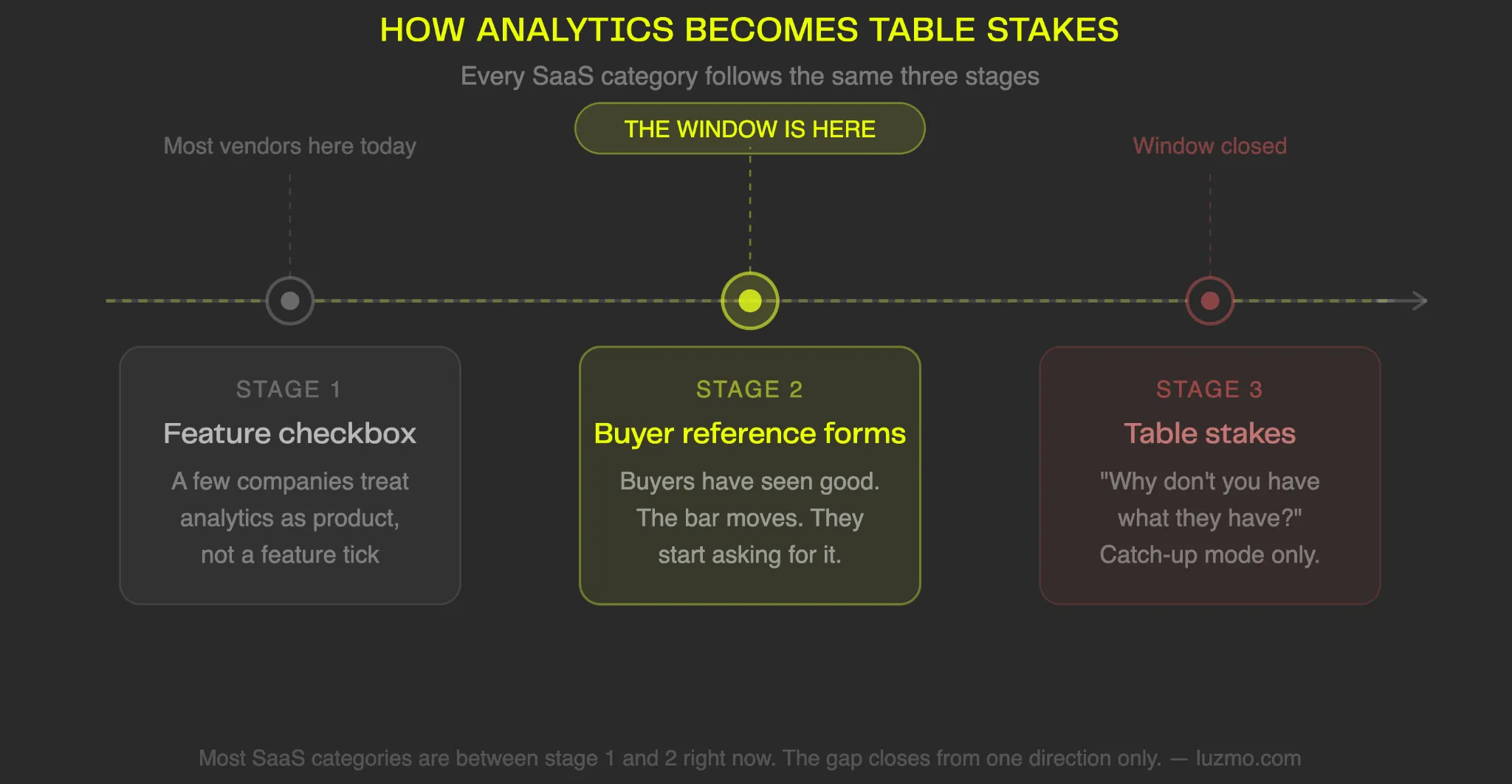
The transition happens in three stages. First, a few companies in a category treat analytics as a product investment rather than a feature checkbox. They price it, they iterate on it, they build something genuinely good. Second, buyers in that category start to form a reference point. They've seen what good looks like. The bar moves. Third, every vendor who hasn't moved gets the same conversation: "Your competitor has X. Why don't you?"
Most SaaS categories are somewhere between stage one and stage two right now.
The window is the gap between where most of the market is and where the early movers have already gone. That gap is measurable in months, not years. And it is closing from one direction only.
What "Too Late" Actually Looks Like
It's not a sudden collapse. It's quieter than that, and harder to attribute.
Win rates drift. Not catastrophically — just enough that nobody calls it in a quarterly review. A few enterprise deals go to competitors with more capable analytics layers. A few customers who were on the fence about renewing find a reason to leave that has something to do with reporting, with data access, with the fact that your product makes them pull numbers manually that another product surfaces automatically.
The support tickets start to accumulate in a particular way. Customers asking for things that other products already do. Feature requests that feel familiar because you've seen variations of the same request for eighteen months. Your product team knows what they mean. They've been on the roadmap, in various forms, waiting for prioritization.
The pricing conversation gets harder too. Not impossible — just harder. Buyers who have seen category-leading analytics in another product don't think of analytics as a premium feature. They think of it as table stakes. And table stakes don't command premium pricing. They're just the cost of being considered.
That's what too late looks like. Not a cliff. A slope, gradual enough that you don't feel it until you're trying to explain a trend line to your board.
What You're Actually Competing For
Here's the thing that tends to get lost in roadmap conversations about analytics: the competition isn't just for features.
It's for the customer's data habits.
When a customer builds their workflow around your analytics — when your dashboards are the thing they open on Monday morning, when your alerts are the thing that prompts their weekly team meeting, when your self-service exploration is how they answer questions before escalating them — you have something competitors can't easily replicate. Not because your product is technically superior. Because the customer has built around it.
That's a switching cost that doesn't show up in any comparison spreadsheet. It's invisible until someone tries to remove it.
Customers who have built their data habits around your product renew differently. They expand differently. They refer differently. They're less price-sensitive at renewal because the cost of leaving isn't just a price difference — it's rebuilding months of workflow.
You can't create that relationship with a static dashboard. It requires depth of engagement: self-service, personalization, alerts, AI-assisted analysis. The things that make analytics feel like it belongs to the customer rather than being something you show them.
The Compound Effect of Starting Now
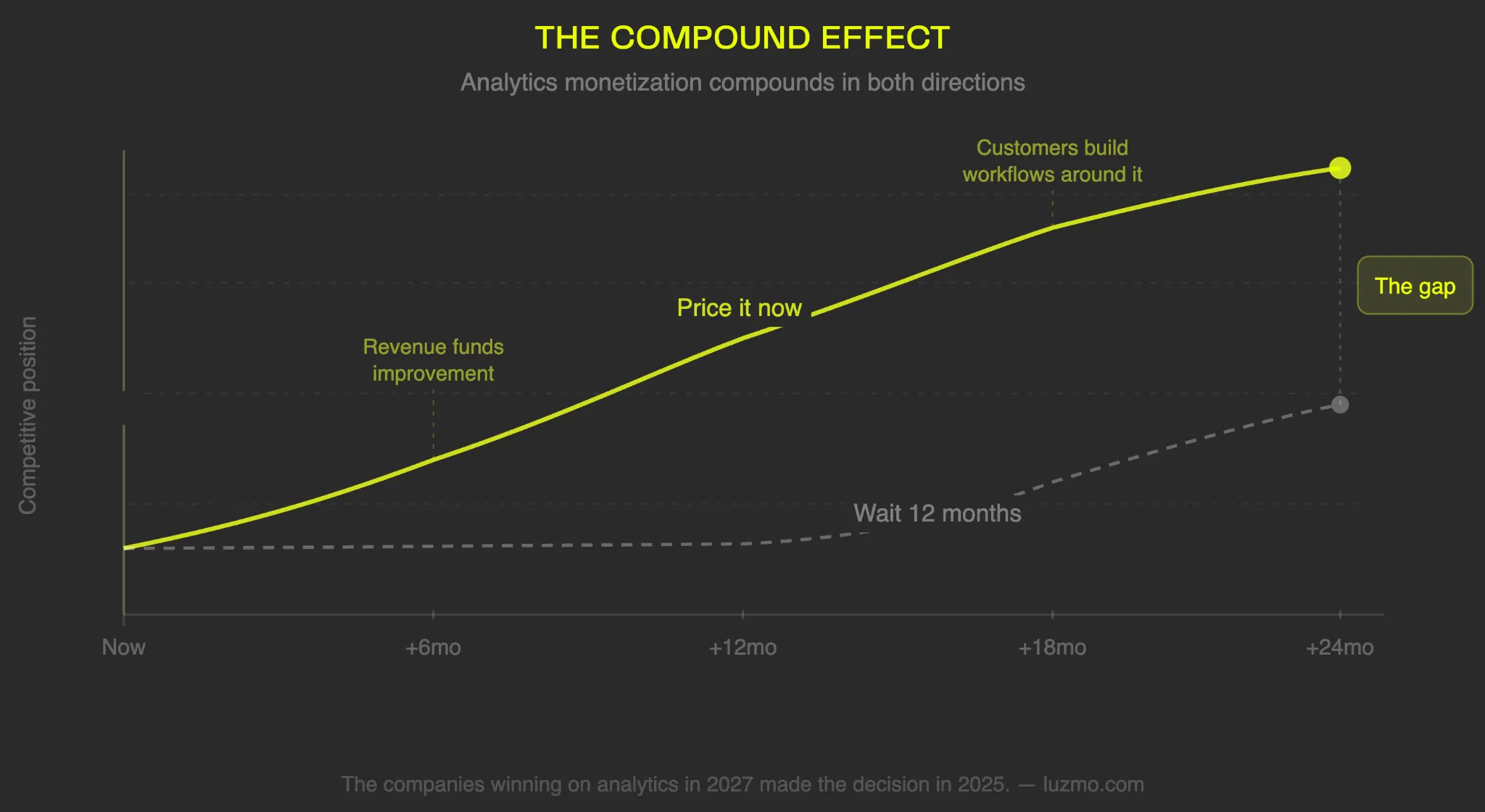
Analytics monetization compounds in both directions.
Start now, invest in the feature, price it deliberately, iterate on what customers actually pay for — and twelve months from now you have a product that's genuinely differentiated, a revenue line that funds continued improvement, and a customer base that's built meaningful workflows around your data layer.
Start in twelve months, after a competitor has established the reference point in your category — and you're building catch-up. You're pricing against a customer expectation that's already been set. You're investing in a feature that buyers have started to treat as the baseline.
The revenue difference between these two paths is real. So is the competitive difference. The two compound together: more revenue funds better analytics, which attracts customers with more sophisticated needs, which generates more revenue.
The companies winning on analytics in 2027 are not going to be the ones who had the best data infrastructure in 2027. They're going to be the ones who decided analytics was worth pricing in 2025 — and spent two years building something their customers built their workflows around.
One Question Worth Answering This Quarter
Not this year. This quarter.
The question isn't whether to monetize analytics. For most SaaS products with meaningful usage data, that decision is already made — the only question is when. The question is whether the window you're sitting in right now, before the reference point in your category is established, is more valuable than the comfort of not deciding yet.
Every month you give analytics away for free, you're training your customers not to pay for it. Every month a competitor prices and improves their analytics layer, the conversation you'll eventually have with your customers gets slightly harder.
The meeting room at the top of this piece — the one twelve months from now, the one where the deal went to someone with better analytics — that outcome isn't fixed. It's a function of decisions made in quarters like this one.
The window is open. It won't stay that way.
Luzmo is an embedded analytics platform built for software teams who want to move before the window closes. See what's possible →
Written by

Ship the future of your data
Let us show you what Luzmo can do for your product.

Book your session with our analytics expert.