10 Best Sisense Competitors and Alternatives in 2026

Sisense is an enterprise analytics platform with multiple embedding routes, including iframe, Embed SDK, SisenseJS and Compose SDK. It also supports white-label, multi-tenant and dedicated deployment scenarios, so it belongs on serious embedded analytics shortlists.
Teams still compare Sisense alternatives when they need a different development model, more predictable entry pricing, a specific deployment option or tighter control over customer-facing analytics.
Looking for something more specific? For what Sisense costs and how it is licensed, see Sisense pricing. For what the platform is and what it does, see what Sisense is. For the wider customer-facing category rather than Sisense specifically, see embedded analytics tools. This page covers the Sisense competitors worth shortlisting and how they differ.
For white-label analytics inside a SaaS product, start with Luzmo, Sisense and GoodData, then test the exact branding, embedding, security and deployment requirements described below. Tableau or Power BI may fit enterprise internal BI better, while Embeddable suits engineering-led teams that want to assemble analytics from components.
This comparison of Sisense competitors and alternatives was reviewed and updated in August 2026; pricing and feature notes reflect current vendor documentation.
Sisense alternatives at a glance
| Tool | Best for | Embedding method | Public pricing? | Deployment |
|---|---|---|---|---|
| Luzmo | White-label customer-facing analytics in SaaS | SDK-based dashboards and components | Yes, one published entry price | Managed cloud, with Enterprise terms confirmed by quote |
| Embeddable | Developer-led teams wanting components | Native Web Components, not iframe-first | No, flat monthly custom quote | Managed |
| Looker | Google Cloud enterprises with LookML skills | Embed SDK and iframe | No, sold through Google Cloud on annual contracts | Google Cloud managed |
| Tableau | Enterprise visual analysis | Embedding API v3 and web components | Partially, starting prices published; embedded terms scoped | Cloud, Server, on-premises |
| Domo | Cloud-first BI with ETL bundled | Embed via Domo Everywhere | No, consumption-based quote | Managed cloud |
| Qlik Sense | Associative exploration at enterprise scale | Capability APIs and iframe | No, enterprise pricing is quote-based | Cloud and on-premises |
| Power BI | Microsoft-stack reporting at scale | Power BI Embedded, separate product | Partially, Embedded uses Azure capacity | Azure managed, on-premises server |
| ThoughtSpot | Search-led and AI-assisted exploration | Visual Embed SDK and APIs | Partially, enterprise pricing is quote-based | Managed cloud |
| GoodData | Regulated or composable embedded analytics with self-hosting needs | Iframe, Web Components and React SDK | Quote-based platform fee plus workspaces | Managed cloud or self-hosted |
| QuickSight | AWS-native scalable reporting | Embedding SDK | Partially, pay-as-you-go with session capacity options | AWS managed |
Treat this table as a shortlist, not a procurement decision. White-label depth, security boundaries and total cost depend on the exact plan and implementation, so validate the finalists in a proof of concept.
What changed in Sisense in 2026
Before comparing alternatives, it's worth being accurate about the current product, because a lot of competitor write-ups describe an older Sisense. Here's what's confirmed as of August 10, 2026:
- Embedding options include iframe, the Sisense Embed SDK, SisenseJS and the component-based Compose SDK.
- Compose SDK supports React, Angular and Vue with TypeScript support. It isn't React-only, which is a common misconception.
- Deployment covers SaaS, dedicated cloud and on-premises options. It isn't SaaS-only.
- Security includes multi-tenant architecture, row-level and column-level controls and SSO in its enterprise materials.
- White-labeling covers replacing the Sisense logo and product name, changing colors and fonts, customizing automated emails and using custom URLs. Availability, including control of the
Powered by Sisenselabel and white-labeling the mobile app, can depend on license, plan, product mode and deployment. - Pricing runs self-service and enterprise plans, with enterprise pricing supplied through sales rather than a public numeric grid.
That is a capable embedded feature set. Teams should compare alternatives when a different architecture, branding workflow, deployment model or pricing structure better matches the product they are building.
How should the Perforce acquisition affect a Sisense evaluation?
Sisense was acquired by Perforce Software in May 2024, becoming a business unit within Perforce rather than an independent company.
An ownership change is a reason to ask procurement questions, not evidence of a negative product outcome. Buyers should request the current roadmap, support commitments, product-mode strategy, deprecation policy and contractual protections relevant to their deployment.
Existing customers should also inventory custom scripts, add-ons, ElastiCube or live-model dependencies and embedded application code. That creates a practical baseline for comparing the cost of staying with Sisense against the cost of migration.
How we evaluated these alternatives
We compared these platforms on the criteria that decide a Sisense replacement, not on feature-count totals:
- Embedding method. Iframe, JavaScript SDK or true component-level embedding, since this determines how much control you have over your own UI.
- Multi-tenancy and security. Tenant isolation, row-level security and SSO, and whether they're structural or tier-gated.
- Deployment model. Cloud, dedicated or on-premises. Data residency requirements often decide the shortlist before features do.
- Pricing transparency. Whether you can model cost before contacting sales, and what the meter actually counts.
- Migration effort. How much of your existing modeling and query logic has to be rebuilt rather than ported, including anything that lives in ElastiCube transformations.
For a white-label deployment, add these criteria:
- Brand coverage: logos, vendor marks, colors, typography, custom domains, email, exports, mobile, loading, empty and error states.
- UI control: whole-dashboard embedding versus individual components, design tokens, responsive layout and accessibility behavior.
- Tenant experience: tenant-specific themes, locale, timezone, currency, feature permissions and self-service controls.
- Security: SSO, token lifecycle, row-level or object-level policies, auditability and negative isolation tests.
- Commercial availability: which branding capabilities are included, licensed separately or restricted by tier, product mode or deployment.
- Embedded AI: whether AI entry points, generated charts, conversations and context handling fit the host product's brand and tenant boundaries.
Score each finalist with the same implementation. Apply two tenant themes, remove or document every vendor mark, embed one dashboard and one component, configure SSO and tenant rules, export a report, trigger an email, test mobile and localization, and inspect loading, empty and error states. Repeat the security test with a deliberately unauthorized tenant. Record what required configuration, custom code, a higher plan or vendor support.
Sisense reviews should be used to design tests, not to declare universal strengths or weaknesses. If reviews mention cost, performance, support, customization or implementation effort, reproduce the relevant workflow with your own data and architecture, then verify plan and support terms in current vendor documentation and the written quote.
Research date. Product, deployment and pricing facts were checked against current vendor documentation on August 10, 2026. Pricing in this category changes often, so treat specifics as a starting point for your own quote.
Our bias, stated plainly. Luzmo builds embedded analytics and competes directly with Sisense, so read our recommendation accordingly. We've kept it narrow: Luzmo for customer-facing embedded analytics inside SaaS products. Where Sisense is genuinely strong, like Compose SDK component embedding and on-premises deployment, we've said so rather than pretending otherwise, and we point to Tableau, Power BI or GoodData where those fit better.
Which alternatives to Sisense are best for white-label analytics inside a SaaS product?
Luzmo, Sisense and GoodData are the most relevant starting points in this comparison for white-label analytics inside a SaaS product. Luzmo is focused on customer-facing embedded analytics with an SDK-based approach and published entry prices. Sisense offers several embedding methods, broad rebranding controls and flexible enterprise deployment, with licensing details confirmed through sales. GoodData combines iframe and component options with managed or self-hosted deployment and quote-based workspace pricing.
When Luzmo belongs on the shortlist
Luzmo's primary audience is SaaS product teams delivering analytics to their own customers. It embeds dashboards and individual components through an SDK rather than an iframe-first architecture, so layout, styling and behavior stay in your own application code, and tenant context flows from your product rather than from a separate BI console.
On AI, Luzmo IQ covers conversational analytics, with prompt to visual, AI conversations and AI Context around it, plus an Embedded MCP Server for agent-driven access. Those surfaces need the same brand and tenant checks as the dashboards themselves.
Luzmo starts at €1,995 per month, billed annually, combining a platform fee with adoption-based usage measured through monthly active users, AI conversations or both. Verify the exact branded surfaces you need, and any Enterprise hosting or support requirements, in a proof of concept rather than from a feature list. Teams needing on-premises deployment should compare the Sisense and GoodData options below.
When Sisense belongs on the shortlist
Sisense gives you a choice among iframe, Embed SDK, SisenseJS and Compose SDK, which is unusual breadth, and it pairs that with SaaS, dedicated cloud and on-premises deployment. Its documentation covers replacing the logo and product name, changing colors and fonts, customizing automated emails and using custom URLs.
The detail to confirm is licensing. Current documentation marks white-labeling as license-dependent, with availability varying by product mode, tier and deployment, and control of the Powered by Sisense label falling into the same category. Mobile app white-labeling is described as a premium offering. Ask which surfaces are included in the plan you are quoted.
Teams already invested in Sisense models and application code also carry a migration advantage that a feature comparison alone will not show.
When GoodData belongs on the shortlist
GoodData supports iframe embedding, Web Components and a React SDK, with managed cloud or self-hosted deployment, which keeps it relevant where residency requirements narrow the field. Multitenancy and white-labeling are part of its embedded offering.
Its current public commercial signal is a platform fee plus the number of workspaces, with the numeric figure supplied by quote. Map how your tenants translate into workspaces before comparing that with a per-MAU or flat-platform model, because unlimited users does not mean unlimited workspaces.
The best white-label product is not the one with the longest customization list. It is the one that passes the required brand, security and tenant tests with acceptable implementation effort and a commercial model that remains workable at the expected scale. Our guide to white-label reports covers the surfaces that most often get missed.
Luzmo vs Sisense vs GoodData: which one fits a white-label SaaS product?
| Decision factor | Sisense | Luzmo | GoodData |
|---|---|---|---|
| Product center | Enterprise analytics with multiple embedded routes | Embedded analytics for SaaS product teams | Composable analytics for embedded and enterprise use cases |
| Embedding | Iframe, Embed SDK, SisenseJS and Compose SDK | SDK-based dashboards and components | Iframe, Web Components and React SDK |
| White-label evaluation | Broad documented rebranding, but confirm license, mode and surface coverage | Test product-native styling and all customer-visible surfaces | Test organization branding, component styling and plan-specific coverage |
| Multi-tenancy and security | Enterprise multi-tenant architecture, SSO and row or column controls | Verify tenant rules, authentication and isolation in the target implementation | Workspace and organization model, RBAC and deployment-specific controls |
| Deployment | SaaS, dedicated cloud and on-premises options | Managed cloud, with custom Enterprise terms | Managed cloud or self-hosted |
| Public pricing signal | Enterprise quote | From €1,995/month, billed annually; platform fee plus adoption-based usage | Quote-based platform fee plus workspaces |
| Best shortlist fit | Complex enterprise deployments and teams valuing multiple embedding routes | SaaS teams prioritizing customer-facing product analytics and published entry pricing | Teams prioritizing composability or self-hosting |
Pricing checked: August 10, 2026. Verify current plans, inclusions and quote terms before publishing or purchasing.
Choose the shortlist by constraint. Keep Sisense when deployment flexibility, existing investment or its specific embedding routes matter most. Test Luzmo when the analytics experience is primarily a customer-facing SaaS feature. Test GoodData when self-hosting or its workspace and component model better match the architecture. A final choice still requires the same branded, multi-tenant proof of concept for all three.
Sisense alternatives for embedded analytics: a focused comparison
Start by separating embedded-first products from broad BI platforms. Luzmo and Embeddable center their product experience on customer-facing or component-level analytics. Sisense and GoodData combine embedded capabilities with broader enterprise analytics and deployment options. Tableau, Power BI, Qlik and Looker can also embed analytics, but their fit depends heavily on the surrounding cloud, governance and licensing model.
Open-source tools such as Apache Superset or Metabase may suit teams prepared to own hosting, security, upgrades and product integration. Do not treat open source as equivalent to a complete white-label SaaS experience.
Use the table and product profiles below to form a shortlist, then run the same proof of concept rather than choosing from category labels alone.
Luzmo: a Sisense alternative for white-label analytics in SaaS products
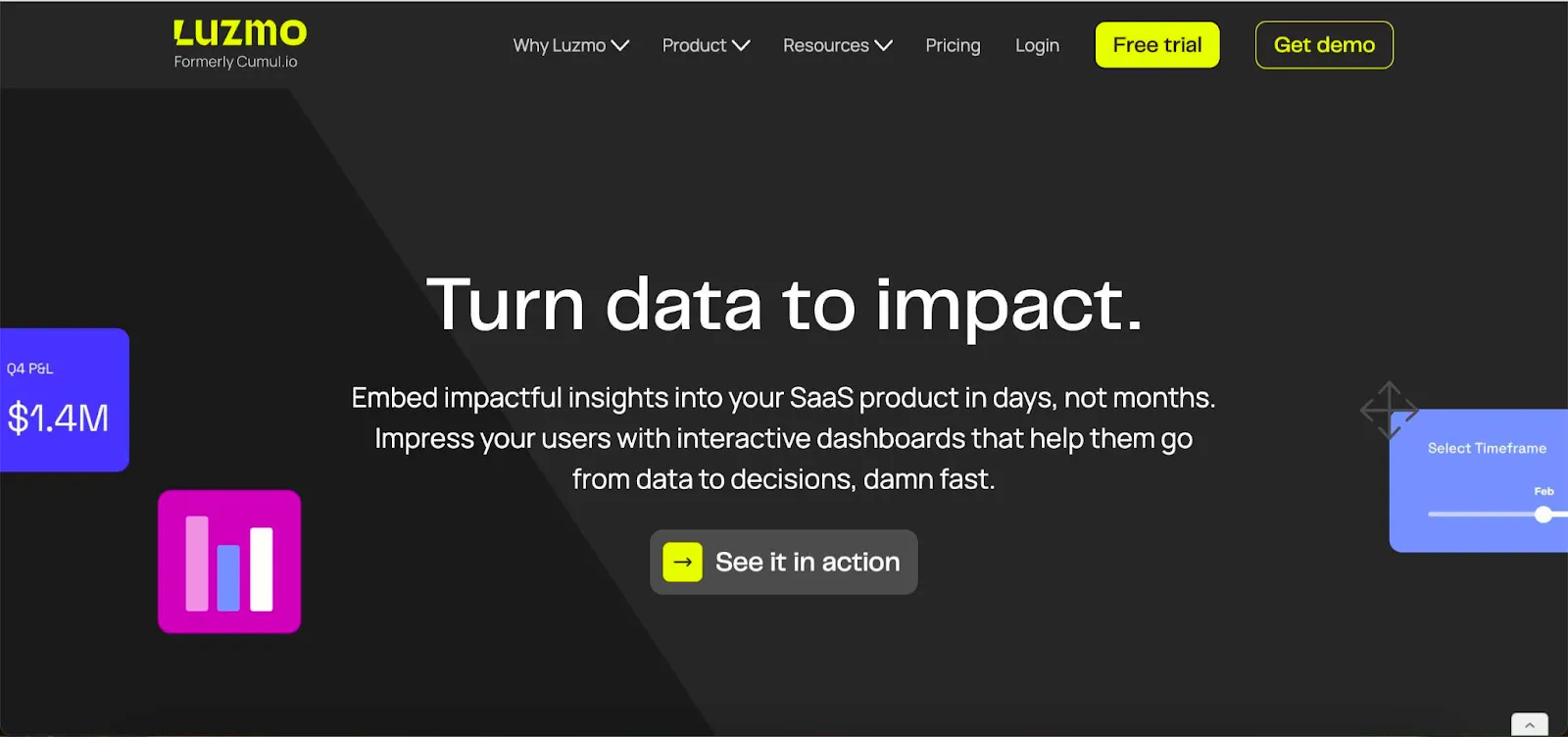
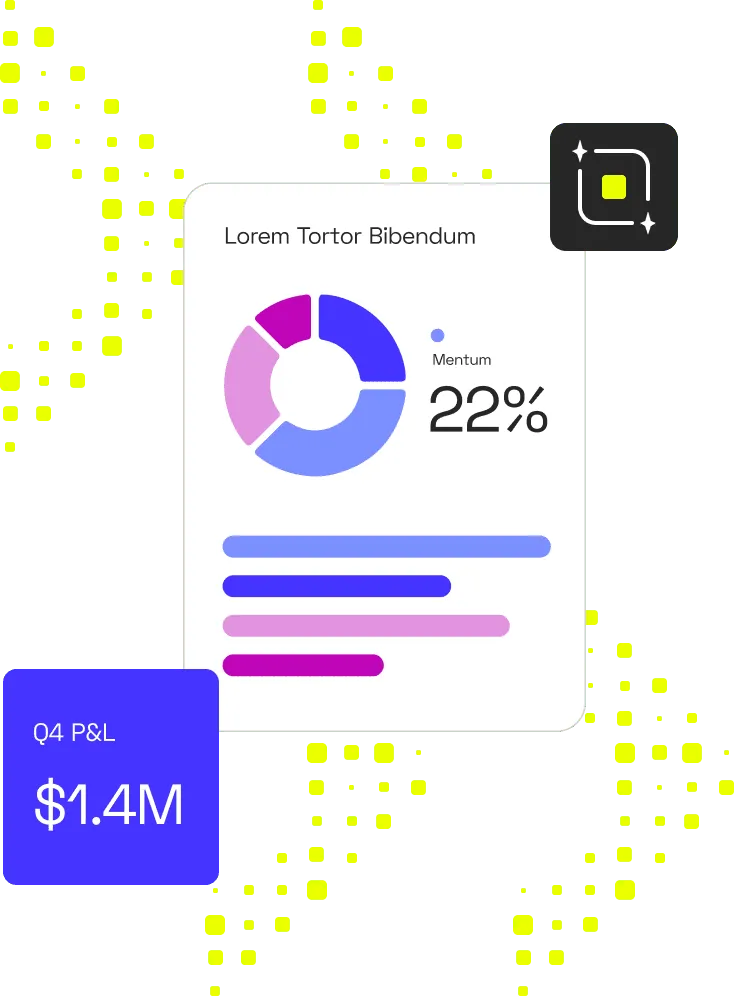
Luzmo is an embedded business intelligence platform that helps SaaS companies bring real-time dashboards directly into their products. If you're looking for scalability, seamless integration capabilities, and a smoother user experience, Luzmo is a modern alternative that goes further with its modular analytics stack.
With Luzmo Studio, you can build dashboards using an intuitive drag-and-drop interface that's accessible to non-technical users. Developers can extend those dashboards with Luzmo Flex, a developer-first SDK that provides full control over design, layout, and data connections. For teams that need AI-driven insights, Luzmo IQ adds natural-language querying and instant chart creation: just type a question in English, and IQ visualizes your data in seconds.
Behind the scenes, Agent APIs automate much of the heavy lifting, handling dataset discovery, in-memory calculations, and continuous updates, while Luzmo AI generates charts from plain-language questions, so your analytics scale across the organization without manual setup.
For white-label use, the SDK-based approach is the relevant difference: dashboards and individual components render inside your own layout, inheriting your design system and tenant context rather than arriving as a separately styled panel. Luzmo connects easily to major data sources, including Google Cloud, Snowflake, and the Microsoft ecosystem, making data integration quick and frictionless.
Unlike traditional BI platforms, Luzmo's advanced features don't require a team of engineers or weeks of deployment. Most customers embed their first dashboard within hours, not days, and the platform scales as your data grows.
Luzmo starts at €1,995 per month, billed annually, combining a platform fee with adoption-based usage measured through monthly active users, AI conversations or both. Buyers who need on-premises deployment or a specific self-hosted architecture should compare the Sisense and GoodData deployment options. See our embedded analytics overview for the wider product context.
Looker: a strong BI tool and alternative to Sisense for enterprise analytics
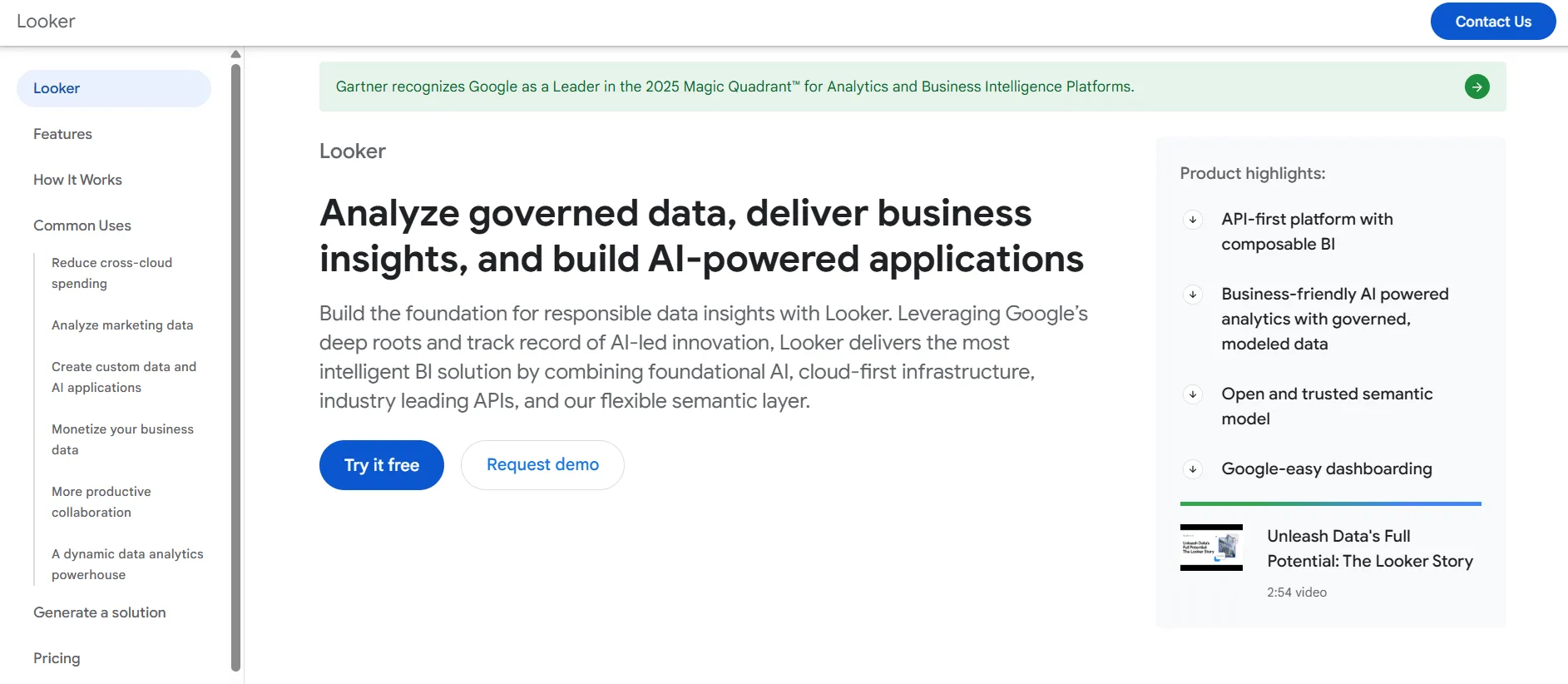
Looking for an app with a strong analytics engine, world-class visualizations, and capable connectors? Looker for embedded analytics has it all. Built on LookML, its own modeling language, it offers extensive data analytics workflows and capabilities inside Google Cloud.
Looker offers a broad visualization library and deep customization, but the value depends on the modeling layer. LookML is Looker's own modeling language rather than a dialect of SQL, so the skill test is whether your team can build and maintain that layer, not just author dashboards. Run a proof of concept on your own metrics before assuming the workflow fits.
The biggest issue with Looker though, is that the pricing is aimed at enterprise budgets. It's sold through Google Cloud on a sales-led, annual-commitment basis at the premium end of the market, so you can't model your spend without a quote. If you're weighing Looker against Sisense, our Looker vs Sisense comparison breaks down the modeling and governance differences.
Tableau: a leading BI platform and Sisense competitor with advanced visualization
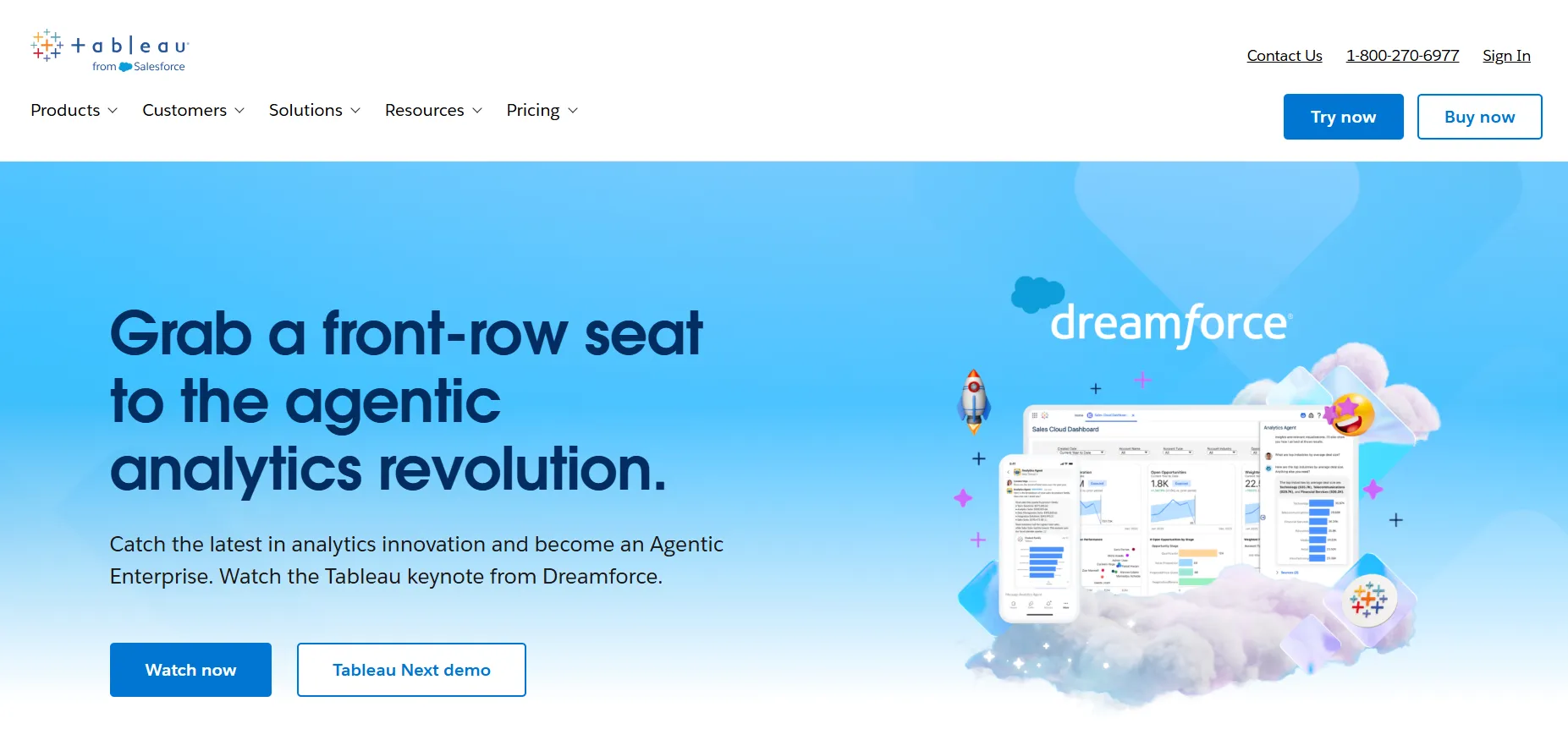
Owned by Salesforce, Tableau is one of the top performers in on-premises and cloud analytics. To compare it fairly with Sisense, it's worth separating Tableau's broader BI products from Tableau's embedded offer, since the interactivity available to a given user depends on the licensed role and the embedded configuration rather than on the product name alone.
For an embedded environment, Tableau supports customer-facing delivery through Embedding API v3, with JavaScript, web components and a supported React package, plus connected apps for JWT-based authentication. What to test: how much authoring, calculated-field logic and administration your team can handle without specialist help, measured on a representative workbook rather than a demo.
On pricing, as of August 2026 Tableau publishes starting prices billed annually, Standard from $15, Enterprise from $35 and Tableau Next from $40 per user per month, while Tableau+, compute-based Server pricing and Viewer Blocks go through sales. Model your full role mix, internal users plus customer-facing viewers, rather than copying one per-user rate. Our roundup of Tableau alternatives for enterprise visual analytics covers how the wider field compares, and Sisense vs Tableau goes head to head if those two are your finalists.
Embeddable: a developer-first Sisense alternative built on native components
If Compose SDK is the reason you're considering Sisense, Embeddable is the most direct comparison on this list. It's built around native Web Components rather than an iframe-first architecture, which is the same architectural bet Sisense made with Compose SDK, taken further.
Embeddable provides an open-source component library and a semantic layer built on Cube technology. Security uses server-side tokens, and it supports multitenant applications. Its commercial model is a flat monthly structure supplied through a custom quote rather than a per-viewer or query-based meter, so compare that unit against a per-MAU or capacity model at your projected end-user count.
Two clarifications worth making. It isn't iframe-based, so don't compare it as though it were. And the open-source component library doesn't mean the full commercial platform is open source, which matters if open source is a procurement requirement rather than a preference.
The trade-off is ownership: you're assembling components into your own UI, which suits engineering-led teams and shifts more of the build onto your side if you expected a finished dashboard product. If frontend control is the deciding factor, our comparison of Embeddable alternatives for developer-led teams covers that niche in detail.
Domo: one of the top 5 Sisense alternatives with AI features and real-time dashboards
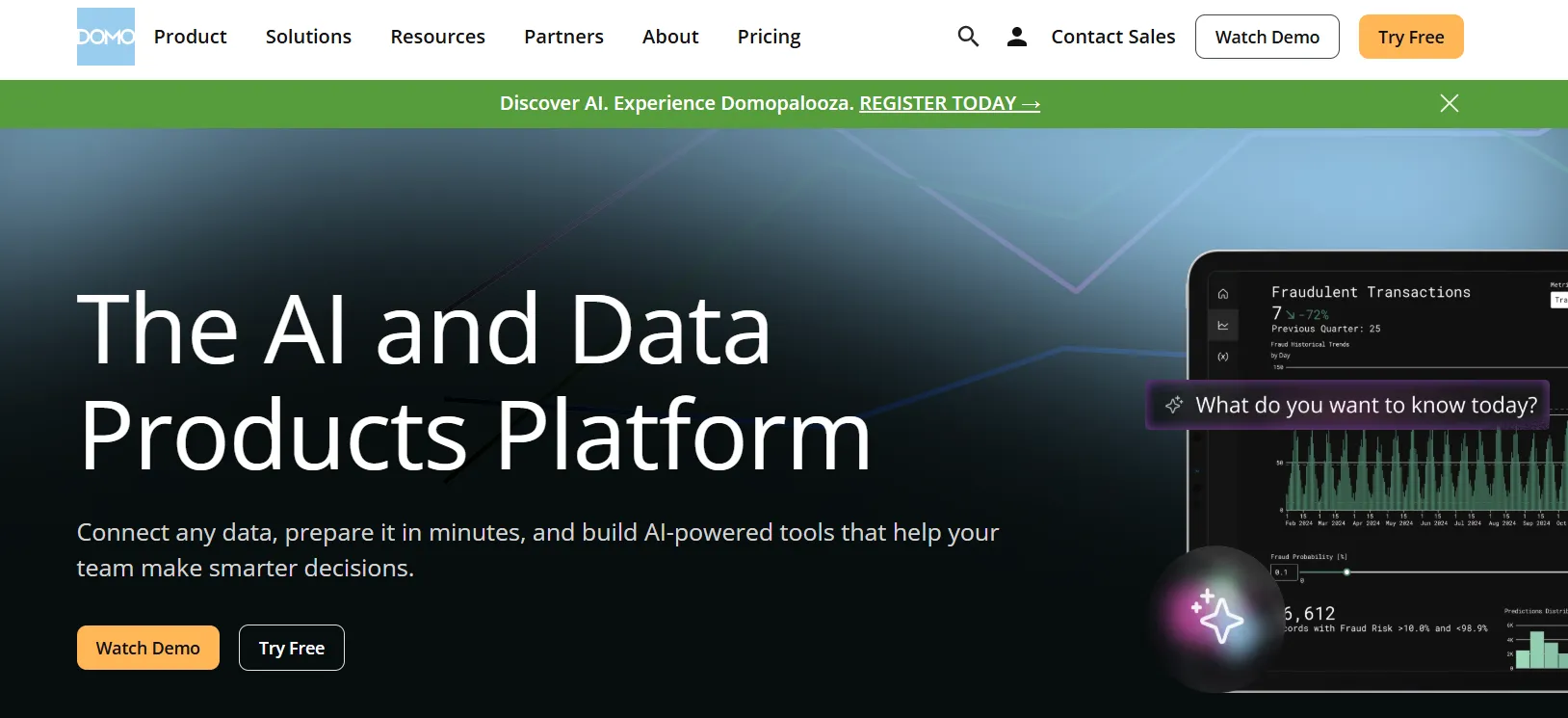
Domo bundles the whole chain, from ETL to data analytics to visualization, which suits teams that would rather buy one platform than assemble three. It's a common shortlist entry where near-real-time metric monitoring matters.
What to test: query and refresh performance against your largest datasets, and how much administrative work the data layer takes before dashboards are useful. Those are the two areas worth measuring rather than assuming, and both are easy to reproduce in a trial. For a customer-facing requirement, prototype the Domo Everywhere embedding route on your own tenant model.
On cost, as of August 2026 Domo uses consumption-based pricing rather than per-seat licensing. User seats are free under that model, and you instead buy a pool of credits consumed by storage, compute and product activity, typically on a one to three year contract. There's no public rate card, so ask Domo to map your expected workloads to credit consumption and model what happens if that volume doubles. Our Domo vs Sisense comparison covers the two head to head.
Qlik Sense: an enterprise BI platform and Sisense competitor with AI-powered analytics

Qlik for embedded analytics is a cloud-based BI platform with a wide connector range and, distinctively, an associative data model that lets users follow relationships across a dataset rather than working through predefined query paths. That exploration model is the main reason to shortlist it.
For a customer-facing deployment, prototype the embedding route you would actually ship, along with the branding and frontend control your product needs, and measure the engineering effort rather than inferring it from the internal product experience.
Like Sisense, Qlik's deployment options and licensing terms come through sales rather than a public grid, so you'll need a quote for your own deployment size and usage model.
Microsoft’s Power BI: a 2026-ready alternative to Sisense for seamless embed analytics
When it comes to embedded analytics, Power BI is not the absolute best option out there, but it is a solid contender. If you’re already in the PBI ecosystem (with Windows, Azure, and a multitude of other Microsoft products) and you have a developer who is proficient in this tool, creating and embedding dashboards is going to be a breeze.
There is a considerable choice of visualizations, one of the largest selections in the BI world. The area to test is branding and frontend control: embed one report, apply your design system, check theming, custom fonts, loading and error states, and measure how much of the result matches your product's UX before committing.
The biggest problem though, is that pricing is genuinely difficult to predict, and it's worth understanding why. The product for customer-facing analytics is Power BI Embedded, which bills through Azure capacity on a pay-as-you-go basis rather than a simple per-viewer fee. You pay for the capacity tier you select and the time it actually runs, and you can pause capacity when it isn't needed. That can be efficient at scale, but your total depends on region, SKU and utilization rather than one stable monthly figure. Don't confuse it with Power BI Pro or Premium Per User either, since those are separate products for internal use.
If licensing model is the sticking point, compare Power BI alternatives with different licensing models against capacity billing, and see Sisense vs Power BI for a direct head to head.
ThoughtSpot: a modern BI tool with AI-powered insights and strong embed analytics
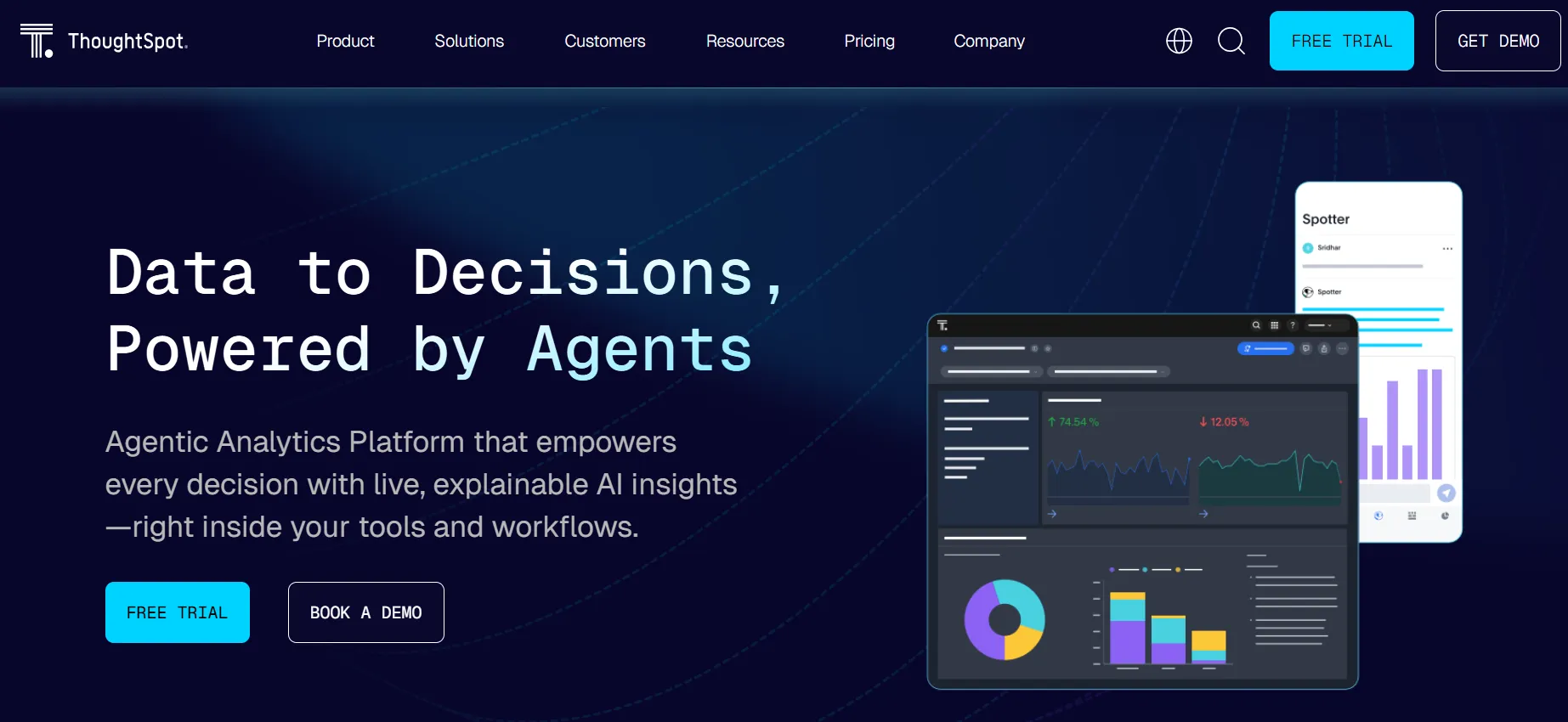
If you’re looking for Sisense alternatives with a focus on the embedded use case, ThoughtSpot is one of the top choices out there. It’s cloud-based, it has a good selection of connectors and data sources, and a pretty welcoming user interface.
ThoughtSpot has a strong focus on AI, promising the end user that they can type out a query in natural language and the tool can then return an answer in the same form, or as visualizations. If you’re not a data science expert, this is a great shortcut that gives you faster access to business insights.
The catch is that search-led analytics rests on the modeling underneath it. Test natural-language querying against your own governed semantic model and your own question set rather than a prepared demo dataset, and budget for the data preparation that supports it.
On the embedded side, the product now called ThoughtSpot Embedded, renamed from "ThoughtSpot Everywhere" in April 2024, covers a REST-based API, the Visual Embed SDK, embedded SSO, multitenancy by organization and row-level security. On cost, as of August 2026, Essentials starts at $25 per user per month billed annually for 5 to 50 users and up to 25 million rows, while Pro starts at $50 per user per month or $0.10 per credit on its usage-based route. Enterprise is custom, so ThoughtSpot pricing needs a conversation once you outgrow the published tiers. An Embedded Developer offer is listed as free for up to ten users and 25 million rows, with current pricing views stating a one-year term, so confirm the duration before treating it as production.
GoodData: a user-friendly BI platform and Sisense alternative focused on AI-driven exploration
Ease of use is the name of the game with GoodData, which is packed rich with AI features for data analysis and exploration. For people who have never used a BI tool, you can use natural language processing to give everyone access to business insights.
Getting value from those AI features depends on the modeling underneath. Metrics are defined in MAQL, GoodData's query language, on top of a logical data model, so build a representative metric during a trial to gauge what the workflow asks of your team.
On capability, GoodData is a genuine embedded platform rather than a repurposed BI tool: it supports iframe embedding, Web Components and a React SDK, with white-labeling, multitenancy and role-based access controls, plus both managed cloud and self-hosted deployment. That self-hosting option is what keeps it on shortlists for regulated industries.
Pricing is where it gets harder to compare. The public pricing page describes Professional as a platform fee plus per-workspace pricing with unlimited users and data, and the exact figure is quote-based. Note what that means for a multi-tenant product: "unlimited users" doesn't mean unlimited workspaces or a flat total, so map how your tenants translate into workspaces before you compare it with Sisense. If composable embedded architecture is your priority, it's worth reviewing the GoodData competitors for composable embedded analytics side by side.
Amazon QuickSight: a cloud-based BI tool and Sisense competitor for scalable AI analytics
If your architecture is already AWS-centered, Amazon QuickSight is a natural shortlist entry. It integrates with Redshift, S3, RDS and other AWS services, and its serverless architecture means capacity isn't something you provision yourself.
QuickSight supports embedding, with identity handled through AWS and session-capacity options that price differently from per-reader pricing. Verify the current embedding, identity and session-capacity terms in AWS documentation for your own region, since pricing units in this area change.
What to test: check the chart library against the specific visualizations your product needs, and confirm the connector coverage for any non-AWS source in your stack, rather than assuming parity either way.
How to migrate from Sisense: what to evaluate before switching
Migrating embedded analytics is harder than migrating an internal BI tool, because the dashboards are part of a live product. Downtime, a changed user experience or a broken integration all land on your customers.
The first thing to assess is your data model dependency. Some Sisense implementations use an ElastiCube model to pre-aggregate data for query performance, while others run on live models. If yours relies on ElastiCube-specific query logic or transformations, understanding how that logic will be rebuilt in the target platform is the most important technical question to answer before starting a migration.
The second consideration is your embedding architecture. Sisense supports iframe, Embed SDK, SisenseJS and Compose SDK, so start by identifying which route you actually use. Then map how dashboards are authenticated, how row-level security is implemented, and how user context is passed from your application, and verify that the target platform's embedding model can replicate this behavior. Our guide to Sisense embedded analytics covers those routes in more depth.
The third consideration is user impact. If your end users have built custom dashboards or saved views in Sisense, those will need to be migrated or recreated. Assess how many users have done this and factor that into the timeline and support resources needed for the transition.
Then inventory the things that don't appear in a dashboard list: custom scripts, add-ons, plugins, themes, automated emails, custom URLs, export templates and mobile surfaces. For a white-label migration, inventory every customer-visible surface before rebuilding dashboards. Compare logos, typography, URLs, automated email, exports, localization, responsive behavior, loading, empty and error states, and any embedded AI entry points. A new dashboard that matches the main screen but exposes a vendor brand elsewhere is not feature parity.
A parallel-run period, where both platforms are live simultaneously, is the lowest-risk migration approach for customer-facing analytics. It lets you validate the new implementation against real usage before deprecating the old one, and gives customers time to adjust.
Compose SDK migration considerations
If your current implementation uses Compose SDK rather than iframes, migration is a different project from a standard dashboard port, and usually a larger one. Worth planning for:
- Component-level code is application code. Compose SDK charts live inside your React, Angular or Vue components. That logic doesn't export anywhere, so it gets rewritten against whatever the target platform exposes. Inventory how many components you've built before estimating.
- Check the target's embedding granularity. Moving from component-level embedding to a whole-dashboard route is a visible change for your users. If frontend control matters, shortlist only platforms that expose an SDK or component library at the granularity you need, and confirm which specific components are available rather than accepting a general claim.
- ElastiCube logic needs a new home, if you use it. Where your implementation relies on ElastiCube transformations or pre-aggregation, that logic has to move into your warehouse, into dbt or into the new platform's modeling layer. This is reliably the biggest hidden cost. Implementations running on live models have a smaller version of this problem.
- Re-derive tenant security from scratch. Don't port a row-level security model you haven't re-reviewed. Verify how user context passes from your app to the new platform, then test isolation with real tenant data before launch.
- Match framework support. Compose SDK covers React, Angular and Vue. Some alternatives are React-first in practice, so confirm your framework is genuinely supported rather than technically possible.
Which Sisense alternatives fit each deployment model?
Deployment usually narrows the field faster than features do:
- Managed SaaS analytics for a software product: evaluate Luzmo and the managed offers from Sisense or GoodData.
- Self-hosted or on-premises requirements: evaluate the current Sisense and GoodData options.
- Component-level frontend control: evaluate Compose SDK, Luzmo Flex, Embeddable and GoodData components against the same UI test.
- AWS-centered architecture: evaluate Amazon QuickSight.
- Microsoft-centered architecture: evaluate Power BI Embedded.
- Google Cloud and LookML-centered architecture: evaluate Looker.
- Open source and self-managed: evaluate Apache Superset or Metabase only with full operational ownership included in the cost.
Compare embedded analytics platforms
Sisense overlaps with both embedded-first analytics products and larger BI platforms. These comparisons are the most useful next steps:
Evaluating embedded analytics for a SaaS product? Explore Luzmo.
Wrapping up
Sisense remains a credible option for embedded analytics, white-labeling and flexible enterprise deployment. An alternative becomes more attractive when its development model, branded product experience, hosting choice or commercial structure better matches the application being built.
For white-label analytics inside SaaS, compare Luzmo, Sisense and GoodData with the same tenant, security and brand-parity proof of concept. Keep Embeddable in the test when component assembly is the priority. Use the broader BI platforms when their ecosystem or internal analytics strengths are more important than an embedded-first workflow. Luzmo lets you embed dashboards in your product in just a few hours, and the customization makes them look and feel like they belong there. For true self-service analytics, we have an embedded dashboard editor and AI charts that anyone on your team can use.
Grab your free trial and see why SaaS product managers love Luzmo.
FAQ
All your questions answered.
What is the best Sisense alternative?
There isn't one universal winner. For customer-facing analytics inside a SaaS product, Luzmo, GoodData and Embeddable are the closest comparisons, and Sisense itself remains credible on component-level embedding. For internal enterprise BI, Tableau, Power BI or Looker cover more ground. Decide by audience, embedding route, deployment and pricing unit.
Which Sisense alternative is best for white-label SaaS analytics?
Start with Luzmo, Sisense and GoodData. Luzmo focuses on customer-facing embedded analytics with published entry prices. Sisense documents broad rebranding across logos, product name, colors, fonts, email and URLs, subject to license and product mode. GoodData adds self-hosting. Decide on branding coverage, tenant security, deployment and the commercial model at your expected scale.
How much does Sisense cost?
Sisense does not publish a numeric enterprise price. It offers self-service and enterprise plans, with enterprise pricing supplied through sales, so your total depends on users, data volume, deployment and licensed capabilities. Expect a quote rather than a rate card, and ask which branding and security features are included in the plan you are offered.
Which Sisense alternatives support component-level embedding?
Embeddable is built on native Web Components, and Luzmo offers SDK-based dashboards and components rather than an iframe-first architecture. GoodData documents Web Components and a React SDK. Sisense itself supports component-oriented development through Compose SDK for React, Angular and Vue. Test each one against your own design system before deciding.
What is the best Sisense app alternative?
It depends on what app means in the evaluation. For analytics embedded inside a SaaS application, shortlist Luzmo, Sisense, GoodData and Embeddable based on the required UI control and deployment model. For an internal BI application, Tableau, Power BI, Looker or Qlik may be more relevant. Define the user, host application, security boundary and authoring workflow before comparing features.
Written by

Ship the future of your data
Let us show you what Luzmo can do for your product.

Book your session with our analytics expert.