What to Do With Customers Who've Been Getting Your Analytics for Free
You've decided to monetize your analytics. Leadership is aligned. You have a pricing structure. You're ready to go.
Then someone asks the question that stops every room cold:
"What do we do with the customers who've been getting this for free for three years?"
It's the right question to ask. Get it wrong and you damage trust with your most loyal accounts. Get it right and you can actually use the transition to strengthen relationships – and learn something valuable about what you've built.
Here's how to think through it.
Why this moment is harder than it looks
Existing customers didn't choose to get analytics for free. You chose to give it to them that way. There was an implicit promise in that bundle – "this is part of what you pay for" – and even if that promise was never explicit, it existed in their mental model of your product.
So when you change the terms, you're not just changing a price. You're revising a deal they thought they understood.
This doesn't mean you can't change it. It means you have to handle the change with more care than a standard feature launch.
The grandfathering principle: defined period, communicated early
The standard playbook here (and it's a good one) is grandfathering with a hard end date.
Give your existing customers a defined period on their current terms, make the timeline clear from the beginning, and honor it without exception.
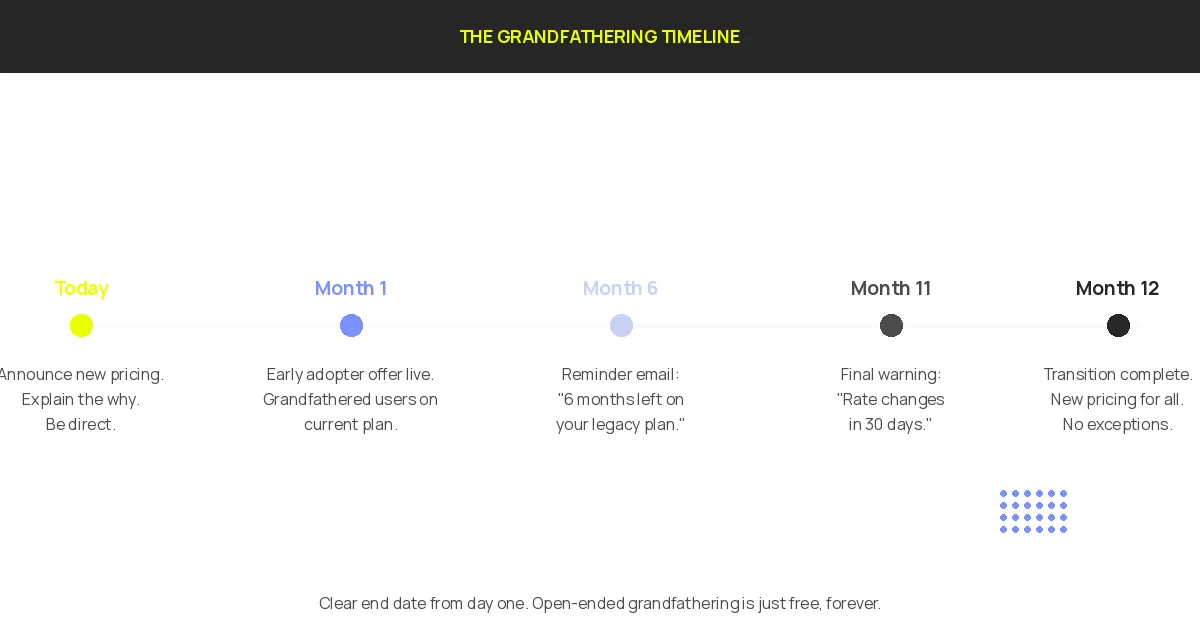
What this looks like in practice:
"As of [date], we're introducing a new analytics tier. Existing customers will stay on their current plan through [date – typically 12 months out]. After that, the new pricing applies to all accounts."
A few things make this work:
- The end date must be specific. "We'll grandfather you for a while" is not grandfathering. It's ambiguity. Ambiguity turns into entitlement. Set a date – 12 months is the standard – and hold it.
- Communicate it early, not late. The customers who feel blindsided are the ones who heard about the change two weeks before it happened. Give them a year. Give them quarterly reminders. Let them plan.
- Don't negotiate individual exceptions. One exception becomes the precedent. The account that screams loudest gets the deal. Instead of rewarding loyalty, you end up rewarding volume.
The upgrade move: monetize a better version
There's a more elegant approach that sidesteps the "paying for something I already had" objection entirely: don't charge for what exists. Charge for something better.
If you can time your pricing launch with a meaningful upgrade to the analytics experience – better self-service, AI-assisted exploration, proactive alerts, deeper export options – the conversation changes completely.
You're not telling customers "the thing you've had for free now costs money." You're telling them "we built something substantially better, here's what it costs, and you can stay on your current version for the transition period."
The iPhone analogy holds here: no one resents paying for a new iPhone because they had the previous model for free. The new version is clearly different. The question isn't "why should I pay?" – it's "what do I get?"
If you can make the same question possible in your transition, do it. It takes more product work, but it makes the commercial conversation much cleaner.
What to do with customers who push back
Some customers will push back. Some will push back hard.
Here's the counterintuitive thing: that's a good sign.
The customers who complain most loudly about being charged for analytics are almost always the ones using it most. They built workflows on top of it. They've embedded it into their team's process. They can't imagine their work without it.
That's not an angry customer. That's a customer who just told you your analytics is essential to them.
Handle these conversations individually and carefully:
- Acknowledge the change is real. Don't minimize it. "I understand this is different from what you've been used to" goes further than "this is actually a great deal."
- Explain the why. If the pricing allows you to invest more in the product, say so. Customers who use analytics heavily tend to want it to get better – they often respond well to "this is how we fund the roadmap."
- Hold the line. You can be empathetic and firm at the same time. Making exceptions for vocal accounts signals to the rest of your base that pushing back gets results. It won't stop with one account.
The segment you should actually worry about
The customers most likely to churn over analytics pricing are the ones who barely use it. They see a new line item, don't associate it with strong value, and decide it's not worth it.
But here's the thing: if they're barely using it, you weren't getting much signal from that usage anyway. And they were probably under-paying relative to your more engaged accounts.
The customers who use your analytics heavily almost always find a way to make it work. They may negotiate, they may push back, they may ask for a brief extension – but they don't leave over something they use every week.
Invest your transition energy in the heavy users. That's where the conversation actually matters, and that's where you'll learn the most about what your analytics is actually worth.
A checklist for the transition
Before you flip the switch:
- Define the grandfather period and communicate it as a specific date from day one
- Segment your existing users by analytics usage – know who your heaviest users are before the announcement lands
- Have a clear upgrade path with real product improvement, not just new packaging
- Prepare your customer success team with a consistent script for pushback conversations
- Set a firm policy on exceptions before you get the first request (not after)
- Plan a reminder cadence – announce, 6-month reminder, 90-day warning, 30-day warning
The transition from free to paid is almost always harder emotionally than it is commercially. Most customers adapt. Most accounts stick. But the ones who feel blindsided or mishandled become the ones who churn, and the ones who tell other people why they left.
Handle it with transparency, a clear timeline, and genuine respect for the relationship you've built.
That's the whole job.
Luzmo helps teams build, embed, and monetize analytics inside their product. If you're in the middle of this transition – or thinking about starting it – we'd be glad to help you think it through.
Written by

Ship the future of your data
Let us show you what Luzmo can do for your product.

Book your session with our analytics expert.