Why Giving Analytics Away for Free Is Costing You More Than You Think
There's a pattern that shows up across SaaS companies with some regularity. Strong product. High NPS. Growing usage. And then someone asks: what are you actually charging for the analytics?
Long pause.
The answers that tend to follow are remarkably consistent: It's included in the plan. We're planning to monetize it later. Our customers wouldn't pay for it.
That last one is almost always an untested assumption dressed up as market intelligence. But even the first two answers carry a cost that most product and revenue teams significantly underestimate.
Free Is Not a Neutral Decision
When you include analytics in a plan without pricing it, you're not giving customers a bonus. You're making a quiet strategic choice — one that compounds over time in ways that aren't immediately visible on any dashboard.
Here's how Karel Callens, CEO of Luzmo, frames it: if analytics isn't priced, it doesn't become a revenue generator. And because it doesn't generate revenue, it doesn't get the attention, investment, or prioritization it needs to become genuinely great. It stays good enough. It sits on the roadmap. It gets bumped when something more urgent comes up.
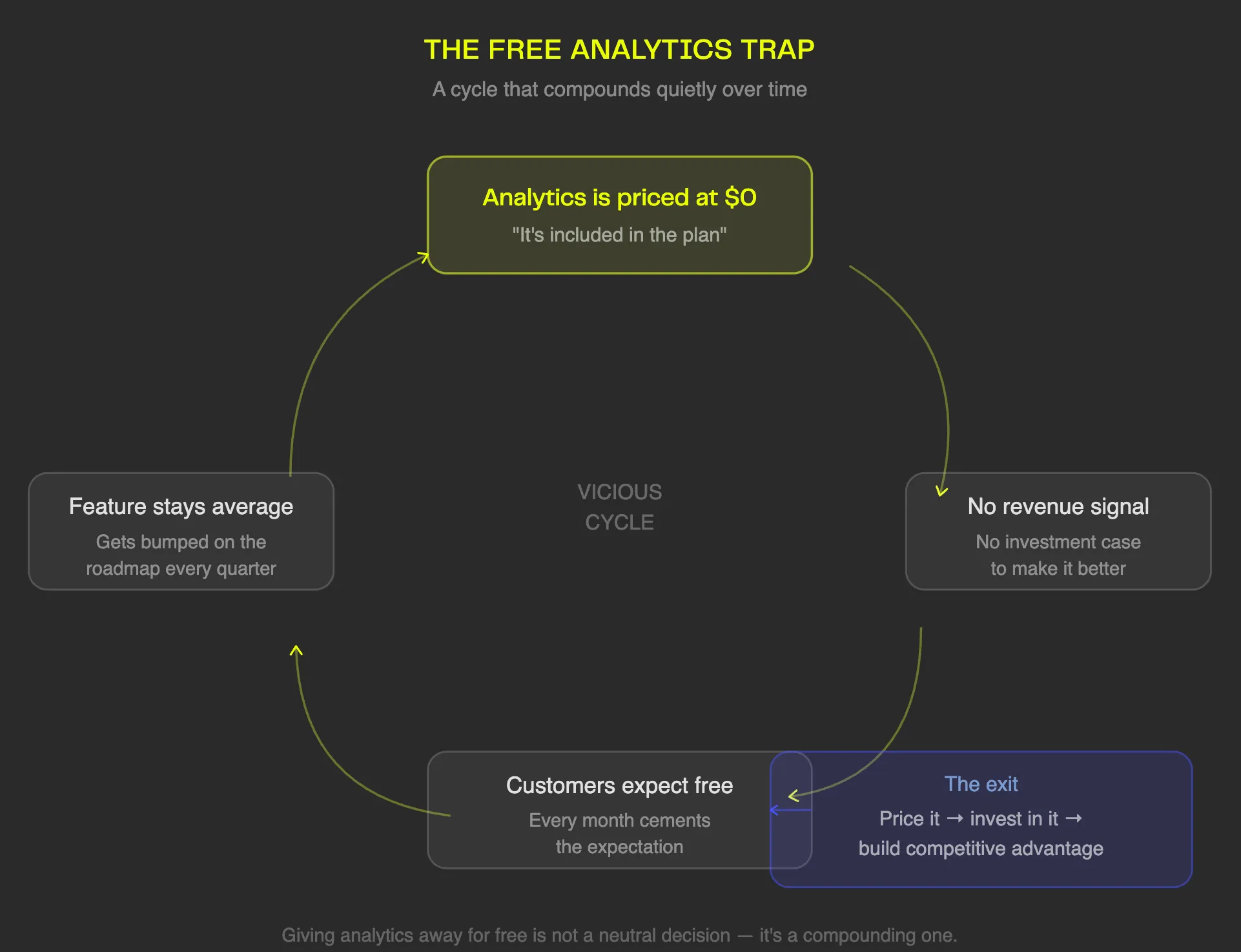
That's not a product problem. It's an incentive problem.
What You're Actually Paying For
The irony of "free" analytics is that it's never actually free — not for you, and not for your customers.
Your customers are already paying for it. It's baked into your pricing whether they realize it or not. The question is whether the value they're getting from it matches what they're implicitly paying. In most cases, it doesn't — because without dedicated revenue attached to the feature, there's no business forcing function to make it better.
And on your side, the engineering time, data infrastructure, maintenance, and iteration cycles that go into analytics cost real money. When none of that cost is recovered through pricing, you're essentially subsidizing a feature that could be a revenue driver without any mechanism to grow it.
The Attention Problem
Here's what makes this genuinely damaging rather than just suboptimal: the companies that do price their analytics — even modestly — end up with a fundamentally different product.
When there's money tied to a feature, teams spend time and effort researching what customers actually want from it. They build specifically. They iterate based on real usage signals tied to real willingness to pay. They build something worth paying for, which means they build something that creates competitive advantage — because not everyone is doing that work.
Pricing analytics forces quality. It turns a passive feature into a deliberate product investment. And that investment, compounded over 12 or 24 months, is the gap between your analytics layer and your competitor's.
The Customer Expectation Problem
There's a second-order effect that's harder to fix once it sets in.
Every month you give analytics away for free, you're training your customers not to pay for it. That expectation — analytics is just included — becomes load-bearing. It gets built into their evaluation criteria, their budget planning, their internal conversations about your product. When you eventually try to price it, you're not introducing a new paid feature. You're renegotiating an implied agreement.
That's a much harder conversation than pricing it correctly from the start.
The Competitive Clock
Analytics is becoming table stakes in most B2B SaaS categories. What differentiates you today — better interactivity, proactive alerts, self-service exploration, AI-powered insights — will be baseline expectations within 24 months.
The window to build a defensible analytics layer that customers associate real value with, and pay for accordingly, is open right now. It won't stay open indefinitely. The companies moving early on analytics monetization are setting the reference point for what customers in your category expect to pay for. Once that reference point is established by a competitor, the conversation changes.
What Pricing Analytics Actually Does
Priced analytics get maintained. They get improved. They get resourced. Teams ask harder questions about what customers actually use, what they would miss, what they would pay more for.
The result isn't just additional revenue — though that's real and material. It's a feature that gradually becomes central to your product's value proposition, instead of floating somewhere in the background.
Giving analytics away for free doesn't make your product more valuable to customers. It just makes it harder to capture the value that's already there.
Luzmo is an embedded analytics platform built for software teams who want to turn their analytics layer into a product customers pay for — not a feature they forget about. See how it works →
Written by

Ship the future of your data
Let us show you what Luzmo can do for your product.

Book your session with our analytics expert.