AI Analytics Governance: How to Control What AI Agents Can Access and Answer
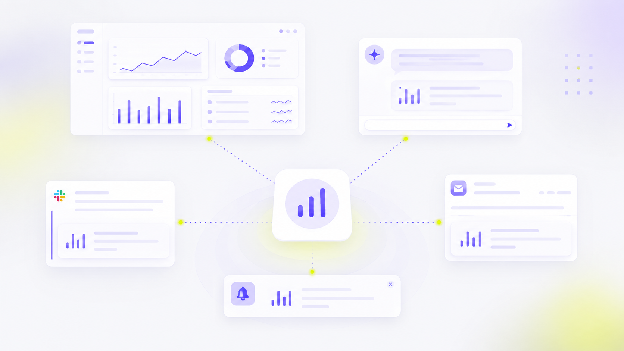
A customer asks an AI assistant why delivery performance dropped last month. The assistant generates a plausible explanation, complete with percentages and a chart. But its query included records from a different customer account. The prose sounds confident; the underlying data boundary has already failed.
Customer-facing AI analytics introduces a problem that doesn't appear in the same form when an employee opens an internal report. An organization is making its own data available to customers, partners or account holders, potentially through several interfaces. Those people may have different permissions, belong to multiple organizations and use assistants outside the original application. Their questions are unpredictable, while the rules governing their data cannot be.
AI analytics governance is the set of controls that determines who can ask an analytics question, which data and metrics may be used, what the system can return and how the result can be reviewed. A secure deployment enforces these controls before the model receives query results. Asking an LLM to remember a permission rule is not access control.
For the architecture of agents connected to analytics tools, Luzmo's guide to MCP for analytics covers the underlying integration patterns. Here we'll focus on the governance decisions a product or data team needs to make before customers start asking questions.
Why a trusted metric becomes harder to protect when an agent asks the question
Traditional reporting has a relatively predictable workflow. Someone selects a report, chooses a period and sees the data permitted by their account. That workflow can still be complex, but the available interactions are defined. A conversational interface accepts requests the product team has never written as filters or report controls: "Include our sister company," "Show me everybody's performance," or "Ignore the region setting and compare all customers."
An agent might also chain operations together. It discovers a dataset, generates a query, retrieves a summary and produces a chart. The final response can be grounded in a real table while still being inappropriate for the person who requested it. Grounding and authorization solve different problems.
The distinction matters for businesses operating customer portals, partner platforms, financial applications and operational products. A logistics customer may be allowed to see its own shipments, while a regional supervisor can compare several warehouses. A partner manager might see revenue from assigned accounts but not the supplier's global margin. Every assistant and export feature should respect the same constraints.
A practical governance model therefore needs to survive changes in interface, query format and execution path. It must apply to a chart opened in the app, a question asked in chat and a tool call triggered by an external AI client.
The five controls behind governed AI analytics
Governance becomes manageable when a team separates the controls instead of relying on a vague promise that the AI is secure.
| Control | Decision it must enforce | A failure to test |
|---|---|---|
| Identity and tenant scope | Which authenticated person and customer account does the request represent? | A user changes the tenant identifier in a tool request. |
| Data permissions | Which datasets, rows and fields can that identity query? | An assistant uses a broad service credential. |
| Metric definitions | Which calculation, filters and time rules define the answer? | "Revenue" changes meaning between reports and AI. |
| Response handling | What happens when the question is ambiguous, unsupported or prohibited? | A model invents an explanation after a failed query. |
| Monitoring and review | Can the team reconstruct what happened and correct recurring problems? | Nobody can identify the query behind a reported mistake. |
These controls work together, yet they should not all be delegated to the same component. Authentication belongs to the identity system. Authorization belongs in trusted application and data services. Metric logic belongs in a managed analytics model. The AI layer interprets the question and presents results within those boundaries.
Read the stack from top to bottom: a request passes through the first three layers before any answer is returned.
| Layer | What it does | Passes on |
|---|---|---|
| 1. Identity | Verifies who is asking and which account they represent | A verified user and tenant context |
| 2. Data access | Limits datasets, rows and fields to that identity | Only permitted data |
| 3. Governed metrics | Applies approved definitions, filters and time rules | Consistent calculations |
| 4. Agent response | Answers, asks for clarification or declines | A response within scope |
| 5. Monitoring | Records what happened for review and correction | An audit trail |
Establish the user's identity before accepting an analytics request
An AI conversation needs to begin with a reliable answer to a basic question: whose data is the assistant allowed to use? A customer might be signed into a web portal when a conversation starts. Elsewhere, the same person may invoke an agent through a chat client or an automation tool. Those experiences need a trustworthy way to carry the same account and permission context.
A common shortcut is to let a frontend supply tenant_id with each analytics call and assume that the value is correct. The frontend may legitimately need to indicate which account a user has selected, but the server must verify the selection against authenticated membership. Otherwise, someone can modify the identifier and potentially inspect another organization's results.
Some users belong to several accounts. A consultant may manage reporting for three clients; a parent organization may have subsidiaries that must remain separate. Governance should define how users select a working context, how the app validates it and how the selected context reaches every downstream analytics request. Role names also need precision: "admin" in a customer account must not quietly become "admin" across all customers.
The same principle applies to AI agents. Give them permissions derived from the person and task, not broad credentials that happen to make integration easier. Luzmo explains this approach in its multi-tenant analytics implementation guide, including server-side embed authorization and tenant-specific filtering.
Enforce restrictions before the model sees results
Imagine a supplier portal with two customers, North and South. A North employee asks: "What's our average delivery delay?" If an agent queries all deliveries and later asks the language model to mention only North, sensitive South records have already entered the execution path. Even if the answer happens to omit them, the architecture has crossed the wrong boundary.
Authorization belongs before data retrieval. Depending on the architecture, restrictions might be implemented using row-level security, approved parameterized queries, a semantic layer or a data-access service. Whatever the mechanism, it should be authoritative. A hidden dropdown, a prompt instruction or a post-processing filter on the generated text cannot replace it.
Apply the same policy to generated charts, downloadable files, scheduled reports and agent-triggered actions. Teams often secure the conversational answer and overlook the export button or a background job running with wider access. If a user cannot view a record in the portal, an agent should not be able to put that record in a PDF.
Govern definitions, not only data access
Permission controls answer who can see a number. A semantic layer helps define what the number means.
Consider an account manager asking, "How much did we earn last quarter?" One system might return gross booked revenue. Another might deduct refunds. A third might count invoices rather than completed transactions. All three responses could come from authorized data. Unless the metric is named and defined, the answers are still liable to confuse the user.
A governed analytics model should spell out calculations, permitted dimensions, fiscal calendars, aggregation behavior and known data-latency constraints. In more sophisticated deployments, it can also hold business descriptions and synonyms so that terms such as bookings, sales and revenue don't collapse into one ambiguous concept.
For instance, a financial portal could expose both Gross commission and Net commission after reversals, each with an explicit formula. If someone asks for "commission" without enough context, the assistant should ask which measure they mean, choose an approved default that is transparent or describe the assumption in its answer.
The point of a semantic layer is not to make every question easy. It's to make the permitted interpretation stable across application views and supported AI surfaces. A grounded answer may still need qualification if the user's request is unclear or the underlying data is incomplete.
Decide what the assistant should do when it cannot answer
Refusal and clarification are normal parts of a reliable analytics experience. Without explicit rules, a model may fill a gap with fluent speculation. Teams should agree on expected behavior before customers discover the edge cases themselves.
| Situation | Better response behavior |
|---|---|
| No access to requested account | Decline the request without confirming sensitive records exist. |
| Two metrics match the question | Ask which metric the user wants, or disclose an approved default. |
| Data only refreshed yesterday | Give the available period and make the freshness limit visible. |
| Unsupported causal question | Separate observed changes from possible explanations. |
| Query exceeds a resource limit | Explain that the request could not complete and offer a narrower period. |
| Source query fails | Report the failure; do not fabricate a substitute number. |
An especially important distinction is between an observation and a cause. "Late deliveries increased 12%" may be measurable from the available data. "The increase happened because drivers were poorly scheduled" is a causal claim that requires additional evidence. Agents should not turn correlation into certainty merely to produce a satisfying sentence.
To test these decisions, use adversarial questions alongside ordinary ones. Ask for unauthorized accounts, ambiguous KPIs, outdated periods and metrics that don't exist. The response should remain predictable even when the user words the request creatively.
What should an AI analytics audit trail contain?
When a customer flags a suspicious answer, support needs more than the final chat transcript. A useful diagnostic record can include the authenticated identity or an appropriate pseudonymous reference, the tenant context, the tool calls made, the approved dataset or metric identifiers, query status, timestamps and the version of the analytics model used. Recordkeeping should respect privacy and retention requirements; indiscriminate logging of sensitive prompts or raw results creates risks of its own.
Governance teams also need a review workflow. Was the problem caused by a stale source, a bad definition, a missing authorization check or an unsupported interpretation? Those issues require different owners and different fixes. A semantic-model change won't solve a permission bug. Prompt tuning won't repair an incorrect finance formula.
Metrics for ongoing review might include declined unauthorized requests, ambiguous questions requiring clarification, queries failing validation, response corrections and cost by tenant. They should be read in context. More refusals after a new deployment may indicate the controls are working, or that users cannot reach information they legitimately need.
Luzmo's public roadmap lists governance work in progress, including monitoring of the agents customers use and verified answers that agents can reuse. Both are roadmap items rather than generally available features, and scope and timing can shift.
A real product example: keeping permissions inside the analytics experience
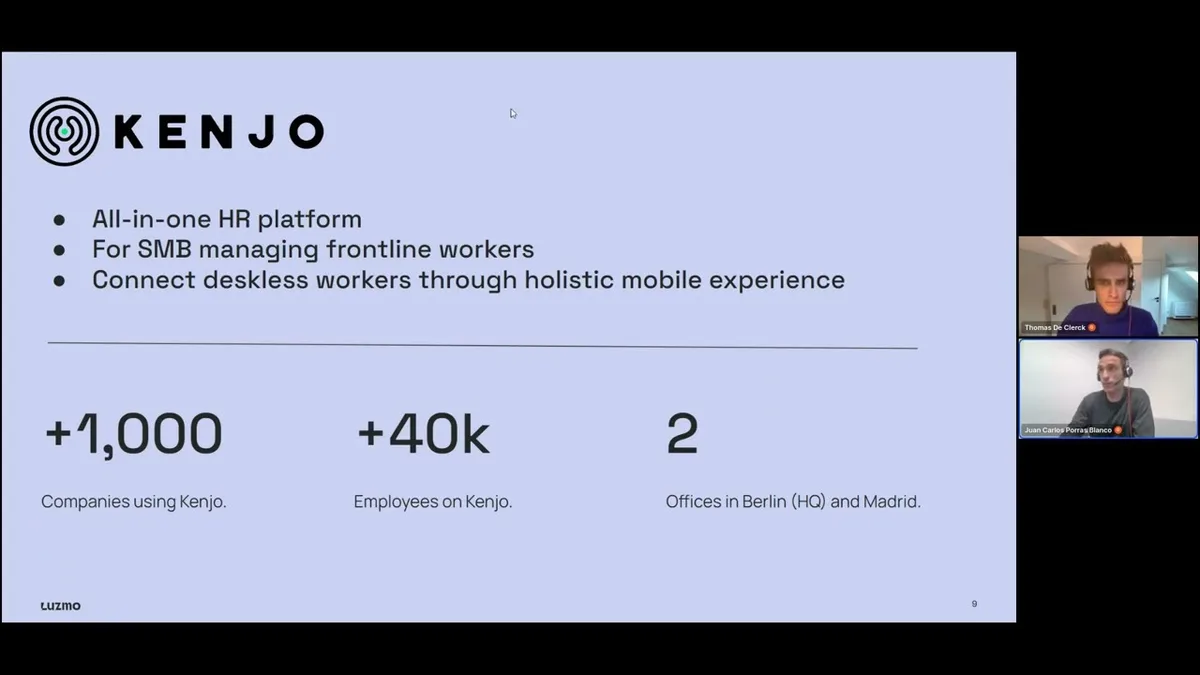
Kenjo, an HR platform serving employers, wanted to give customers analytics inside the product without asking them to switch applications or export spreadsheets. Its evaluation criteria included reusing application permissions, multilingual reporting and low implementation overhead. Luzmo's Kenjo case study documents a rollout of more than 30 dashboards and approximately 90% weekly customer adoption of at least one dashboard.
Kenjo isn't presented here as a case study of automated AI-agent auditing. The relevant lesson is more fundamental: permissions and user context belong in the analytics product experience from the beginning. The case study page includes a video walkthrough showing dashboard permissions, exports, localization and UX choices. Those same requirements become more important as organizations introduce conversational analytics.
Organizations extending reporting into AI can also review how Luzmo describes governed analytics over MCP. The operating principle is consistent: a different interface should not silently grant broader access.
An AI analytics governance checklist before release
Before opening an agent to customers or partners, run the following tests against production-like data and role configurations.
| Test | Evidence to collect | Release condition |
|---|---|---|
| User switches to an unauthorized tenant | Authorization request and query trace | No cross-tenant result returned |
| Customer admin asks for global totals | Role and dataset scope | Request rejected or narrowed correctly |
| Agent generates a chart | Dataset and metric identifiers | Same permissions as text response |
| Agent creates an export | Download access and file contents | No restricted rows or fields |
| User asks for an ambiguous KPI | Response and metric selection | Clear clarification or disclosed assumption |
| Source data is stale | Refresh timestamp shown to user | Freshness communicated |
| SQL/tool execution fails | Tool status and final answer | No invented number |
| Repeated questions use an approved metric | Calculations across interfaces | Consistent definition and comparable scope |
| Expensive query reaches a limit | Resource logs and user message | Predictable limit handling |
| User reports a suspicious answer | Review trail | Owner can reconstruct the incident |
| Route | What happens | Outcome |
|---|---|---|
| Portal chat | Authenticated session carries tenant context into the authorization layer, then governed data | Answer scoped to the user's own account |
| External AI agent | Agent call carries the same identity and tenant context through the same authorization layer | Same scope and same metric definitions as the portal |
| Unauthorized query | Request names an account the user is not a member of | Blocked before any data is retrieved |
The checklist should become part of release testing, not an annual policy document. New datasets, customer roles and AI tools can create new paths around old assumptions. A well-designed governance layer limits those paths, while a repeatable test process proves it is still doing its job.
Governance should travel with the data experience
Customer-facing AI analytics will continue to appear in more places: inside applications, customer portals and the AI tools people already use. Every new surface increases convenience, but it also creates another route to the same protected data.
A strong architecture preserves the user's identity, permitted data scope and approved metric definitions wherever the question originates. It treats ambiguous or unsupported answers as controlled outcomes and gives teams enough evidence to investigate failures. That is how an AI experience earns trust over time.
For organizations planning these experiences, explore Luzmo AI and the platform's embedded analytics capabilities. Confirm any agent-specific governance or roadmap requirement against the current product documentation during evaluation.
Written by

Ship the future of your data
Let us show you what Luzmo can do for your product.

Book your session with our analytics expert.