7 Best Knowi Alternatives in 2026 for Embedded and Multi-Source Analytics

Knowi is not a lightweight dashboard tool.
In 2026, it covers a wide surface: SQL and NoSQL analytics, REST APIs, embedded dashboards, white-labeling, multi-tenancy, natural-language querying, private AI, document analytics and cloud, hybrid or on-premise deployment.
That makes Knowi unusually broad.
It also means the best alternative depends on what you actually need from the platform.
A SaaS team building customer-facing analytics may care most about native product UX and fast deployment. A regulated company may prioritize private AI and on-premise control. Another team may want the broadest possible embedded SDK, a lower starting price or a simpler fit for a cloud warehouse.
The 7 best Knowi alternatives in 2026 are:
- Luzmo: best overall for native customer-facing embedded analytics
- Sisense: best for complex enterprise embedded deployments
- GoodData: best for governed analytics and deployment flexibility
- DataBrain: best for flat-rate embedded analytics with developer-friendly components
- Metabase: best for an open-source starting point and lower-cost BI
- ThoughtSpot: best for search-first and agentic analytics
- Explo: best for customer-facing dashboards, reporting and data sharing
Knowi alternatives at a glance
| Tool | Best for | Embedded-first? | Public pricing? | AI capabilities |
|---|---|---|---|---|
| Luzmo | Native customer-facing analytics inside SaaS products | Yes | Yes | Luzmo AI + Luzmo IQ |
| Sisense | Enterprise embedded analytics, regulated industries and complex deployments | Strong embedded focus | Mostly custom | Sisense Intelligence + BYO LLM |
| GoodData | Governed enterprise analytics and multi-tenant deployments | Strong embedded focus | Sales-led | AI Assistant, Agents and governed AI |
| DataBrain | Fast product embedding with flat platform pricing | Yes | Yes, from $999/month | AI-powered reports, agents and MCP |
| Metabase | Open-source BI and accessible paid embedding | No, BI-first with embedding | Yes | AI querying and embedded AI |
| ThoughtSpot | Search-first, agentic analytics at scale | Internal + embedded | Yes for some tiers; Enterprise custom | Spotter AI Agents |
| Explo | Embedded dashboards, self-service reporting and data sharing | Yes | Yes, Pro from $1,995+/month | AI-powered reports and GenAI |
Why look for a Knowi alternative?
Knowi is a capable platform, especially when your data does not fit neatly into one modern cloud warehouse.
Its strongest differentiator is breadth: SQL, NoSQL, APIs and documents can all sit in the same analytics environment, often without a separate ETL project.
But not every company needs that breadth.
The starting price may be high for smaller product teams
Knowi currently says pricing starts at $20,000 per year.
Its embedded analytics plan uses custom annual pricing and includes a baseline of internal and embedded users, with pricing scaling as the embedded user count grows.
For an enterprise buyer, that may be reasonable.
For an early-stage SaaS company trying to validate a new analytics feature, it can be a significant commitment before usage is proven.
This is where alternatives with lower published entry points can be easier to pilot.
Luzmo, for example, publishes embedded analytics pricing starting at €1,995 per month, billed annually. DataBrain advertises flat pricing from $999 per month. Metabase Pro starts at $575 per month plus user fees.
The cheapest option is not automatically the best one. But the commercial model matters when analytics are still becoming part of your product.
You may not need a platform built around every type of data source
Knowi is particularly strong when data is fragmented.
It can connect directly to SQL databases, MongoDB, Elasticsearch, APIs and documents, then join across sources without forcing everything into one warehouse first.
That solves a real problem.
But many modern SaaS products already centralize analytics data in Snowflake, BigQuery, Databricks, ClickHouse or another warehouse.
If your product data is already modeled and accessible in one place, the "no ETL across everything" advantage may be less important than:
- how fast your team can build the customer experience
- how deeply analytics fit the product UI
- how easy self-service is for end users
- how pricing behaves as customers adopt analytics
In that scenario, a more focused embedded analytics platform can be easier to evaluate and operate.
Knowi offers several embedding paths, but they solve different problems
Knowi supports iframe embedding, a JavaScript SDK and REST APIs.
That is a solid range.
An iframe is the fastest path. The JavaScript SDK gives developers more control over filters, events and interactivity. The REST API can support a completely custom analytics UI.
The trade-off is common across embedded analytics platforms: the more custom the final experience becomes, the more work your own engineering team tends to own.
If you want a highly branded dashboard, an iframe or SDK may be enough.
If you want individual analytics elements distributed across workflows, cards, pages and product states, compare how each vendor handles component-level composition.
Luzmo's composable analytics, for example, is designed around building with individual analytics components rather than treating the full dashboard as the default unit.
The question is not simply "Does it have an SDK?"
It is: how much of the final analytics experience does the platform give you before your own frontend team has to take over?
Knowi's AI breadth may be more than some teams need
Knowi has invested heavily in AI.
Its current stack includes Agentic BI, dashboard and query agents, natural-language analytics, document AI, anomaly detection, embedded agent chat and private AI deployment.
For regulated companies or teams combining structured data with documents, that breadth is compelling.
A smaller SaaS product may have a narrower requirement.
Maybe users only need to ask questions about a governed dataset and get a trustworthy visual answer inside the application.
In that case, a more focused conversational analytics layer may be easier to roll out and explain.
Luzmo IQ, for example, sits directly inside the customer-facing analytics experience instead of requiring the product team to adopt a broader AI analytics platform.
Per-user scaling deserves a close look
Knowi's embedded plan scales with embedded user count.
That is not inherently a problem. Many analytics vendors use user-based, viewer-based or usage-based pricing.
But customer-facing products can behave differently from internal BI.
You may have thousands of provisioned users, hundreds of active users and only a smaller group that builds or edits analytics. A pricing model that looks simple at launch can change materially as adoption grows.
Before choosing Knowi or any alternative, model your expected economics at:
- 100 active users
- 1,000 active users
- 10,000 active users
- multiple tenants with different adoption levels
For more context on the category, see Luzmo's guide to the best embedded analytics tools.
How much does Knowi cost?
Knowi currently says its pricing starts at $20,000 per year.
The company does not publish one fixed price for every use case. Instead, it separates plans around different deployment needs.
Its embedded analytics offer is a custom annual license designed for SaaS companies building white-labeled, multi-tenant analytics into their products.
The current plan description includes:
- 20 internal + 100 embedded users as the starting package
- SSO embedding
- full white-label and OEM licensing
- multi-tenant data isolation
- AI analytics, NLQ, NLG and machine learning
- private AI options
- cloud, on-premise or hybrid deployment
Pricing scales with embedded user count and deployment type.
Knowi also offers separate positioning for internal analytics and regulated industries.
That makes direct price comparisons difficult unless you model the same scenario across vendors.
Ask every provider to quote the same setup: number of tenants, active end users, internal builders, environments, deployment requirements, AI usage and expected growth.
How we evaluated Knowi alternatives
We compared these platforms on the criteria that decide a multi-source or embedded analytics choice:
- Source connectivity. SQL, NoSQL, REST and document stores, and whether joins across them are native or need a pipeline first.
- ETL requirement. Whether the tool queries sources directly or expects modelled warehouse data.
- Deployment model. Cloud, on-premises or hybrid, since Knowi buyers often shortlisted it for exactly this.
- Embedding method. Secure iframe, JavaScript SDK or encrypted URL, plus tenant isolation and SSO.
- Pricing structure. Annual contract minimums versus monthly platform fees, and where user allowances cap out.
Research date. Product and pricing facts were checked against current vendor documentation on August 5, 2026.
Our bias, stated plainly. Luzmo builds embedded analytics and competes with Knowi on customer-facing product analytics. We don't compete with it on direct NoSQL and API connectivity, which is genuinely its strongest card. If querying MongoDB and a REST API in one join is your requirement, Knowi does something most of this list can't, and we say so below rather than pretending otherwise.
Direct NoSQL versus warehouse-first tools
This is the distinction that makes Knowi comparisons awkward, and it's worth being explicit because it means not every embedded analytics platform is a real substitute.
Direct multi-source tools query your sources where they live. Knowi connects to SQL, NoSQL and REST/API sources and promotes cross-source analysis without a mandatory ETL step. If your operational data sits in MongoDB, your events in Elasticsearch and your billing in a REST API, that removes an entire pipeline project from your roadmap.
Warehouse-first tools assume the modelling work already happened. They expect Snowflake, BigQuery, Databricks or Postgres with clean tables behind it. That assumption is why they can be simpler, faster and cheaper, and it's also why swapping one in for Knowi can quietly add a data-engineering project you hadn't budgeted.
The honest framing: Knowi can query and join multiple sources without making ETL mandatory. That's not the same as ETL being pointless. For many teams a warehouse is still the right destination, and paying for direct connectivity you don't need is waste. But if you shortlisted Knowi specifically because your data isn't consolidated, understand that most alternatives on this list solve a different problem, and consolidating first is the hidden cost of switching.
Two adjacent categories worth knowing. If the real goal is analytics your customers use inside your product, the DataBrain alternatives for embedded product analytics are the tighter comparison set. And if what you actually need is internal database exploration and admin tooling rather than customer-facing analytics, the Basedash alternatives for internal data tools are a better starting point than any platform here.
Best alternatives to Knowi
1. Luzmo: best overall Knowi alternative for customer-facing embedded analytics
Knowi is broad.
Luzmo is more focused.
If your main job is to put analytics inside a SaaS product and make the experience feel like something your own team shipped, that focus can be an advantage.
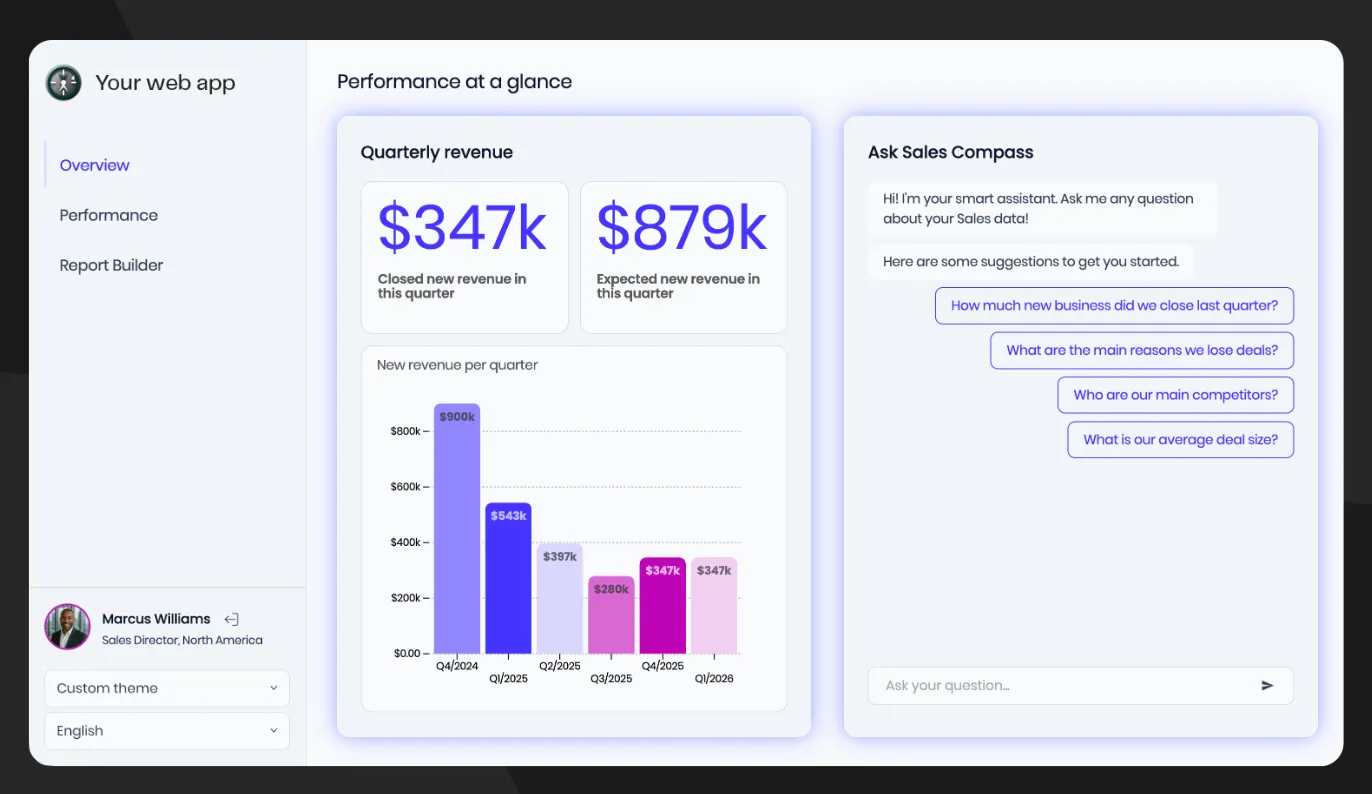
Luzmo combines visual dashboard building, embedded self-service, multi-tenant controls, APIs, SDKs, composable components and conversational AI around one primary use case: customer-facing analytics.
Start from the product experience
Knowi can serve internal teams, regulated deployments, multi-source analytics, document AI and embedded products from one platform.
Luzmo starts from a narrower question:
What does your end user need to see and do inside your application?
Product teams can build dashboards visually, connect them to customer data and embed them without first designing a larger BI architecture.
That is useful when analytics are one product capability among many.
Your team can ship the first experience quickly, then add deeper customization as the feature matures.
Self-service without sending customers to a separate BI environment
Customer-facing analytics often starts with dashboards and ends with requests.
"Can I change this breakdown?"
"Can I save my own view?"
"Can I build a dashboard for my team?"
If every request returns to your support or data team, analytics do not truly scale.
Luzmo's self-service analytics lets end users create and adapt their own analytics inside the host product while staying inside the permissions you define.
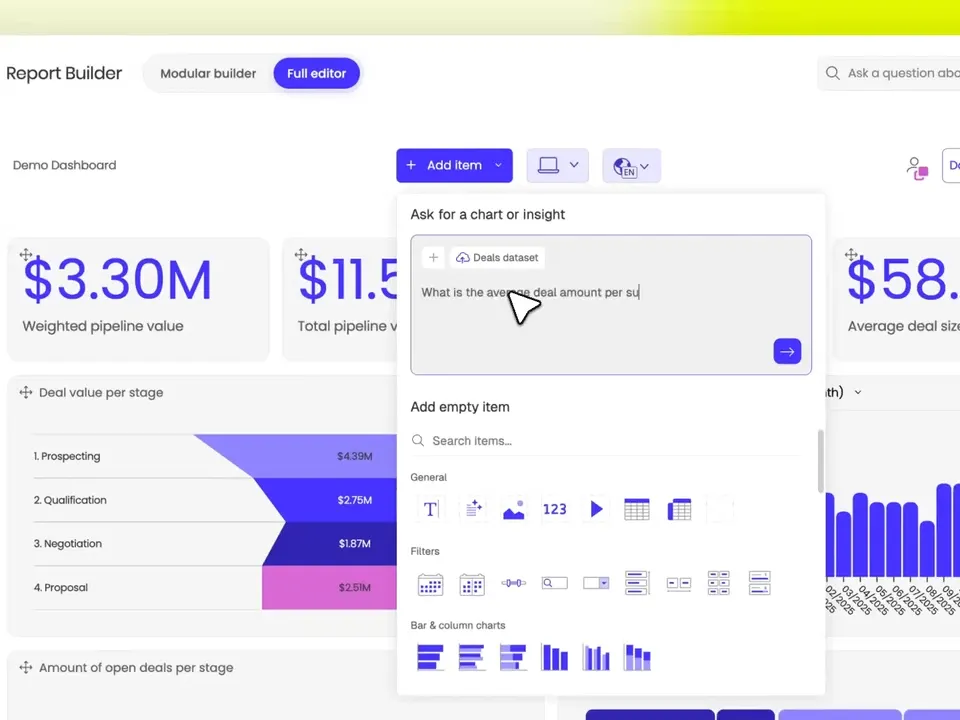
For multi-tenant SaaS, this works alongside tenant-aware governance so each customer can explore its own data without exposing anyone else's.
Luzmo's guide to multi-tenant analytics explains how that model works at product scale.
Build below the dashboard level
Knowi's JS SDK and REST APIs give developers several ways to control an embedded experience.
Luzmo adds another model through composable analytics.
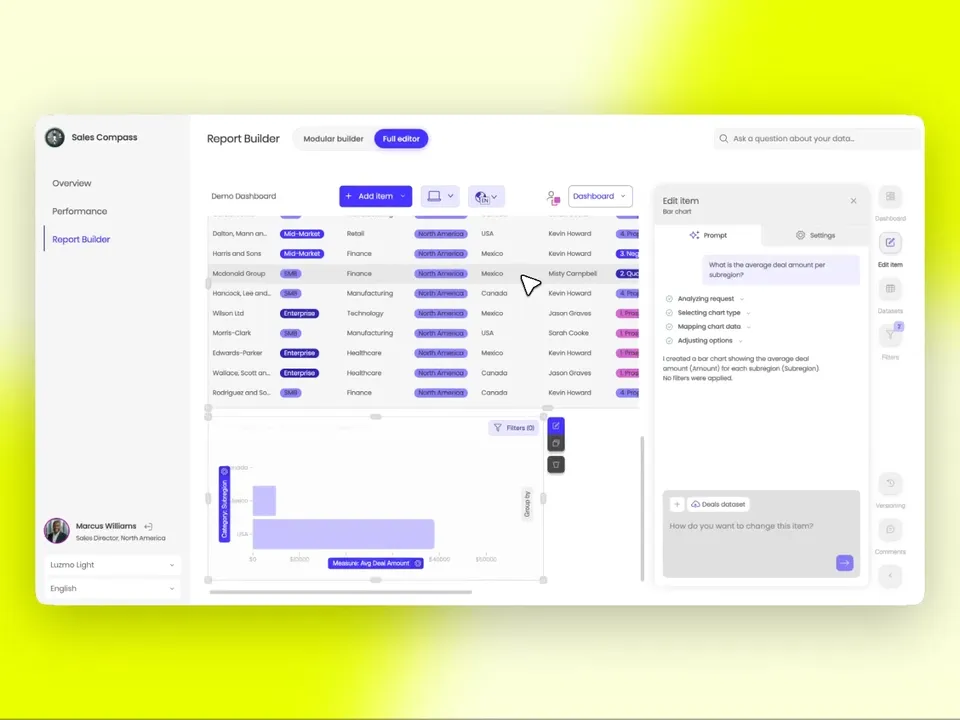
Instead of treating a dashboard as the main unit, developers can work with individual analytics components and integrate them into their own layouts.
A KPI can sit inside a workflow.
A chart can react to product state.
An analytics panel can follow the same component system as the rest of the application.
That is useful when "white-label" needs to mean more than changing colors and removing a vendor logo.
Read what composable analytics is for the deeper distinction.
AI that lives inside the analytics experience
Knowi has one of the broader AI feature sets in this comparison.
Luzmo takes a more focused embedded path.
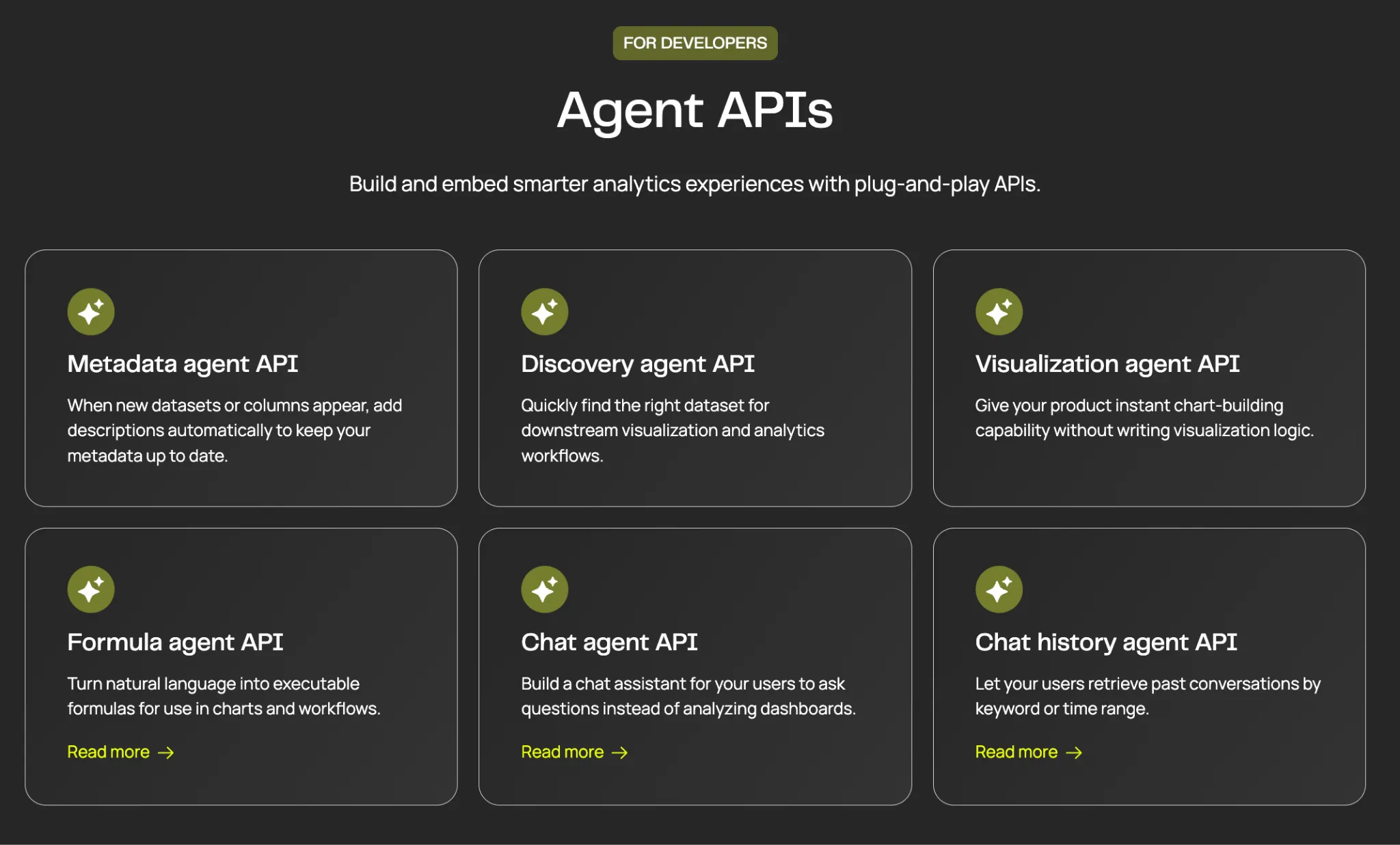
Luzmo IQ lets end users ask questions about governed data in plain language without leaving the product.
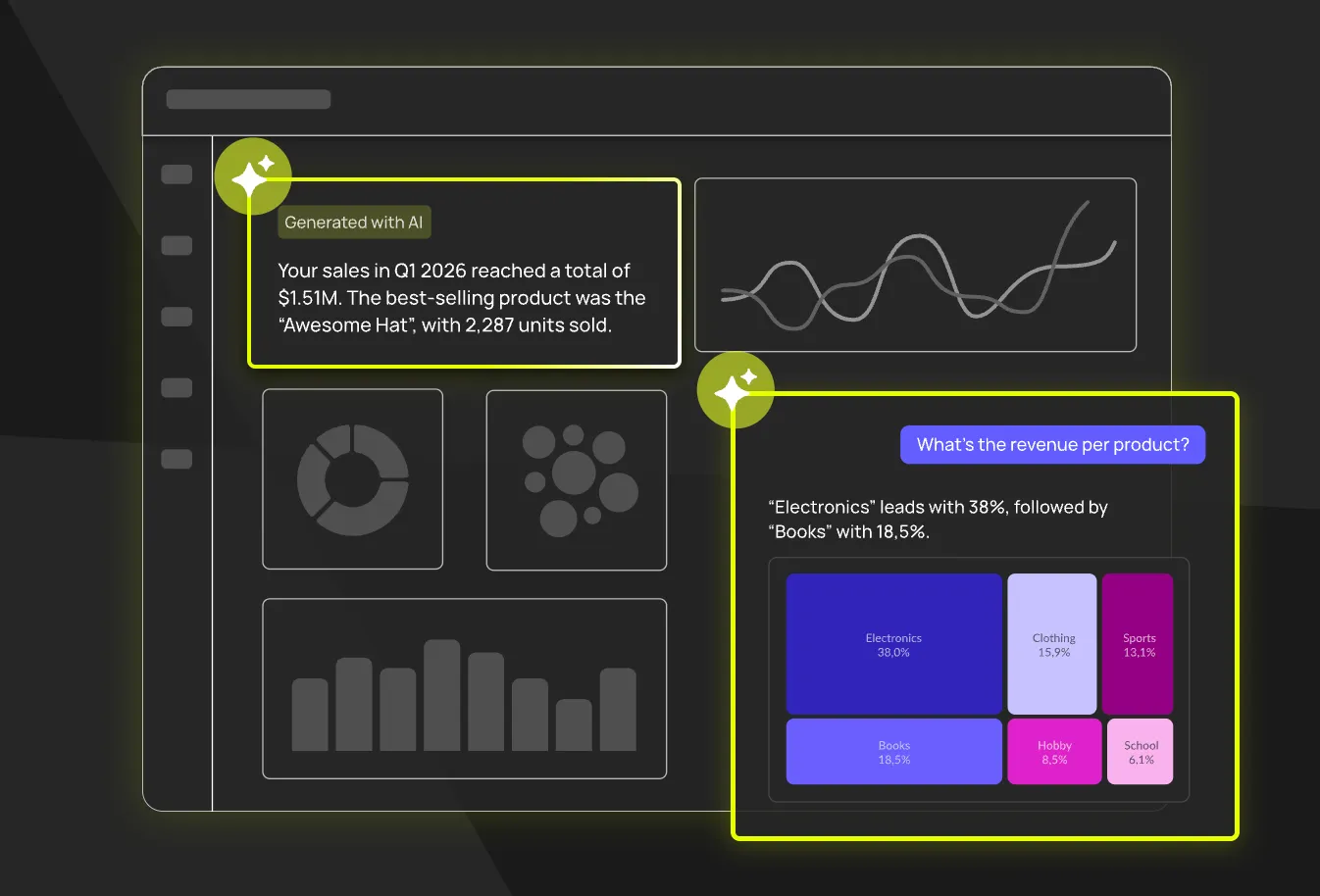
For a SaaS product team, the benefit is simplicity.
You do not need every customer to learn a separate analytics application. AI becomes another interaction mode inside the experience they already use.
Knowi may be stronger when you need a broader combination of structured data, documents, private AI and agentic workflows.
Luzmo is stronger when the goal is to make governed AI analytics feel native to a customer-facing product.
A lower published starting point
Luzmo currently starts at €1,995 per month, billed annually, on a single Embedded Everywhere plan combining a platform fee with adoption-based usage. Enterprise requirements change the deployment rather than the product feature set.
The model combines a platform fee with adoption-based usage.
That can make early-stage forecasting simpler for SaaS companies than a larger annual enterprise commitment.
See the current Luzmo pricing for the full breakdown.
Best for: SaaS product teams that want native customer-facing analytics, quick implementation, embedded self-service, composable UI and conversational analytics without adopting a broad internal BI platform.
2. Sisense
Sisense is one of the closest Knowi alternatives for complex enterprise embedding.
Both platforms support customer-facing analytics, white-labeling, multi-tenancy, AI and deployment options that go beyond a simple public SaaS environment.
Sisense's current Enterprise positioning is especially strong for regulated and high-stakes industries.
It supports SaaS, dedicated cloud and on-premise deployment, along with multi-tenant architecture, advanced security controls and bring-your-own-LLM options.
For developers, Sisense offers iframe embedding and Compose SDK.
That makes it a good fit for companies that want a mature embedded analytics vendor with a long enterprise track record.
The main trade-off is commercial and implementation weight.
Enterprise pricing is customized, and a large deployment can involve more procurement, modeling and technical setup than a smaller product team needs.
Luzmo's Sisense alternatives guide and direct Luzmo vs. Sisense comparison go deeper into the differences.
Best for: enterprises and regulated products that need complex embedded analytics, deployment flexibility, strong security and hands-on implementation support.
3. GoodData
GoodData is a strong Knowi alternative when governance and multi-tenant analytics are central to the decision.
Its platform combines a semantic layer, embedded analytics, APIs, AI and enterprise deployment controls.
GoodData Cloud supports embedded use with workspaces, custom domains and API access, while its enterprise options add more flexibility around deployment and governance.
The biggest difference from Knowi is data architecture.
Knowi leans heavily into querying many source types directly, including SQL, NoSQL, APIs and documents.
GoodData is more naturally evaluated as a governed analytics and semantic platform for organizations that want standardized metrics and repeatable analytics across many tenants.
That makes GoodData particularly relevant for larger B2B software companies.
The trade-off is complexity.
Like Knowi, it can become a platform-level decision rather than a lightweight embedded feature purchase.
See Luzmo's guide to GoodData competitors and the direct Luzmo vs. GoodData comparison.
Best for: larger SaaS companies and enterprises that need governed analytics, multi-tenant architecture and flexible deployment at scale.
4. DataBrain
DataBrain is a more focused embedded analytics alternative.
Its current positioning is built around shipping customer-facing dashboards, AI-powered reports and white-label analytics into a product quickly.
Pricing starts at $999 per month with a flat platform model and no per-seat fees advertised on its embedded analytics page.
That can be attractive for SaaS companies expecting a large external audience.
DataBrain supports web components and works across React, Angular, Vue, Svelte and plain HTML. Guest-token authentication handles user context, while tenant isolation and row-level security are built into the embedded model.
The platform has also expanded into AI and agent workflows, including MCP connections for external AI systems.
Compared with Knowi, the scope is narrower.
Knowi is stronger when the buyer needs broad direct connectivity across SQL, NoSQL, APIs, documents and private AI deployment.
DataBrain is easier to understand as a focused customer-facing analytics purchase.
That clarity can be useful for smaller product teams.
Best for: SaaS companies that want flat-rate embedded analytics, modern web components and a simpler product-focused alternative to a broad BI platform.
5. Metabase
Metabase is the strongest option on this list if open source and a low-cost starting point matter.
The open-source edition can be self-hosted for free.
For advanced embedding, Metabase Pro currently starts at $575 per month, with the first 10 users included and additional users charged separately.
Pro includes:
- multi-tenant embedded analytics
- row- and column-level security
- SSO
- white-labeling
- embedded AI capabilities
- modular embedding
Metabase now also has dedicated tenant functionality for SaaS use cases, making it much more capable for customer-facing analytics than older comparisons suggest.
The main difference from Knowi is data breadth and enterprise flexibility.
Knowi is much stronger when you need direct NoSQL analytics, private AI, document intelligence or on-prem/hybrid deployments as part of one commercial platform.
Metabase is a better fit when the team wants approachable BI, open-source optionality and a lower initial cost.
For more detail, read Luzmo's guide to Metabase alternatives.
Best for: startups and data teams that want open-source BI, a low entry point and a path into paid embedded analytics as requirements grow.
6. ThoughtSpot
ThoughtSpot is a strong Knowi alternative when AI-driven exploration is the center of the buying decision.
Its product is built around search, conversational analytics and agentic experiences.
ThoughtSpot Embedded lets product teams integrate dashboards, visualizations, natural-language search and Spotter AI Agents through APIs and SDKs.
Pricing now spans several models.
A Developer embedded tier is free for one year for small teams, while Enterprise embedded deployments use flexible custom pricing. ThoughtSpot also offers a startup program with flat annual pricing for eligible companies.
Compared with Knowi, ThoughtSpot is less differentiated around direct NoSQL and multi-source analytics without ETL.
Its edge is the AI and search experience.
If the primary user story is "customers should ask any question in natural language and explore from there," ThoughtSpot deserves a serious look.
If the primary problem is "we have SQL, MongoDB, Elasticsearch, APIs and documents and need one private analytics layer across all of it," Knowi may remain the stronger fit.
Read Luzmo's guide to ThoughtSpot alternatives or see the direct Luzmo vs. ThoughtSpot comparison.
Best for: product and enterprise teams that want search-first analytics, AI agents and natural-language exploration as the primary user experience.
7. Explo
Status note first. Omni announced its acquisition of Explo in October 2025. Omni's customer FAQ says the majority of Explo customers are expected to migrate to Omni during a roughly 12-month transition ahead of the planned sunset of the Explo platform, with existing pricing held through each customer's current contract. Explo hasn't shut down and current customers aren't stranded, but we wouldn't start a new embedded build on it today. Treat any current price as transitional.
With that caveat, Explo is another purpose-built embedded analytics option.
It focuses on customer-facing dashboards, self-service reporting, data exports and AI-powered reporting.
The workflow is product-friendly: connect databases, build interfaces and embed them inside the application.
Explo Pro is listed from $1,995+ per month, with tiered pricing that scales with customers, and Enterprise is custom.
One thing a new buyer has to factor in: Omni acquired Explo in October 2025 and announced a roughly 12-month migration period, with the Explo platform slated to be sunset after the transition. Existing customers keep access during that window, but anyone evaluating Explo today is really evaluating Omni as the long-term destination. Confirm current access, migration timing and commercial terms in writing before shortlisting it.
The platform also supports white-labeling and multiple data-sharing formats.
Compared with Knowi, Explo is a narrower tool.
It does not lead with the same broad "query anything without ETL" story across NoSQL, documents and private AI infrastructure.
That can be a limitation or an advantage.
For teams that primarily need polished analytics and reporting for customers, a narrower platform can be easier to evaluate and implement.
For teams with heterogeneous operational data and strict private deployment requirements, Knowi may offer more in one system.
Best for: SaaS teams that want customer-facing dashboards, reporting, exports and data sharing from a dedicated embedded analytics vendor.
How to choose the right Knowi alternative
Start with the reason Knowi made your shortlist.
There is one important question worth asking:
Is Knowi's data-source breadth solving a real problem for you?
If your analytics need to join MongoDB, Elasticsearch, SQL, REST APIs and documents without centralizing everything, Knowi has a genuine advantage.
Do not throw that away because another vendor has a prettier pricing page.
But if all your analytics already run from one governed warehouse, compare the products on the experience your customers will actually get.
That is where the differences become much clearer.
Best alternative by data architecture
Your architecture, not your budget, should drive this shortlist:
- Data spread across SQL, NoSQL and APIs, not consolidated. Knowi remains the specialist. Its pricing starts at $20,000 per year for a package with up to five users, so it isn't a low-cost option for a small product team and anyone framing it that way is misleading you.
- Modelled cloud warehouse already in place. Almost everything here works. Pick on embedding depth and cost rather than connectivity, and Luzmo is the strongest fit for customer-facing delivery.
- On-premises or hybrid required. GoodData for self-hosted embedded analytics, or Sisense for on-premises. Both are genuine options rather than cloud products with a footnote.
- Self-hosted on the lowest possible licence cost. Metabase Open Source, accepting the operational burden. The Metabase alternatives for self-hosted BI comparison weighs that trade properly.
- Non-technical end users who need guiding rather than exploring. Guided, narrative analytics is a different design philosophy, and the Toucan Toco alternatives for guided analytics cover it.
- Search-led exploration for internal analysts. ThoughtSpot, provided you invest in the modelling underneath it.
Compare embedded and multi-source analytics platforms
If Knowi is on your shortlist, compare it with platforms that take different routes to embedded analytics, governed BI and customer-facing dashboards:
For analytics designed to live directly inside your SaaS product, explore Luzmo.
The bottom line
Knowi is one of the more unusual embedded analytics platforms in the market.
Its value is not just dashboards.
It combines direct SQL and NoSQL analytics, APIs, documents, private AI, multi-tenancy, white-labeling and several deployment models in one platform.
For the right company, replacing that combination with a "simpler" tool could create more work, not less.
But breadth has a cost.
Knowi starts at a higher annual commitment than several alternatives, and teams that only need customer-facing analytics may be buying capabilities they do not use.
For SaaS product teams, Luzmo is the strongest alternative when the priority is the end-user product experience.
It gives you embedded analytics, self-service, multi-tenancy, composable components and conversational AI in a platform designed around analytics that live inside your application.
Knowi is strongest when the data landscape itself is complicated.
Luzmo is strongest when the product experience is the center of the decision.
That is the distinction to make first.
FAQ
All your questions answered.
What is Knowi?
Knowi is an analytics and BI platform that connects directly to SQL databases, NoSQL systems, REST APIs and documents. It supports dashboards, embedded analytics, white-labeling, multi-tenancy, natural-language querying, AI agents and cloud, hybrid or on-premise deployment.
How much does Knowi cost?
Knowi says pricing starts at $20,000 per year. Embedded analytics uses custom annual pricing that scales with embedded users and deployment requirements. The current embedded package includes capabilities such as white-labeling, SSO, multi-tenancy, AI analytics and multiple deployment options.
What is the best Knowi alternative for embedded analytics?
Luzmo is the strongest Knowi alternative when the primary use case is customer-facing embedded analytics. It focuses on native product experiences, self-service, multi-tenancy, composable components and conversational AI with a lower published starting price.
What is the best lower-cost Knowi alternative?
Metabase has one of the lowest entry points. Its open-source edition is free to self-host, while Pro starts at $575 per month plus user fees and adds advanced embedding, white-labeling, multi-tenancy and SSO. Luzmo starts at €1,995 per month, billed annually, for embedded-first use cases.
Which BI tool supports NoSQL?
Knowi is the specialist here, querying SQL, NoSQL and REST sources directly and joining across them without a mandatory ETL step. Most alternatives expect a warehouse first, so if MongoDB or Elasticsearch is a primary source rather than an edge case, that materially narrows the field.
Which Knowi alternative supports self-hosting?
GoodData offers managed cloud and self-hosted deployment, Sisense supports cloud, dedicated and on-premises, and Metabase Open Source is free to self-host. Knowi itself supports cloud, on-premises and hybrid, so if deployment flexibility is why you shortlisted it, check those three first.
Does Knowi support white-label embedded analytics?
Yes. Knowi supports full white-labeling, custom themes, custom domains, OEM licensing, multi-tenant isolation and several embedding methods, including iframe, JavaScript SDK and REST API options.
Knowi vs. Sisense: which is better?
Knowi is particularly strong for organizations that need analytics across SQL, NoSQL, APIs and documents without centralizing everything first. Sisense is a strong enterprise alternative for complex embedded deployments, regulated industries and teams that want mature SDK-based embedding with flexible hosting options.
Knowi vs. Luzmo: which is better for SaaS products?
Knowi is a strong fit when a SaaS product has a complex data landscape, needs private AI or requires cloud, hybrid or on-premise deployment. Luzmo is a stronger fit when the main goal is to ship native customer-facing analytics quickly with self-service, composable UI and predictable product-focused pricing.
Written by

Ship the future of your data
Let us show you what Luzmo can do for your product.

Book your session with our analytics expert.