7 Best Basedash Alternatives in 2026 for AI and Embedded Analytics

Basedash has moved fast in 2026.
What began as an AI-native business intelligence platform for internal teams now includes dashboards, automated insights, a semantic layer, Slack, MCP, embedding and a developer platform that exposes Basedash through APIs.
That makes it a much broader product than a typical dashboard tool.
It also makes the alternatives question more interesting.
Some teams will want a more mature customer-facing analytics platform. Others will care more about agentic analytics, spreadsheet-style exploration, open source, frontend control or a governed semantic layer.
The short verdict. If your goal is analytics your own customers use inside your product, Luzmo is the strongest Basedash alternative, because multi-tenancy, white-labeling and embedded pricing are the starting point rather than an Enterprise upgrade. If you want agentic, AI-first exploration for your internal team, Basedash is genuinely good and ThoughtSpot is the closest rival. For a governed semantic layer, look at Omni. For open source, Metabase. Evaluated August 5, 2026.
The best Basedash alternative depends on which version of the problem you are trying to solve.
The 7 best Basedash alternatives in 2026 are:
- Luzmo: best overall for native customer-facing embedded AI analytics
- ThoughtSpot: best for search-first and agentic analytics at enterprise scale
- Omni: best for governed warehouse BI with flexible exploration
- Sigma: best for spreadsheet-style analytics and data applications on cloud warehouses
- Metabase: best for an open-source starting point and lower-cost BI
- Embeddable: best for developer-led, highly bespoke embedded analytics UX
- Hex: best for collaborative analytics, notebooks and AI-assisted data work
Basedash alternatives at a glance
| Tool | Best for | Embedded-first? | Public pricing? | AI capabilities |
|---|---|---|---|---|
| Luzmo | Native customer-facing analytics, self-service and embedded AI | Yes | Yes | Luzmo AI + Luzmo IQ |
| ThoughtSpot | Search-first and agentic analytics at enterprise scale | Internal + embedded | Yes for some plans; Enterprise custom | Spotter AI Agents |
| Omni | Governed warehouse BI with semantic modeling and exploration | Internal + embedded | No public list pricing | AI grounded in governed models |
| Sigma | Spreadsheet-style warehouse analytics and embedded data apps | Internal + embedded | Sales-led | Sigma Agents + AI analytics |
| Metabase | Open-source BI with accessible paid embedding | No, BI-first with embedding | Yes | AI querying + embedded AI |
| Embeddable | Code-first native customer-facing analytics | Yes | Yes for Lite; larger tiers custom | Conversational analytics + agent-assisted development |
| Hex | Collaborative analytics, notebooks, apps and AI workflows | No, broader analytics platform | Sales-led | Hex Agent + AI workflows |
Why look for a Basedash alternative?
Basedash is changing quickly.
In May 2026, it launched embedding. In June, it added a semantic layer. In July, it launched a developer platform that exposes chats, charts, dashboards, automations and analyst responses through APIs.
Those launches make older comparisons stale almost immediately.
The reasons to evaluate alternatives now are not that Basedash "cannot embed" or "does not have governance." It can do both.
The real trade-offs are about product maturity, embedding model, pricing and which user experience you want to own.
Customer-facing embedding is a newer part of the product
Basedash was built first as an AI-native BI product for internal teams.
Its embedding product launched on May 29, 2026.
That matters because embedding a dashboard is only the beginning of a customer-facing analytics product.
At scale, teams start asking about:
- tenant provisioning
- versioning across customers
- reusable themes
- self-service controls
- auditability
- deployment environments
- component-level customization
- long-term migration paths
- how analytics behave across thousands of external users
Basedash now has credible answers to several of these questions, including JWT authentication, row-level security, full-app embedding and APIs.
But teams comparing it with long-standing embedded analytics vendors should still validate the exact production workflows they need.
A newer embedded surface can be perfectly capable. It simply deserves a different proof checklist from a platform that has spent years serving customer-facing analytics.
Full-app embedding still uses an iframe
Basedash supports two main embedding paths.
Dashboard embedding lets teams publish a chart or dashboard in an iframe.
Full-app embedding uses JWT-based authentication to load the Basedash application inside the host product, also through an iframe. Customers can then chat with the AI agent, build dashboards and use more of the Basedash experience without leaving the host application.
That is much more powerful than a static dashboard.
But it is still an embedded application boundary.
For many SaaS products, that is enough.
For teams that want analytics components to behave like native pieces of their frontend, compare the iframe experience with component-level or code-first alternatives.
Luzmo's composable analytics and Embeddable's code-first component model take a different route.
The question is not "iframe good or bad?"
It is how invisible do you need the analytics vendor to become inside your product?
The new developer platform creates more control, but also more build ownership
Basedash launched its developer platform on July 24, 2026.
It exposes Basedash capabilities through APIs so product teams can create chats, stream AI analyst answers, render generated charts and manage dashboards or automations behind their own UI.
That is an important shift.
It means Basedash is no longer limited to embedding its own full application.
Developers can build custom experiences on top of the platform.
The trade-off is familiar: more control usually means more of the frontend experience becomes your responsibility.
A product team should decide where it wants to sit on that spectrum:
ready-made application → configurable embedded experience → native components → fully custom UI backed by APIs
Different Basedash alternatives start at different points.
Luzmo gives teams a visual embedded starting point plus SDKs and composable components.
Embeddable pushes further toward code-owned frontend experiences.
ThoughtSpot and Sigma combine broader BI platforms with embedded and API surfaces.
Choose based on how much analytics product work you actually want your engineers to own.
Current public pricing puts embedding in Enterprise
Basedash's current public pricing page lists one self-serve team plan and one Enterprise tier.
Startup costs $1,000 per month plus AI usage for up to 25 users.
The public plan includes the Basedash Warehouse, 750+ data sources, automations, insights, Slack and MCP.
Embedding is listed under Enterprise, which uses custom pricing.
So a SaaS buyer evaluating Basedash for customer-facing analytics cannot use the $1,000 headline price as the embedded analytics price.
You need an Enterprise quote.
That is a different buying motion from tools with published embedded tiers such as Luzmo pricing or Metabase Pro.
AI usage introduces another variable to model
Basedash's Startup plan includes monthly AI credits and charges additional usage after the included amount.
Enterprise pricing is custom.
For an AI-native BI product, usage-based AI costs make sense.
But they add another variable for teams embedding AI in front of customers.
Internal usage is easier to predict. A small team may ask a few hundred questions per month.
External usage can behave very differently.
One customer may barely touch analytics. Another may ask hundreds of questions. An AI feature that succeeds can generate more cost precisely because adoption is strong.
When comparing Basedash with alternatives, ask each vendor to price the same scenario:
- number of internal builders
- number of tenants
- monthly active external users
- AI questions per active user
- dashboard usage
- dev, staging and production environments
That gives you a much more useful number than comparing homepage prices.
For a wider look at vendor economics, see Luzmo's guide to embedded analytics tools.
How much does Basedash cost?
Basedash's current public pricing is simpler than many enterprise BI platforms.
Startup: $1,000/month + AI usage
Startup includes up to 25 users.
The current public plan includes:
- Basedash Warehouse
- 750+ data sources
- automations and insights
- Slack support
- Slack app
- MCP server
- monthly AI usage credits
Basedash says AI usage beyond the included credits is billed separately.
Enterprise: custom pricing
Enterprise is the relevant tier for teams that need more advanced deployment and product capabilities.
The current pricing page lists:
- custom seats
- embedding
- SSO
- SCIM
- audit logs
- custom AI models
- self-hosting
- dedicated support
Basedash also offers a 14-day free trial.
The key distinction for this article is simple:
$1,000 per month is not the published price for a production embedded analytics deployment.
If embedding is the reason Basedash is on your shortlist, request an Enterprise quote and compare it against the same deployment assumptions from every alternative.
How we evaluated Basedash alternatives
We compared these platforms on what actually separates them for a team outgrowing Basedash:
- AI grounding. Whether AI answers rest on a governed semantic layer or query raw tables. This decides whether you can trust the output in front of a customer.
- Embedding method. Iframe, SDK, Web Components or API, and how much frontend control each leaves you.
- Tenant security. Isolation and row-level rules, and whether they're structural or gated behind an Enterprise plan.
- Pricing model. Flat platform fee, per user, per monthly active user, or a platform fee plus metered AI usage.
- Internal versus customer-facing orientation. The fork that decides most of the rest.
Research date. Product, embedding and pricing facts were checked against current vendor documentation on August 5, 2026. AI pricing in this category is moving quickly, so verify metered usage terms before you budget.
Our bias, stated plainly. Luzmo builds embedded analytics and competes with Basedash on customer-facing product analytics. We recommend Luzmo for that specific job, not as a replacement for Basedash's internal AI workflow, which is a different and genuinely strong product. Where ThoughtSpot, Omni, Sigma, Metabase, Embeddable or Hex fits better, the comparison says so.
Basedash versus alternatives: AI grounding and governance
Every tool here claims AI. The question that separates them is what the AI is allowed to look at.
Grounded in a governed semantic layer. Metrics are defined once, and the AI answers using those definitions. Basedash has a semantic layer, and Omni and GoodData centre theirs. This is the only version that's safe to put in front of a customer, because "revenue" means the same thing every time and nobody can accidentally surface another tenant's rows.
Grounded in schema only. The AI sees tables and columns and writes SQL against them. Flexible, fast to set up, and prone to confidently wrong answers when it picks the wrong join or a column that looks right and isn't. Fine for an analyst who can sanity-check the output. Not fine for your customers.
Narrative rather than visual. Some tools return a written explanation instead of a chart. Useful for "explain last month" and not a substitute for a dashboard your users open daily.
Two governance questions worth asking any vendor on this list, including Basedash: can the AI cross a tenant boundary under any circumstances, and can an end user see the query it generated? If the answers are "no" and "yes", you're in reasonable shape. Our primers on agentic analytics and why agentic BI matters now go deeper on where this is heading.
Best alternatives to Basedash
1. Luzmo: best overall Basedash alternative for customer-facing embedded AI analytics
Basedash starts from AI-native BI and is expanding outward into embedding.
Luzmo starts from embedded analytics and is expanding outward into AI and agentic experiences.
That difference in starting point matters.
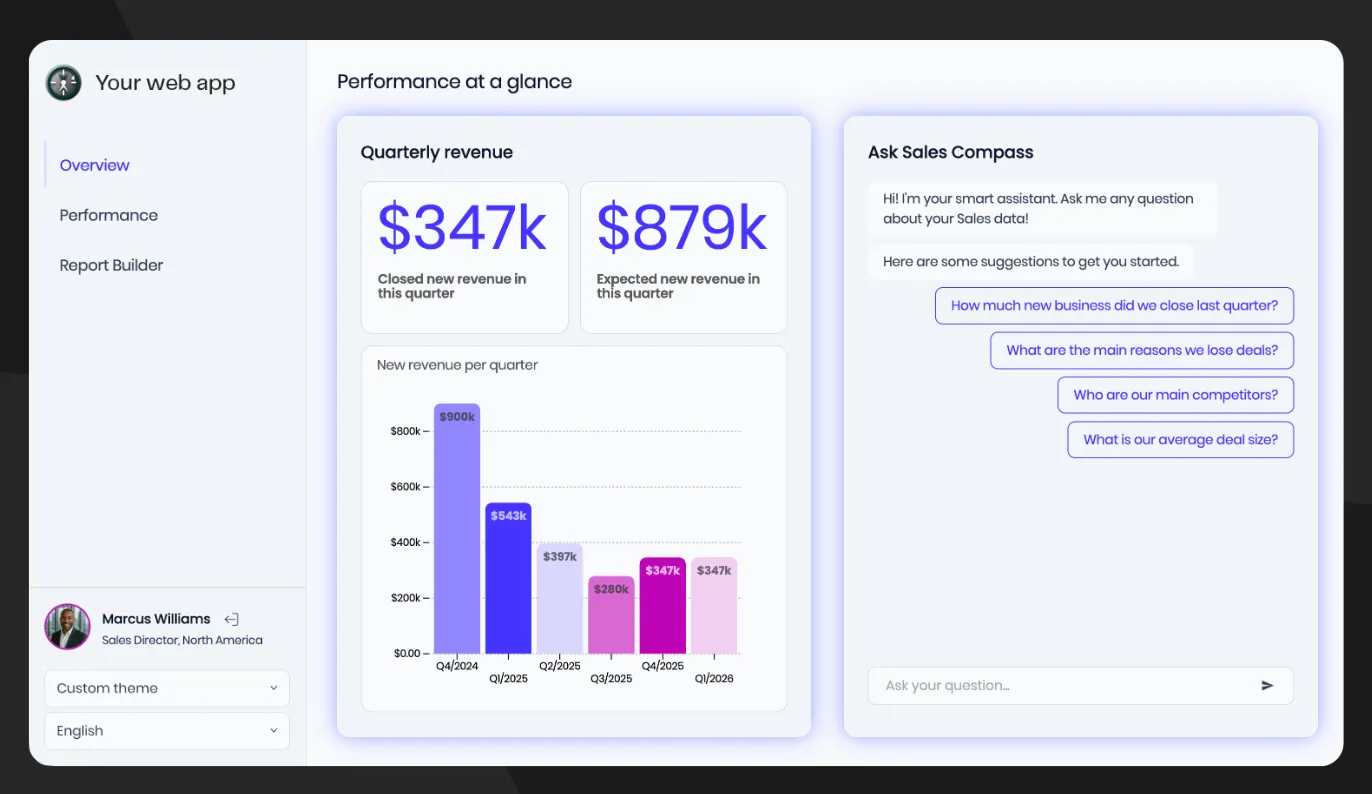
If the main user of your analytics is your customer, Luzmo is the strongest Basedash alternative.
Native product analytics as the starting point
Basedash can now embed dashboards and its broader application.
Luzmo was built around analytics that live inside another product.
Teams can design dashboards visually, apply branding, connect customer data and embed the experience without first building an analytics frontend.
Developers can then extend the implementation through APIs, SDKs and components.
That progression is useful because most SaaS analytics roadmaps do not start fully custom.
They start with a dashboard.
Then customers want their own filters.
Then they want editable views.
Then analytics spread across workflows.
A platform that supports each stage gives the product team room to evolve without rebuilding the stack.
Self-service designed for external users
Basedash full-app embedding gives customers access to a broader AI analytics application, including dashboard creation.
Luzmo takes a more product-specific route to self-service.
Its self-service analytics lets customers create and adapt analytics inside the host product while staying within the permissions and experience the SaaS company defines.
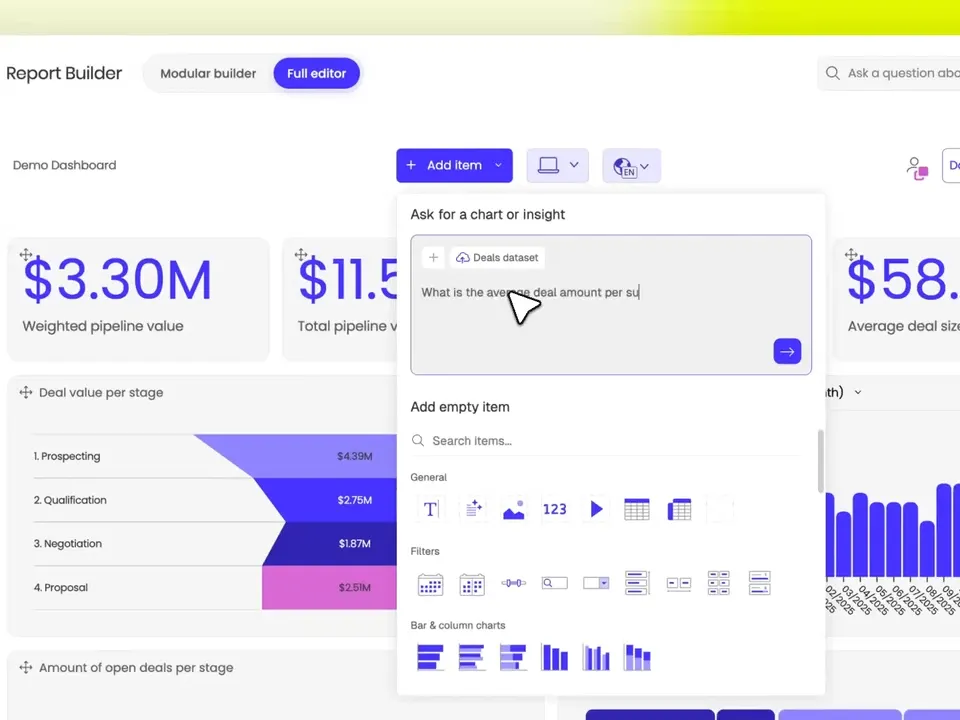
The goal is not to expose a separate BI tool.
It is to give end users enough freedom to answer their own questions without leaving the application.
For multi-tenant analytics, that means reusing one analytics foundation while keeping every customer's data and permissions governed separately.
Go below dashboards with composable analytics
Basedash's new developer platform makes it possible to build custom interfaces backed by Basedash APIs.
That gives developers substantial flexibility.
Luzmo offers a middle ground between a full embedded application and building the entire UI yourself.
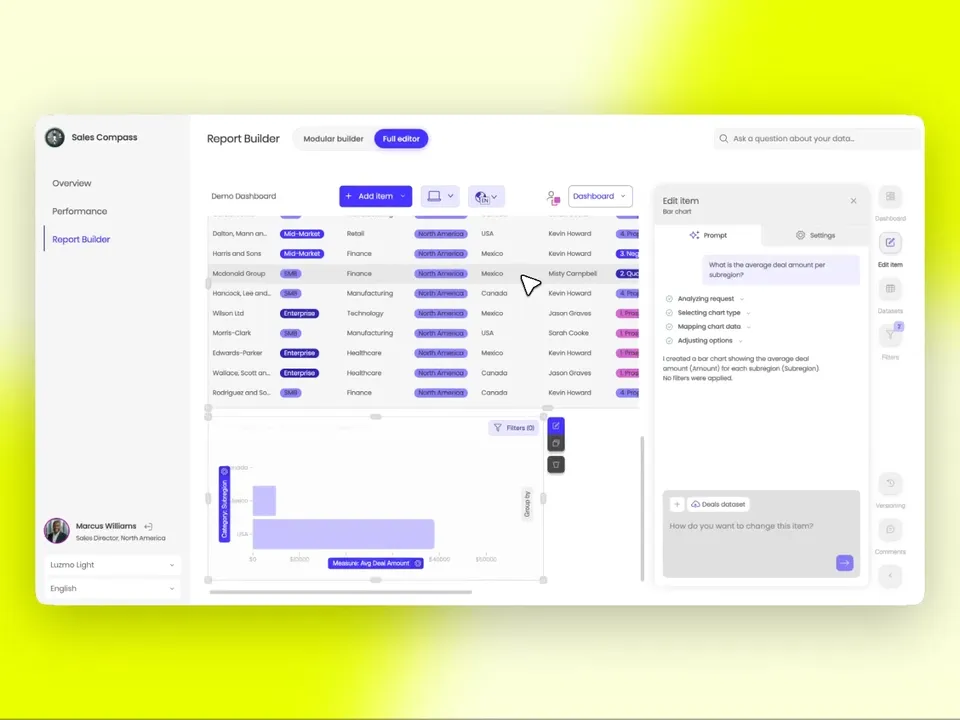
With composable analytics, product teams can work with individual analytics components and assemble them inside their own frontend.
A KPI can sit next to a workflow.
A chart can react to application state.
A metric panel can follow the same design system as every other component.
This is useful when you want analytics to feel native without rebuilding querying, security, visualization behavior and data interactions from scratch.
See what composable analytics is for a deeper explanation.
AI that lives where the customer already works
Basedash is one of the strongest AI-native products on this list.
Its agent can build dashboards, answer questions, surface insights, run automations and work through MCP.
Luzmo's AI story is narrower but more tightly tied to embedded product analytics.
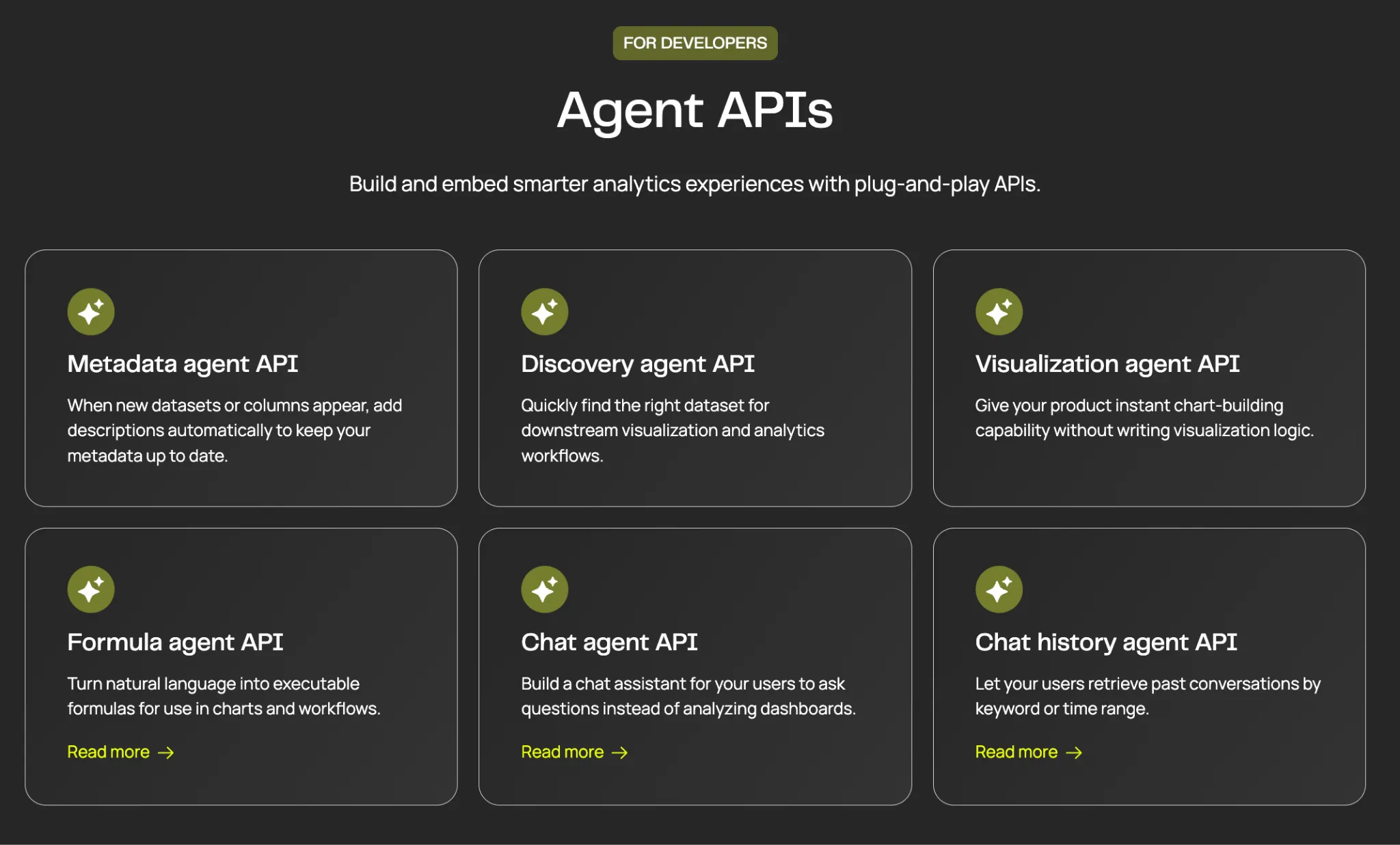
Luzmo IQ lets users ask questions in plain language inside the analytics experience.
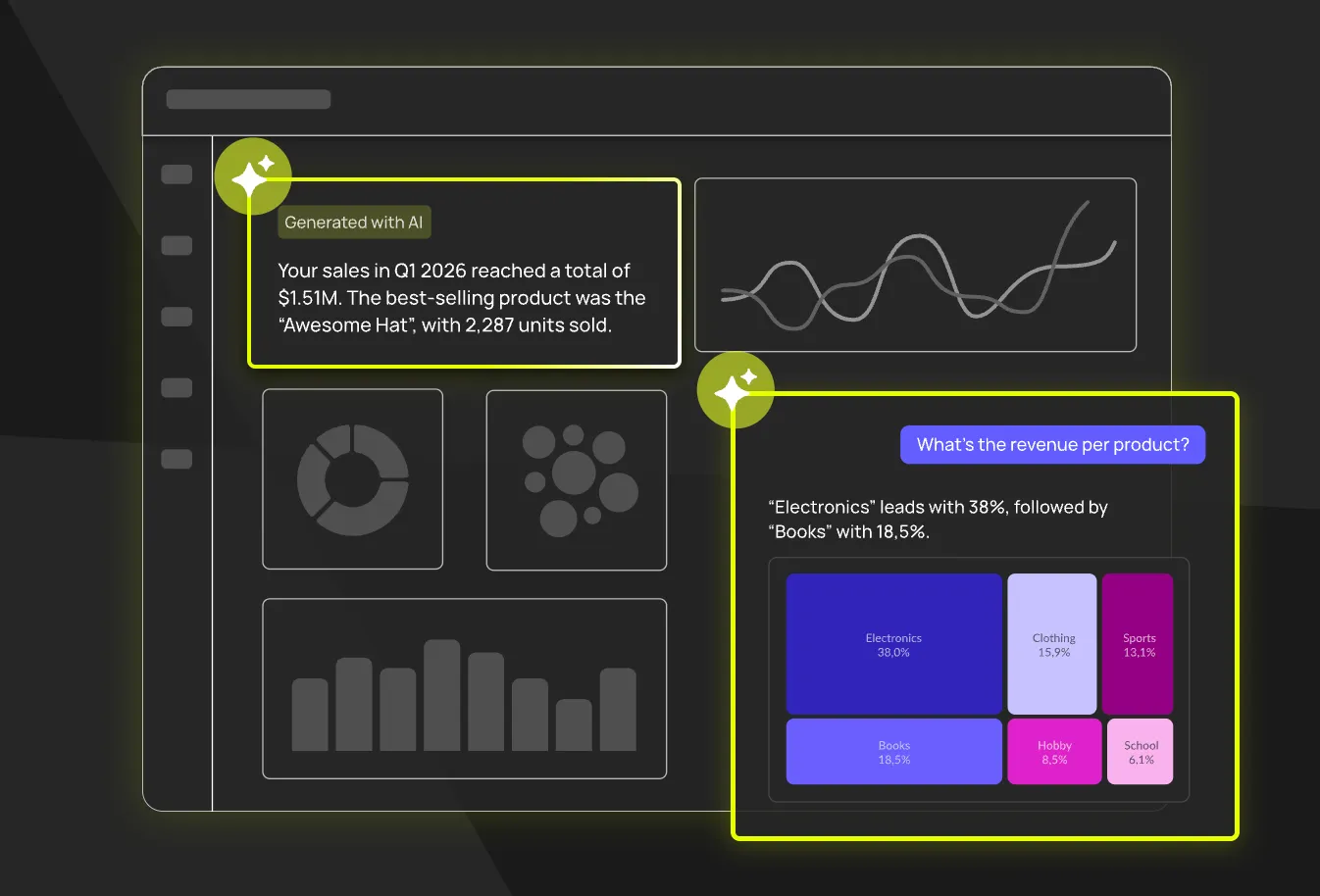
Luzmo also supports broader agentic workflows through its API and MCP direction, but the product principle stays the same: analytics should appear where users already work.
That lines up with the wider move toward agentic analytics, where insights are not limited to one dashboard destination.
Basedash may be stronger if you want one AI-native BI environment for internal users, agents and automations.
Luzmo is stronger when AI analytics need to become part of your own product experience.
Published embedded pricing
Luzmo starts at €1,995 per month, billed annually, on a single Embedded Everywhere plan. White-labeling, self-service analytics, AI, APIs and SDKs are included in the complete product rather than unlocked by a higher tier, and Enterprise requirements change the deployment rather than the feature set.
Plans are structured around the solutions deployed and monthly active users.
That makes it possible to estimate an embedded use case before entering enterprise procurement.
See the current Luzmo pricing for the full model.
Best for: SaaS product teams that want embedded analytics and AI to feel native, need governed self-service and multi-tenancy and want a path from ready-made dashboards to component-level product experiences.
2. ThoughtSpot
ThoughtSpot is the strongest Basedash alternative when AI-powered search and agentic analytics are the center of the decision.
Its product has been moving in that direction for years.
Spotter AI Agents let users ask questions in natural language, explore data and move from questions to analysis without starting from a fixed dashboard.
ThoughtSpot Embedded brings those experiences into external applications through APIs and SDKs.
This creates clear overlap with Basedash.
Both products want users to interact with data conversationally rather than navigate a traditional dashboard hierarchy.
The differences are scale, maturity and buying motion.
ThoughtSpot has a longer enterprise track record and a more mature embedded product. It also comes with more enterprise weight.
Current pricing includes lower-cost Analytics plans, while large-scale multi-tenant Embedded deployments use Enterprise pricing. ThoughtSpot also offers a Developer embedded option and a startup program for eligible companies.
Basedash may feel faster and more AI-native for a small internal team.
ThoughtSpot may be a safer shortlist choice when search-first analytics and enterprise deployment need to scale across a larger organization or customer base.
Read Luzmo's ThoughtSpot alternatives and the direct Luzmo vs. ThoughtSpot comparison.
Best for: enterprises and product teams that want natural-language analytics, search and AI agents as the primary way users interact with data.
3. Omni
Omni is a strong Basedash alternative for teams that want AI but do not want to give up a deeply governed warehouse BI workflow.
The platform combines a semantic layer, SQL, point-and-click exploration, dashboards and embedded analytics.
That creates a different balance from Basedash.
Basedash is AI-native first: chat, agents, automations and generated dashboards are central to the user experience.
Omni is more visibly rooted in governed BI and warehouse analytics, with AI layered onto a mature exploration model.
For data teams that still expect analysts to model, validate and explore data directly, that can be a better fit.
Omni also supports embedded use cases and has been expanding that side of the product aggressively.
Pricing remains sales-led.
There is no simple public list price comparable to Basedash's $1,000 Startup plan.
The recent acquisition of Explo also makes Omni particularly important for buyers watching the customer-facing analytics market, because the company is bringing more embedded expertise into the broader platform.
Read the full Omni Analytics alternatives guide or compare Luzmo vs. Omni.
Best for: warehouse-first data teams that want governed metrics, analyst flexibility, AI and internal plus embedded analytics from one platform.
4. Sigma
Sigma is a strong alternative when business users still want a familiar spreadsheet-style way to work with large warehouse data.
Instead of making chat the primary interface, Sigma gives users a spreadsheet-like environment on top of cloud data warehouses.
That can be easier to adopt for finance, operations and business teams that already think in tables, formulas and pivots.
Sigma has also moved far beyond spreadsheets.
Its current platform includes AI agents, embedded analytics, data applications and workflow capabilities.
For customer-facing use cases, Sigma supports white-labeled analytics and applications embedded through JWT-based authentication.
Compared with Basedash, the user experience is fundamentally different.
Basedash tries to reduce the amount of manual dashboard and analysis work through AI.
Sigma gives users a powerful interactive workspace and increasingly adds AI around it.
Choose based on your users.
If they want to ask a question and let an agent do more of the work, Basedash may feel more natural.
If they want to manipulate live warehouse data in a familiar grid-based environment, Sigma is hard to beat.
See the direct Luzmo vs. Sigma comparison.
Best for: business and data teams that want spreadsheet-style exploration on cloud warehouses, with embedded applications and AI layered on top.
5. Metabase
Metabase is the strongest Basedash alternative when cost, open source and ease of adoption matter more than an AI-native product philosophy.
Its open-source edition is free to self-host.
Starter currently begins at $100 per month, with the first five users included and additional users charged separately.
Pro starts at $575 per month, with advanced embedding, multi-tenant data segregation, white-labeling, SSO and granular permissions.
Metabase has also moved quickly on AI.
AI querying and SQL generation are available broadly, while paid plans add more governance and embedded AI controls.
That makes the comparison with Basedash more interesting than it would have been a year ago.
Basedash still feels more AI-native. Agents, daily insights, automations, MCP and generated dashboards sit at the center of the product.
Metabase gives you a more traditional BI foundation with an open-source path and AI added across the workflow.
For embedded SaaS analytics, model user pricing carefully. Users accessing embeds can count toward paid user totals.
Read Luzmo's guide to Metabase alternatives and the direct Luzmo vs. Metabase comparison.
Best for: startups and data teams that want open-source flexibility, a low entry point and familiar BI workflows with increasingly capable AI.
6. Embeddable
Embeddable is the most developer-led alternative on this list.
Where Basedash began as an AI BI application and is now opening more of itself through APIs, Embeddable starts from a code-first model for customer-facing analytics.
Data models and components can live in your own repository, under version control.
Developers can use Embeddable's component library, customize it or write their own.
That gives product teams deep control over the frontend experience.
Embeddable also offers conversational analytics and focuses heavily on fully native, white-labeled customer-facing data experiences.
Its pricing is positioned as a flat monthly custom quote with unlimited usage and features, rather than a per-viewer or query-based model. That's predictable once your end-user count grows, but it still means a sales conversation rather than a number you can look up.
Compared with Basedash, Embeddable is less of an internal AI BI environment.
It is more directly a product development platform for analytics.
That makes it a better fit when your main question is not "How do our employees analyze data faster?"
It is "How do we build analytics our customers experience as part of our product?"
Read Luzmo's Embeddable pricing guide and direct Luzmo vs. Embeddable comparison.
Best for: developer-heavy product teams that want analytics components and frontend UX to live close to their own codebase.
7. Hex
Hex is a strong Basedash alternative for data teams that want AI, collaboration and deeper analytical workflows in the same environment.
The product combines notebooks, SQL, Python, data apps, dashboards and AI-assisted analysis.
That makes Hex particularly useful when analysis goes beyond standard BI.
A data scientist can work in code.
An analyst can build an interactive application.
A business user can consume the result without touching the underlying notebook.
Hex also supports embedded analytics with row-level security, custom themes and an Embed API.
The product has continued investing heavily in AI, including its Hex Agent and external web search for bringing live context into analysis.
Compared with Basedash, Hex gives technical teams more explicit notebook and coding workflows.
Basedash aims to let the AI agent do more of the work directly from natural-language requests.
The right choice depends on how much hands-on analysis your team wants to keep.
If your analysts and data scientists still want notebooks and code as first-class tools, Hex is compelling.
If you want an AI-native BI experience that minimizes manual analysis steps, Basedash may feel more direct.
Best for: data teams that want collaborative notebooks, SQL, Python, interactive apps and AI in one analytics workspace.
How to choose the right Basedash alternative
Start with the user you are actually buying analytics for.
Then decide how much of the analytics product you want the vendor to own.
Basedash now gives you several options:
- embed a dashboard
- embed the full app
- call the developer platform and build your own UI
That flexibility is useful.
But each step toward a custom experience changes the implementation cost.
A vendor with a ready-made component system may save frontend work.
A full-app embed may ship faster.
An API-first build may give you the most control.
Choose the operating model before you compare feature matrices.
Best Basedash alternative by use case
- Analytics your customers use inside your product: Luzmo. Multi-tenancy, white-labeling and embedded pricing are the starting point, not an Enterprise gate.
- Agentic, AI-first exploration for your internal team: Basedash is genuinely strong here, and ThoughtSpot is the closest rival if you want search-led analysis at enterprise scale.
- A governed semantic layer several tools can share: Omni. See the Omni alternatives for governed analytics if you're weighing that category.
- Spreadsheet-style exploration on your warehouse: Sigma.
- Open source and lowest license cost: Metabase, accepting the operating burden.
- Maximum frontend control: Embeddable, or Luzmo Flex if you also want a no-code path.
- Notebook-style analysis for data scientists: Hex.
- Published embedded pricing with fast setup: the DataBrain alternatives for customer-facing analytics are worth comparing, since DataBrain lists Growth and Pro rather than quoting.
- Querying NoSQL or API sources directly: the Knowi alternatives for direct database exploration cover that gap, which most tools on this list don't fill.
- Internal dashboards on a small budget: the Metabase alternatives for internal BI comparison is the right starting point.
One distinction worth restating, because it's where teams waste the most money: an internal AI analytics tool and a customer-facing embedded platform are different products. Basedash started as the former and has been extending toward the latter. If your requirement is genuinely customer-facing, buy for that from the beginning rather than upgrading into it.
Compare similar AI analytics platforms
Looking beyond Basedash? These platforms take different routes to AI-assisted, governed and developer-led analytics:
Building customer-facing analytics into your product? Explore Luzmo for embedded analytics.
The bottom line
Basedash is moving too quickly to dismiss with old BI-tool stereotypes.
In the space of a few months, it has added embedding, a semantic layer, enterprise controls and a developer platform.
Its AI-native direction is clear.
The real question is where that direction fits your product.
For internal teams that want an AI analyst, automated insights, dashboards, Slack and MCP in one fast-moving environment, Basedash is compelling.
And for SaaS product teams whose main job is to ship analytics to customers, Luzmo is the strongest overall alternative.
It combines embedded analytics, self-service, multi-tenancy, composable components and AI around one goal: analytics that feel like part of your own product.
Basedash is becoming a programmable AI BI platform that can also live inside your product.
Luzmo starts with the product experience itself.
That is the distinction to make first.
FAQ
All your questions answered.
What is Basedash?
Basedash is an AI-native business intelligence platform with dashboards, AI chat, automated insights, automations, a semantic layer, Slack, MCP, embedding and developer APIs. It connects to databases, warehouses and hundreds of SaaS data sources.
How much does Basedash cost?
Basedash's current Startup plan costs $1,000 per month plus AI usage for up to 25 users. Enterprise pricing is custom and adds capabilities including embedding, SSO, SCIM, audit logs, custom AI models and self-hosting.
What is the best Basedash alternative for embedded analytics?
Luzmo is the strongest Basedash alternative when customer-facing embedded analytics is the primary use case. It combines native product embedding, governed self-service, multi-tenancy, composable components and conversational AI with published embedded pricing.
Does Basedash support embedded analytics?
Yes. Basedash supports dashboard embedding and full-app embedding. Dashboard embeds use an iframe, while full-app embedding uses JWT-based authentication and loads the Basedash application inside the host product. Basedash also launched developer APIs in July 2026 for building custom interfaces on top of its analytics capabilities.
What is the best open-source Basedash alternative?
Metabase is the strongest open-source option for teams that want a traditional BI foundation with AI features and a path into paid embedded analytics. Its open-source edition is free to self-host.
Basedash vs. ThoughtSpot: which is better?
Basedash is a fast-moving AI-native BI platform with internal analytics, automations, MCP and newer embedded capabilities. ThoughtSpot has a longer enterprise track record in search-first analytics and large-scale embedded agentic analytics. The better fit depends on deployment scale, governance needs and the maturity of the embedded use case.
Basedash vs. Luzmo: which is better for SaaS products?
Basedash is a strong fit when you want one AI-native BI platform for internal teams, agents, automations and programmable analytics. Luzmo is a stronger fit when the main goal is native customer-facing analytics with governed self-service, multi-tenancy, composable UI and embedded AI as part of the product experience.
Written by

Ship the future of your data
Let us show you what Luzmo can do for your product.

Book your session with our analytics expert.