7 Best Toucan Toco Alternatives for Embedded Analytics in 2026

Toucan Toco is no longer simply a guided dashboard product.
Its 2026 platform combines embedded dashboards, AI chat, self-service analytics, a governed semantic layer, multi-tenant security and several deployment options. Toucan also now embeds through a web component or React SDK and explicitly positions the experience as native rather than iframe-based.
That makes Toucan a serious option for SaaS product teams.
It also means the reasons to compare alternatives have become more specific. Some companies need a lower entry point for full white-labeling. Others want a different pricing model, deeper component-level composition, broader enterprise governance or a platform that connects customer-facing analytics with a larger product strategy.
The 7 best Toucan Toco alternatives in 2026 are:
- Luzmo: best overall for native customer-facing analytics that can grow from dashboards to composable experiences
- Explo: best for dashboards, reporting, exports and customer data sharing
- Qrvey: best for multi-tenant SaaS analytics deployed in your own cloud
- Embeddable: best for code-first teams that want maximum frontend control
- GoodData: best for governed enterprise analytics and complex tenant structures
- Metabase: best for an open-source starting point
- Sisense: best for regulated and enterprise embedded deployments
Toucan Toco alternatives at a glance
| Tool | Best for | Embedded-first? | Public pricing? | AI capabilities |
|---|---|---|---|---|
| Luzmo | Native customer-facing analytics, self-service and composable UX | Yes | Yes | Luzmo AI + Luzmo IQ |
| Explo | Dashboards, reporting, exports and data sharing | Yes | Yes, but the product is transitioning to Omni | AI-powered reporting |
| Qrvey | Multi-tenant analytics deployed in the customer's cloud | Yes | Quote-based | Embedded and agentic AI |
| Embeddable | Code-owned, highly bespoke analytics interfaces | Yes | Lite pricing public; larger plans custom | Conversational analytics |
| GoodData | Governed enterprise analytics and flexible deployment | Strong embedded focus | Sales-led | Governed AI and agents |
| Metabase | Open-source BI with paid advanced embedding | No, BI-first with embedding | Yes | AI querying and embedded AI |
| Sisense | Complex enterprise and regulated embedding | Strong embedded focus | Sales-led | Sisense Intelligence + BYO LLM |
Why look for a Toucan Toco alternative?
Toucan now covers most of the capabilities a modern embedded analytics shortlist needs.
Its strengths include multi-tenancy, row-level security, white-labeling, AI chat, self-service, web components and self-hosting options.
The trade-offs sit in packaging, pricing and product fit.
Full white-labeling starts above the entry plan
Toucan's plans page lists Start from €890 per month as of August 5, 2026. Treat that as a dated starting point rather than a universal quote: Toucan's own pricing FAQ says the final figure depends on architecture, tenant count, users and deployment.
The entry-level Start package includes unlimited embedded dashboards and web-component charts, but the current plan page places full white-labeling, deeper CSS customization and the Embed SDK in the Grow plan.
That distinction matters.
A team may see the €890 headline price and assume it covers the complete customer-facing experience described on Toucan's embedded product page. The actual plan needed for a deeply branded SaaS deployment may sit higher.
Before comparing Toucan with Luzmo pricing or another vendor, list the non-negotiable requirements:
- no vendor branding
- custom domain
- CSS control
- SSO
- end-user self-service
- AI chat
- number of builders
- number of customer groups
Then compare the first plan that includes the full set.
Self-service is packaged for larger deployments
Toucan's current plan page lists end-user self-service under Scale and Enterprise.
That may be fine for companies that only need fixed dashboards at launch.
It matters more for SaaS products where users are expected to build, edit or save their own analytics early in the roadmap.
Customer-facing analytics often starts as a reporting tab and then creates a queue of requests:
- add one more chart
- create a view for a different role
- let the customer change the layout
- support a custom dashboard per account
A platform with self-service analytics available in the plan you can adopt now may reduce the need for another commercial upgrade later.
Packaging scales through user and customer-group allowances
Toucan's published packages include allowances for builders, internal users and client-user groups.
Start lists two builders, 20 internal users and up to 10 client-user groups. Grow expands those limits, while Scale reaches up to 1,000 client-user groups.
This gives buyers a visible framework, which is better than fully opaque pricing.
It also means teams should model how the commercial structure maps to their customer base.
A SaaS company with many small tenants may scale differently from one serving a handful of large enterprise customers. Ask Toucan how client-user groups map to tenants, organizations and active users in your specific architecture.
AI introduces a separate usage layer
Toucan's current platform includes AI chat grounded in its semantic layer.
The company describes AI usage through a credit-based system, where messages consume credits from a monthly allowance.
This creates a second scaling variable beside dashboards and customer groups.
The same issue applies across AI analytics vendors: a feature that succeeds can create more usage cost because customers ask more questions.
Before signing, model:
- expected active users
- AI questions per user
- whether unused credits roll over
- overage pricing
- how AI usage differs across plans
- which model powers the experience
For a broader view of the category, see the guide to agentic analytics.
Toucan is broad, but your use case may be narrower
Toucan now tries to cover three product surfaces:
- AI chat
- self-service dashboards
- embedded reporting
That breadth can be convenient.
A company that only needs one of those outcomes may prefer a platform optimized more narrowly around it.
A developer-led team may choose a code-first component platform. A regulated enterprise may prioritize deployment and governance. A product team may want a faster path from embedded dashboards to composable analytics.
The right alternative depends on the layer you want the vendor to own.
How much does Toucan Toco cost?
Toucan's plans page lists a starting price of €890 per month, checked August 5, 2026. Two caveats before you build a budget on it. First, Toucan's own pricing FAQ states that exact pricing depends on architecture, tenants, users and deployment, so €890 is a floor for the smallest configuration rather than a rate card. Second, AI usage sits on a separate credit-based layer, so heavy conversational analytics adds cost that the plan price doesn't capture.
Its plan structure includes:
Start
Designed for a basic deployment.
The current plan page lists:
- two builder users
- 20 internal users
- up to 10 client-user groups
- unlimited embedded dashboards
- unlimited web-component charts
- unlimited web apps
- the query builder and data connectors
- standard support and onboarding
Grow
Grow expands the deployment and adds capabilities important to customer-facing products, including:
- full white-labeling
- deep CSS customization
- PDF reports
- usage analytics
- the Embed SDK
- dedicated customer success
Scale
Scale is aimed at larger deployments and adds:
- up to 1,000 client-user groups
- end-user self-service
- custom domain and SMTP options
- more advanced usage analytics
- expanded onboarding and support
Enterprise
Enterprise offers on-demand or unlimited deployment, custom architecture and broader support.
Optional add-ons include dedicated servers, self-hosting, SSO and additional transformation or storage capacity.
The headline starting price is useful, but request a quote for the exact plan that includes your required branding, self-service, authentication and AI usage.
How we evaluated Toucan alternatives
We compared these platforms on the criteria that decide an embedded analytics purchase, rather than on feature-count totals:
- Integration method. React or Web Components versus iframe, since this decides how much of your own frontend you keep control of.
- End-user self-service. Whether your customers can build and save their own views, and which plan that sits on.
- Semantic grounding. Whether metrics are defined once in a governed layer, which is what makes AI answers trustworthy in front of a customer.
- Tenant security. Isolation, row-level rules and SSO, and whether they're structural or plan-gated.
- Pricing model. Flat platform fee, per active user or per customer group, plus any separate AI usage metering.
Research date. Product, integration and pricing facts were checked against current vendor documentation on August 5, 2026. Where a vendor says pricing depends on deployment, we've said so rather than presenting a headline figure as a quote.
Our bias, stated plainly. Luzmo builds embedded analytics and competes directly with Toucan. We recommend Luzmo where product-led embedded analytics with end-user self-service is the goal. Where Toucan's guided storytelling approach genuinely fits better, which is a real scenario and not a courtesy, we say so in the next section. Qrvey, GoodData, Embeddable, Metabase and Sisense each win on specific constraints, and those are named in the table above.
Guided storytelling versus self-service
This is the philosophical fork that separates Toucan from most of this list, and picking the wrong side of it wastes a year.
Guided storytelling, Toucan's core idea, presents analytics as a curated narrative. Each screen focuses on one insight with context and explanation. The bet is that most end users don't want to explore data, they want to be told what matters. For a non-technical audience, or a product where analytics is a supporting feature rather than the main event, that bet is often correct. Adoption tends to be higher because nobody faces a blank dashboard wondering what to filter.
Self-service assumes the opposite: that your customers have questions you haven't anticipated, and that the value is in letting them answer those themselves. It demands more of the user and more of the platform, since you need governed metrics, safe tenant boundaries and an interface a non-analyst can operate without breaking anything.
The honest test: if your support team fields the same five analytics questions repeatedly, guided storytelling solves it. If they field a hundred different ones, self-service does. Most products need both eventually, which is why it's worth checking whether a platform can do one without abandoning the other, and which plan each capability sits on.
SDK and web-component comparison
Integration method is the hardest thing to change later, so it's worth being precise about what each tool actually offers rather than trusting a marketing line.
Toucan's current product pages describe embedding through an SDK, Web Component or React component rather than an iframe-first model. That's a genuine strength and it puts Toucan ahead of several better-known BI platforms. Note that the plan page places the Embed SDK and deeper CSS customization above the entry tier, so the architecture being available doesn't mean it's available on the plan you were pricing.
Among the alternatives: Embeddable is built entirely on native Web Components, Luzmo Flex exposes rendering and data as building blocks you compose yourself, Sisense Compose SDK supports React, Angular and Vue with TypeScript, and GoodData offers iframe, Web Components and a React SDK. Metabase is the most iframe-oriented of the group, which is fine for internal use and limiting for a branded customer experience.
The question to ask every vendor: can I place a single chart inside my own layout, with my own CSS, and does that require a plan upgrade?
Best alternatives to Toucan Toco
1. Luzmo: best overall Toucan Toco alternative for product-led embedded analytics
Toucan and Luzmo now overlap in several areas.
Both offer embedded dashboards, multi-tenancy, white-labeling, self-service and conversational analytics.
The biggest difference is how the product experience can evolve after the first dashboard goes live.
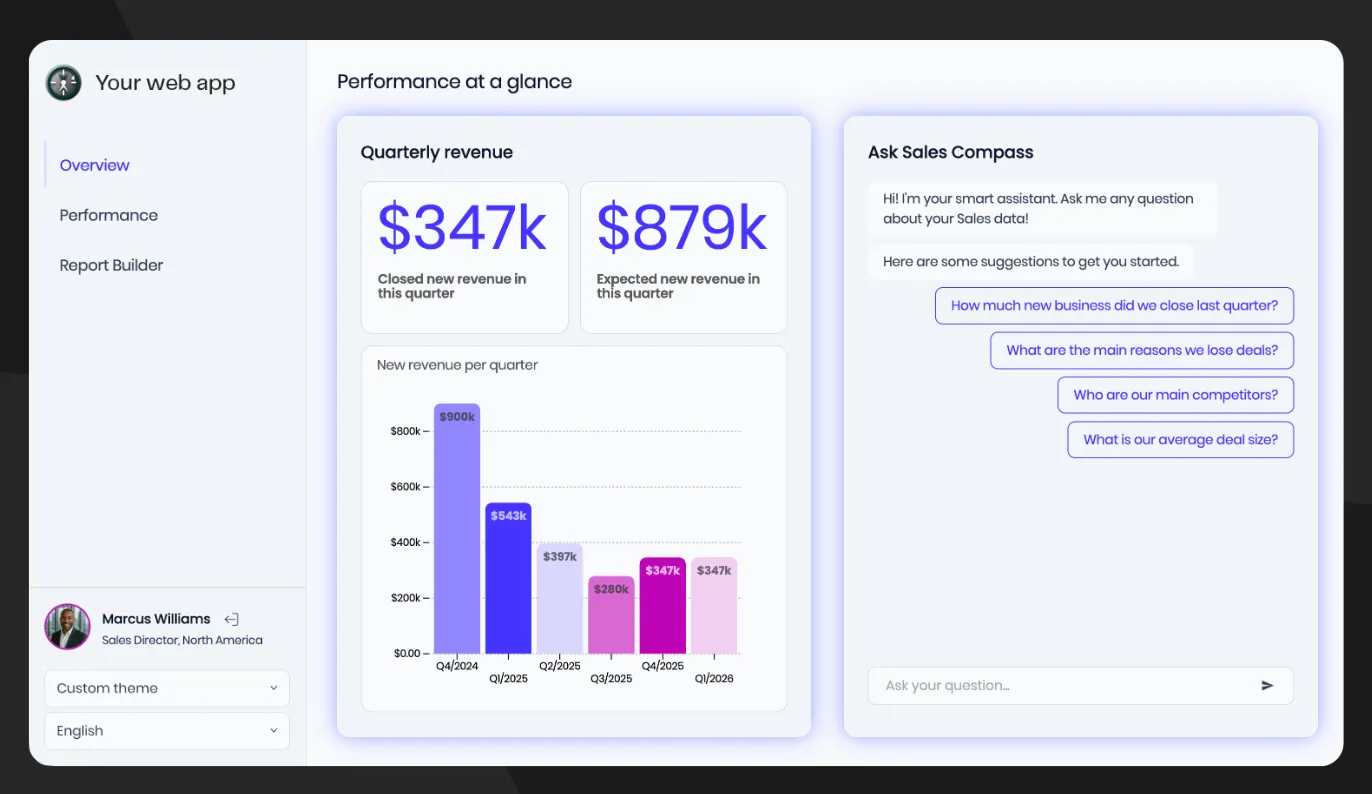
Luzmo gives product teams a path from a ready-made embedded dashboard to a fully composed analytics experience built from individual components.
Launch visually, then customize more deeply
Luzmo Studio gives teams a visual dashboard builder for getting customer-facing analytics live quickly.
Product managers and analysts can build and iterate without sending every change through engineering.
Developers still get full API and SDK access.
This matters when ownership is shared. The product team can manage the experience, while engineers control authentication, application state and deeper integrations.
See the current embedded analytics platform for the full product model.
Self-service as a customer-facing product surface
Luzmo includes self-service analytics, letting users create and edit analytics inside the host product.
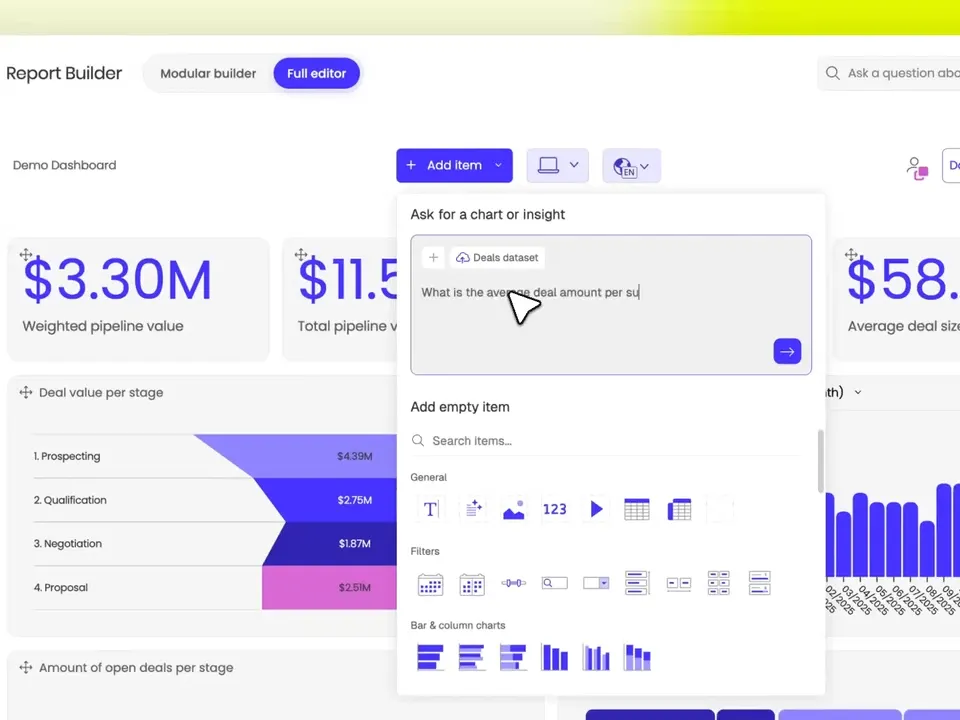
This goes beyond giving users a fixed dashboard with filters.
Customers can shape views around their own decisions while remaining inside the data and permission boundaries the product team defines.
The setup is designed for multi-tenant analytics, where the same analytics foundation serves many customers without exposing data across accounts.
Component-level composition
Toucan's current embedded page emphasizes its web component and React SDK.
Luzmo also supports web components and SDKs, then goes further with a dedicated composable analytics toolkit.
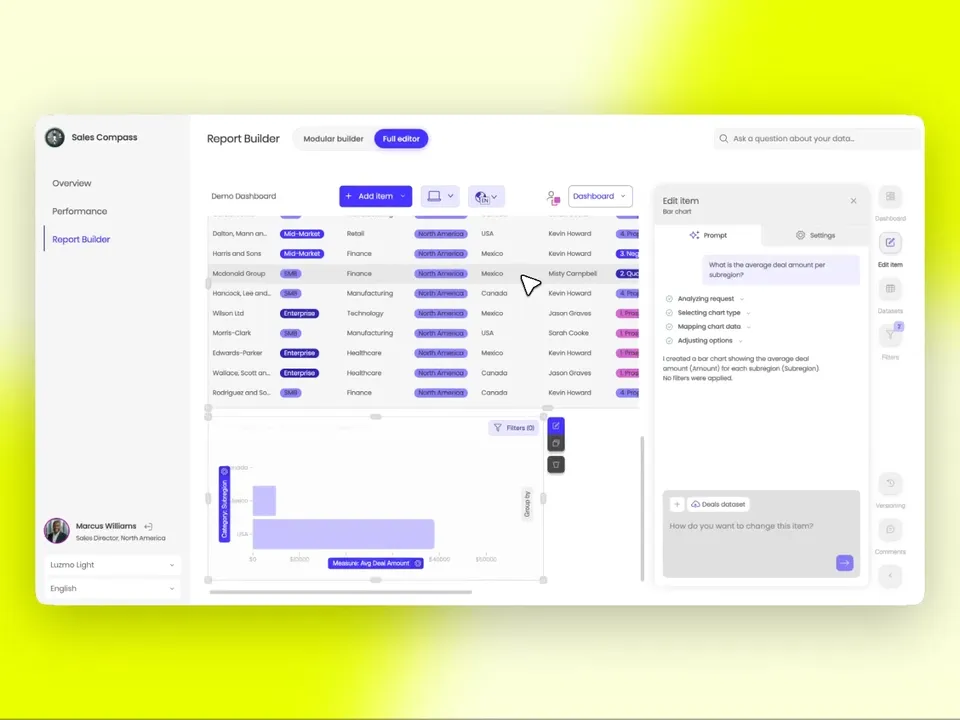
Developers can work with individual fields, filters, chart slots and visualization components instead of treating a full dashboard as the smallest unit.
That is useful when analytics need to appear across workflows rather than inside one reporting destination.
Read what composable analytics is for the deeper distinction.
Conversational analytics inside the product
Toucan AI Chat is one of Toucan's strongest current features.
Luzmo IQ also lets end users ask questions in natural language and receive answers as text and visualizations.
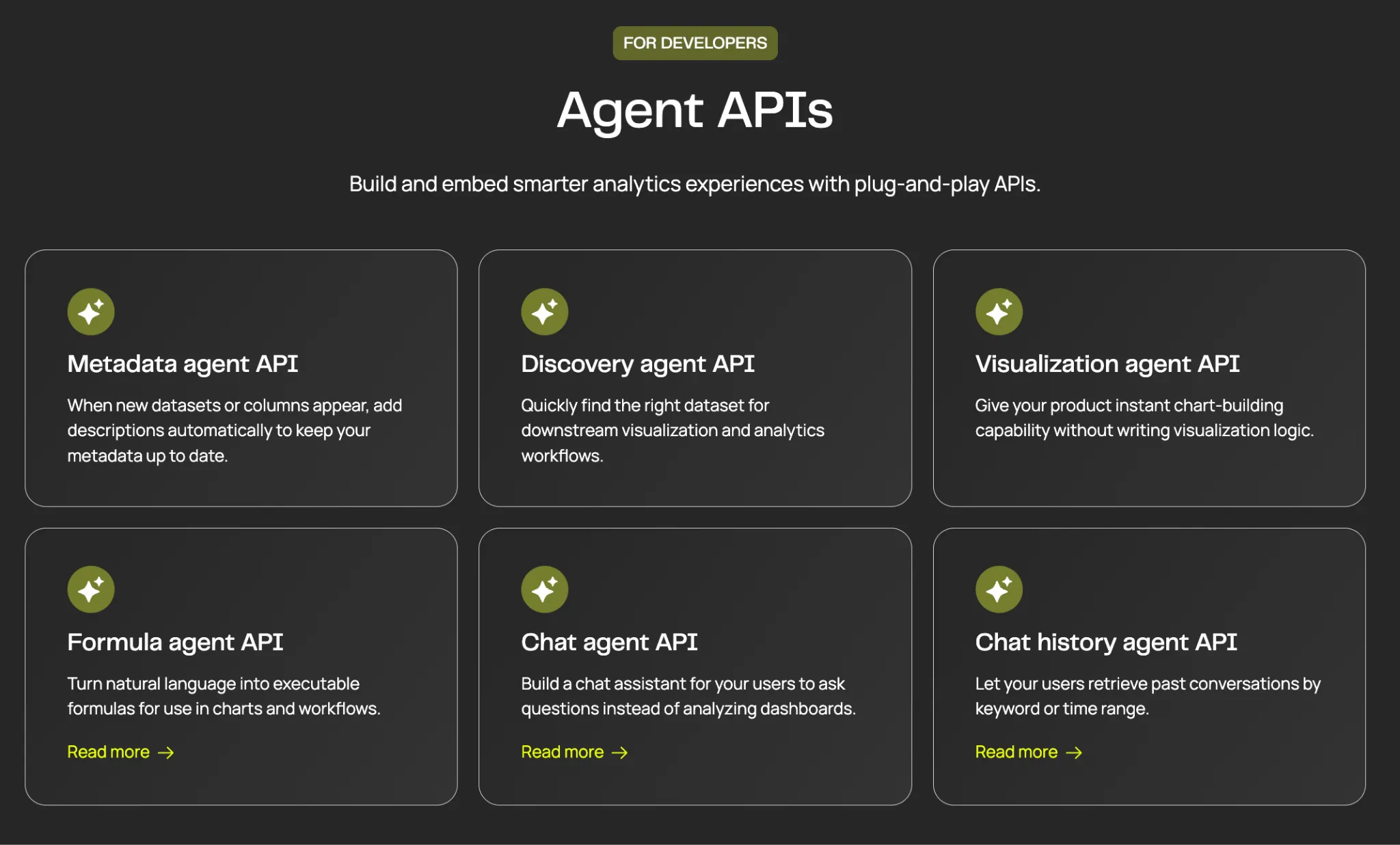
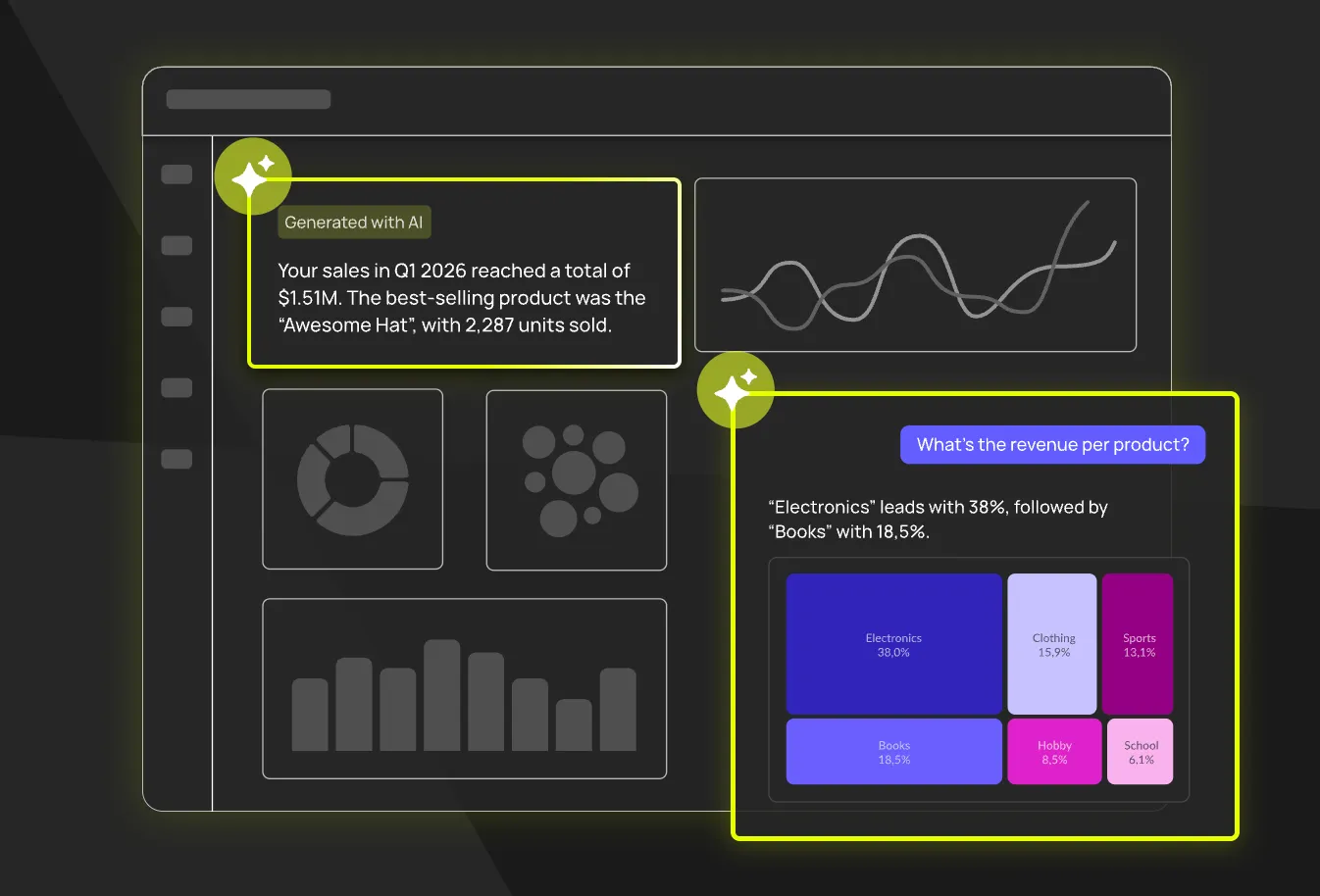
The practical question is how the AI surface fits your product and governance model.
Luzmo IQ is designed to be embedded as a chat, search experience or custom workflow, while permissions are handled through the same access layer as the surrounding analytics.
Pricing aligned with product usage
Luzmo starts at €1,995 per month, billed annually, on a single Embedded Everywhere plan. White-labeling, self-service analytics, AI, APIs and SDKs are included in the complete product rather than unlocked by a higher tier, and Enterprise requirements change the deployment rather than the feature set.
Plans are based on the solutions deployed and monthly active users.
That structure differs from Toucan's package allowances around builders, internal users and customer groups.
Neither model wins automatically. Compare both at your target customer scale.
The direct Luzmo vs. Toucan Toco comparison covers the platforms side by side, though fast-moving AI and packaging details should always be rechecked against current product pages.
Best for: SaaS product teams that want a visual starting point, secure multi-tenancy, end-user self-service, conversational analytics and a clear route into component-level product experiences.
2. Explo
Explo was built specifically for customer-facing analytics.
It combines embedded dashboards, report building, exports, white-label portals and end-user customization.
That makes it a natural Toucan alternative when reporting and data sharing are as important as interactive analytics.
There is one major strategic consideration: Omni announced its acquisition of Explo in October 2025, and Omni's customer FAQ says the majority of Explo customers are expected to migrate to Omni during a roughly 12-month transition ahead of the planned sunset of the Explo platform.
Existing customers retain access during the transition, but a new buyer should evaluate the long-term Omni destination rather than treating Explo as an independent roadmap.
Explo's current public Pro pricing starts at $1,995+ per month, with pricing scaling by customer logos. Enterprise is custom.
Read the direct Luzmo vs. Explo comparison and Omni Analytics alternatives before choosing a migration path.
Best for: current Explo customers comparing migration options, and teams that need dashboards, reporting, exports and customer data delivery in one workflow.
3. Qrvey
Qrvey is a strong alternative for companies that want the analytics platform deployed inside their own cloud environment.
Its product is built around multi-tenant SaaS analytics and includes dashboards, reporting, workflow automation and AI.
Compared with Toucan's SaaS or self-hosted model, Qrvey makes customer-cloud deployment central to the product.
That can simplify security and data-residency conversations for organizations standardized on AWS.
Qrvey uses sales-led pricing and has promoted flat-rate and perpetual licensing options.
The trade-off is a more infrastructure-heavy buying decision.
See the direct Luzmo vs. Qrvey comparison.
Best for: SaaS platforms that want embedded analytics deployed in their own cloud and value predictable platform licensing.
4. Embeddable
Embeddable is the developer-led option.
Its models and components can live in your codebase and version-control workflow, giving frontend teams deep ownership over the analytics experience.
Compared with Toucan's no-code configuration and ready-made platform surfaces, Embeddable asks developers to play a larger role.
That is an advantage when the interface must be highly bespoke.
It can be a disadvantage when product and data teams need to build or change analytics without engineering involvement.
Read the Embeddable alternatives, Embeddable pricing guide and direct Luzmo vs. Embeddable comparison.
Best for: frontend-heavy product teams that want analytics UX managed in code and are comfortable owning more of the implementation.
5. GoodData
GoodData is the governance-heavy alternative.
It combines a semantic layer, multi-tenant workspaces, embedded analytics, APIs, AI and enterprise deployment controls.
GoodData may be a better fit than Toucan when analytics need to follow a larger enterprise data-governance strategy.
The trade-off is implementation weight.
A smaller product team may find GoodData broader and more complex than the customer-facing use case requires.
See GoodData competitors, GoodData pricing and the direct Luzmo vs. GoodData comparison.
Best for: larger SaaS products and enterprises with complex governance, tenant provisioning and deployment requirements.
6. Metabase
Metabase is the most accessible open-source alternative on this list.
Its open-source edition can be self-hosted for free.
Paid plans add white-labeling, granular permissions, multi-tenant embedding, SSO and AI features.
Metabase is not as narrowly embedded-first as Toucan, but it gives teams an easier way to start with standard BI and move into customer-facing use cases later.
The main trade-off is user-based economics on paid embedding plans.
Read the Metabase alternatives and direct Luzmo vs. Metabase comparison.
Best for: teams that want open-source optionality and a lower-cost route into BI before committing to a dedicated embedded platform.
7. Sisense
Sisense is the enterprise alternative for complex deployments.
It supports multi-tenancy, iframe and Compose SDK embedding, white-labeling, advanced security and several hosting models.
Sisense is especially relevant in regulated industries or environments where the vendor must support a long procurement and security process.
Compared with Toucan, Sisense is heavier and pricing is sales-led.
It may be excessive for a product team that wants to launch in days with a small implementation group.
Read the Sisense alternatives, Sisense pricing guide and Luzmo vs. Sisense comparison.
Best for: enterprises that prioritize deployment flexibility, complex security controls and enterprise support over a lightweight buying process.
How to choose the right Toucan Toco alternative
Start with the product outcome.
Want analytics to evolve from dashboards into self-service and custom components? → Luzmo.
Need customer-facing reporting, exports and data delivery? → Explo or, for a long-term decision, Omni.
Want analytics deployed into your own cloud? → Qrvey.
Want developers to own the frontend analytics experience in code? → Embeddable.
Need enterprise governance and repeatable tenant provisioning? → GoodData.
Want open source and a low entry point? → Metabase.
Need regulated enterprise deployment and mature support? → Sisense.
Then compare the plan that includes your real requirements.
Toucan's €890 starting point is attractive, but full white-labeling, the Embed SDK and self-service sit higher in its current packaging.
The right comparison is not homepage price against homepage price.
It is the total cost of the experience you intend to ship.
Best option by product team
Match the tool to who's building and maintaining the analytics, since that predicts which constraint bites first:
- Product team with no dedicated frontend capacity. You need a visual builder and a plan that includes white-labeling without an upgrade. Luzmo, or Toucan's Grow tier if guided storytelling is genuinely what your users need.
- Product team with a frontend engineer to spare. Component-level embedding becomes realistic and worth it. Embeddable or Luzmo Flex. Our roundup of Embeddable alternatives for developer-led teams covers that group.
- Team that needs analytics shipped this quarter with predictable cost. Published pricing matters more than maximum flexibility, so the DataBrain alternatives for faster embedded delivery are the right comparison set, since DataBrain lists its Growth and Pro tiers rather than quoting.
- Enterprise with governance and data-residency requirements. Self-hosting and a governed semantic layer dominate. GoodData, or Qrvey if it must run in your own cloud account.
- Team whose data isn't in a warehouse yet. This is the constraint most comparisons ignore. If your data spans SQL, NoSQL and APIs, connectivity outranks dashboard polish and the Knowi alternatives for multi-source analytics address that directly.
- Internal reporting rather than customer-facing analytics. Metabase, and don't pay embedded-platform prices for an internal audience.
Compare embedded analytics platforms
If you are evaluating Toucan Toco for customer-facing analytics, compare it with these embedded BI platforms next:
Need analytics that fits directly into your SaaS product experience? Explore Luzmo.
The bottom line
Toucan Toco is a credible embedded analytics platform in 2026.
Its current product combines native embedding, AI chat, self-service, multi-tenant security and white-labeling in a package designed for SaaS products.
That means an alternatives article needs to be honest: Toucan can do the job.
The better question is which platform matches your product architecture, pricing model and roadmap.
Choose Toucan when its packaged combination of AI chat, dashboards and guided self-service fits your rollout.
Choose Luzmo when you want the analytics experience to keep evolving—from embedded dashboards to end-user creation, conversational analytics and component-level product UX.
For a wider shortlist, compare the best embedded analytics tools.
FAQ
All your questions answered.
What is Toucan Toco?
Toucan Toco is an embedded analytics platform for SaaS and ISV products. It offers white-labeled dashboards, AI chat, self-service, a governed semantic layer, multi-tenant security and web-component or React SDK embedding.
How much does Toucan Toco cost?
Toucan currently advertises plans starting at €890 per month. Full white-labeling, deep CSS customization and the Embed SDK are listed on Grow, while end-user self-service appears on Scale and Enterprise. Final pricing depends on deployment size and features.
What is the best Toucan Toco alternative?
Luzmo is the strongest overall alternative for SaaS product teams that want embedded dashboards, secure multi-tenancy, self-service, conversational analytics and a path into component-level analytics experiences.
Does Toucan Toco use an iframe?
Toucan's current embedded product page says it embeds through a web component or React SDK without an iframe. Buyers should still validate the exact integration method for every Toucan surface they plan to use.
What is the best open-source Toucan alternative?
Metabase is the most accessible open-source alternative. Its free edition covers standard BI, while paid plans add advanced embedding, white-labeling, tenant controls and SSO.
Toucan Toco vs. Luzmo: which is better?
Toucan is strong for teams that want AI chat, dashboards and self-service in one packaged embedded platform. Luzmo is stronger when product teams want a visual launch path plus deeper composable controls, self-service and AI experiences that can be distributed across the product.
Does Toucan support multi-tenant SaaS analytics?
Yes. Toucan supports row-level security, token-based tenant isolation and tenant-specific themes for customer-facing SaaS deployments.
Written by

Ship the future of your data
Let us show you what Luzmo can do for your product.

Book your session with our analytics expert.