7 Best Cube Alternatives in 2026 for Embedded Analytics and Semantic Layers

Cube has changed a lot in 2026. What started as a developer-first semantic layer now covers business intelligence, embedded dashboards, analytics chat and agentic use cases from the same governed model.
That makes Cube a strong option for teams that want the semantic layer to sit at the center of their analytics architecture. It also makes the buying decision more specific. If your main goal is to ship polished customer-facing analytics inside a SaaS product, give customers self-service tools or make analytics feel like a native product feature, you may not need the same stack.
The best Cube alternative depends on which part of Cube attracted you in the first place: the semantic layer, embedded analytics, AI, internal BI or all four.
The 7 best Cube alternatives in 2026 are:
- Luzmo: best overall for native, customer-facing embedded analytics
- GoodData: best for governed enterprise analytics and deployment flexibility
- Looker: best for Google Cloud teams with mature semantic modeling needs
- Omni: best for warehouse-first teams combining governed BI and exploration
- Holistics: best for SQL-first data teams that want code-based modeling
- Metabase: best for open-source BI with a lower entry point
- Sisense: best for enterprise teams that want SDK-based embedded analytics
Cube alternatives at a glance
| Tool | Best for | Embedded-first? | Public pricing? | AI capabilities |
|---|---|---|---|---|
| Luzmo | Native customer-facing analytics in SaaS products | Yes | Yes, MAU-based plans | Luzmo AI + Luzmo IQ |
| GoodData | Governed enterprise analytics and complex deployments | Strong embedded focus | Partially / sales-led enterprise plans | Governed AI and agentic analytics |
| Looker | Google Cloud enterprises with LookML expertise | No, broad BI + embedded platform | Quote-based | Gemini-powered conversational analytics |
| Omni | Warehouse-first BI with governed exploration | No, internal + embedded analytics | No public list pricing | AI grounded in its semantic model |
| Holistics | SQL-first and code-first data teams | No, embedded analytics is one use case | Core plans public; embedded is custom | AI-assisted analytics |
| Metabase | Open-source BI and lower-cost entry to embedding | No, BI-first with paid embedding | Yes | AI querying and embedded AI on paid tiers |
| Sisense | Enterprise embedded analytics with SDK control | Strong embedded focus | Sales-led / custom | Sisense Intelligence + natural-language analytics |
Why look for a Cube alternative?
Cube is a serious platform. Its semantic layer can centralize business logic, security and metrics across dashboards, APIs and AI. In 2026, Cube also added a broader set of embedded surfaces, including dashboards, analytics chat, Creator Mode and data APIs.
That breadth is useful when your company wants one governed analytics foundation serving many downstream experiences.
It can also be more infrastructure than some product teams need.
You may not need to make the semantic layer the center of the project
Cube's core idea is simple: define trusted metrics and permissions once, then serve them consistently to every analytics surface.
For data-heavy organizations, that can be exactly right. But it also means the model comes first.
A SaaS product team trying to ship a customer dashboard next sprint may have a different priority. You may want to connect data, design an experience, embed it and iterate without turning the project into a broader semantic-layer initiative.
This is where purpose-built embedded analytics platforms can be a better fit. The analytics experience is the product you are buying, not just one surface sitting on top of a central modeling layer.
More UI control can mean more UI ownership
Cube gives teams several ways to embed analytics. The fastest route is a themed iframe. At the other end, its APIs let developers build a far more custom experience.
That range is valuable, but there is a trade-off.
The closer you move toward a completely custom interface, the more product design and frontend work your own team needs to own. If your goal is to get a polished analytics feature into production with less engineering, a platform with ready-made native components, a visual builder and self-service analytics may reduce the build burden.
The question is not simply "Can this be embedded?"
It is: how much of the experience do we still have to build ourselves after buying the platform?
Cube's pricing has several moving parts
Cube now publishes self-serve pricing.
The Free plan covers small projects. Starter begins at $40 per developer per month, while Premium begins at $80 per developer per month and adds embedded dashboards and embedded analytics chat.
That headline price is only part of the cost model. Cube also lists separate rates for infrastructure such as dedicated deployments, additional API instances, caching workers and multi-cluster deployments. Viewer and explorer seats also have their own pricing on supported plans.
For teams building at customer scale, the real question is not the developer-seat price alone. It is the total cost of the production setup once infrastructure, users and the required embedded capabilities are included.
If predictable external-user economics matter, compare the full model with alternatives that price around usage patterns such as monthly active users. Luzmo, for example, publishes embedded analytics pricing based on the solutions you deploy and how many people use them.
Product teams and data teams may optimize for different things
Cube is attractive when analytics architecture is owned primarily by data and platform teams. Its semantic model, APIs, caching and governance all fit naturally into a modern data stack.
A product team can care about those things and still ask different questions:
- Will analytics look like part of our product?
- Can we ship without months of frontend and data modeling work?
- Can non-technical customers edit dashboards safely?
- Can every tenant get a personalized experience?
- Can our users ask questions in plain language without leaving the app?
Those questions put more weight on the end-user experience.
For a deeper comparison of the category itself, see Luzmo's guide to the best embedded analytics tools.
You may want one platform to own more of the customer-facing layer
Cube's strength is that one governed model can feed many surfaces.
Another valid strategy is to choose a platform that owns more of the customer-facing analytics experience for you: the dashboard builder, embedding layer, tenant controls, self-service interface, AI experience and reusable UI components.
Neither model is universally better.
The better choice depends on where you want your own engineers to spend time.
How much does Cube cost?
Cube has four main pricing levels in 2026:
- Free: $0, aimed at hobby projects and smaller use cases
- Starter: $40 per developer per month
- Premium: $80 per developer per month, with embedded dashboards and embedded analytics chat
- Enterprise: custom pricing
The pricing table also lists separate infrastructure costs on applicable plans. These include dedicated deployment compute, extra API instances, Cube Store caching workers and multi-cluster deployments.
Seats can add another layer. Cube lists developer, explorer and viewer roles with different price points depending on the plan.
For a small internal project, the entry price is easy to understand. For a multi-tenant SaaS product, model the full deployment before comparing Cube with other vendors. The cost of the semantic layer, infrastructure, embedded surfaces and end-user scale all matter.
Cube Core versus Cube Cloud
These are frequently conflated, and the distinction changes what you're actually buying.
Cube Core is open source under the Apache 2.0 license. It functions as a semantic layer, not a complete end-user BI application on its own. You define governed metrics and expose them through APIs, then build or bring your own interface. No license cost, and you own hosting, scaling and upgrades.
Cube Cloud is the managed commercial offer. It has a Free plan, with Starter listed at $40 per developer per month and Premium at $80 per developer per month. Premium includes embedded dashboards and embedded analytics chat according to the current pricing page. Cube supports embedded use through APIs, iframes, creator-mode experiences and chat-related interfaces.
The trap to avoid: per-developer platform pricing is not the full cost of building and operating an embedded experience. Your engineering time is the larger line item, and because it's spread across sprints rather than appearing on an invoice, it's routinely underestimated. When you compare Cube Cloud's $40 or $80 per developer against a platform charging several hundred a month, you're comparing a licence against a licence plus a build.
Headless layer or full analytics platform?
This is the decision underneath every tool on this list, so it's worth making explicitly before comparing features.
A headless semantic layer gives you governed metric definitions and APIs. It's the right choice when several different surfaces (a BI tool, your product, an AI agent, a reverse-ETL job) all need to agree on what "active customer" means. The layer outlives any interface built on top of it, which is genuinely valuable architecture.
A full analytics platform gives you the layer and the interface. It's the right choice when the deliverable is a dashboard your customers open, and when nobody on your team is excited about maintaining a charting library.
There's a third pattern worth knowing, sitting between the two: BI-as-code, where dashboards are defined in YAML or SQL and version-controlled alongside your other code. It keeps the code-first workflow that draws people to Cube, but ships an interface rather than expecting you to build one. If that sounds like the balance you actually wanted, compare the Rill alternatives for BI-as-code workflows.
Cube sits firmly in the headless camp and has been adding pieces of the second. The honest question isn't which approach is better, it's whether you want to own the customer-facing layer. If the answer is yes, Cube is a strong pick. If the answer is "we thought we did and now it's competing with our product roadmap", a full embedded analytics tool will serve you better.
How we evaluated Cube alternatives
We compared these tools on the criteria that decide a semantic-layer or embedded analytics choice:
- Semantic layer type. Headless, built-in or absent, and whether metrics are reusable across surfaces.
- Frontend ownership. How much of the customer-facing interface you build versus configure.
- Caching and performance. Pre-aggregation strategy, since this is what makes or breaks an embedded experience at scale.
- Multi-tenancy. Tenant isolation and row-level security, structural or configured.
- AI grounding. Whether AI answers rest on governed metrics or query raw tables, which decides whether they're trustworthy.
- Price model. Per developer, per user, per monthly active user or flat platform fee.
Research date. Product and pricing facts were checked against current vendor documentation on August 5, 2026.
Our bias, stated plainly. Luzmo builds embedded analytics, so we compete with Cube where the goal is customer-facing product analytics. We don't compete with it as a headless metrics layer, and if that's genuinely what you need we'd tell you Cube is good at it. Our recommendation below is scoped to the case where you want analytics shipped inside a product without owning the frontend.
Best alternatives to Cube
1. Luzmo: best overall Cube alternative for customer-facing embedded analytics
If Cube appeals to you because you need analytics inside your product, but you do not want the semantic layer to become a separate platform project, Luzmo is the strongest alternative.
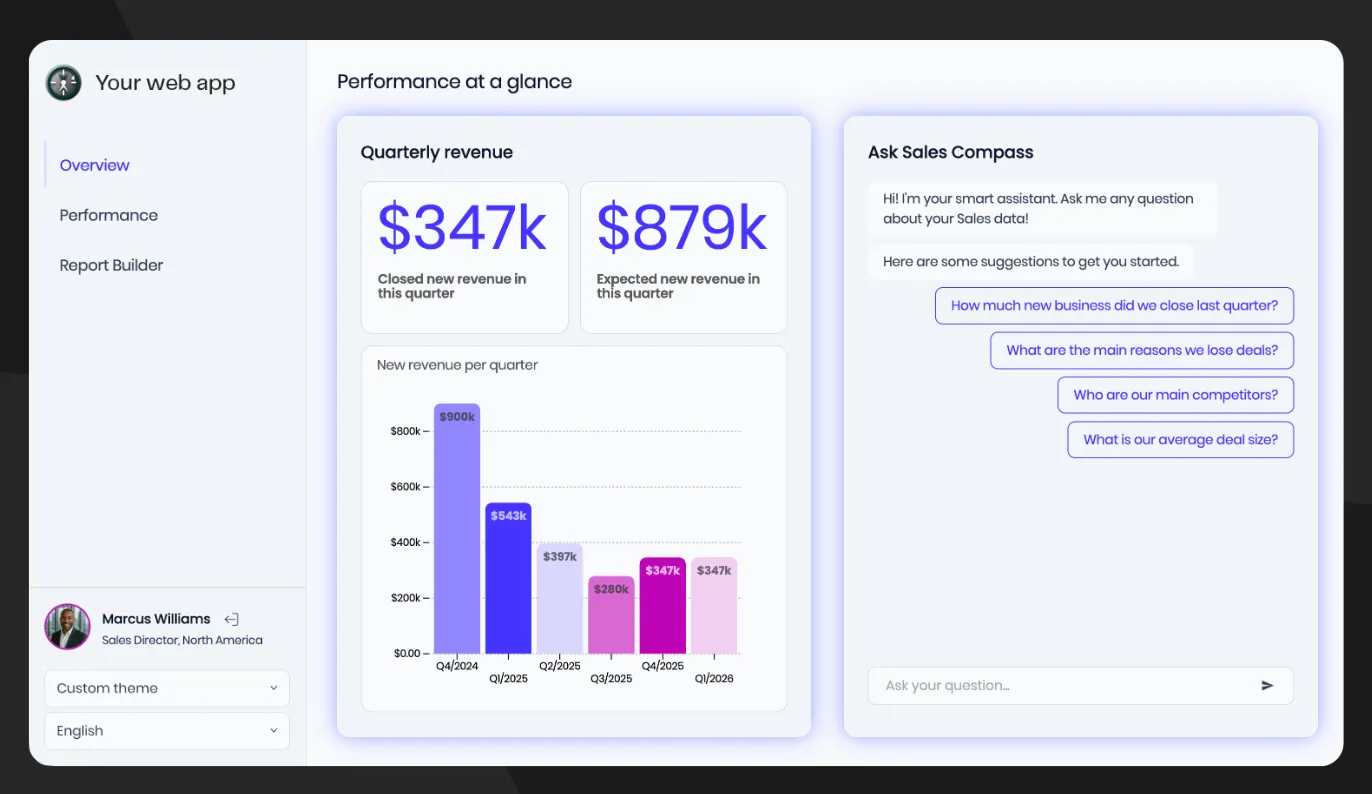
Luzmo is built around one outcome: ship analytics that feel like a feature of your own product.
That difference shapes the product from the embedding method to pricing.
Native analytics without building the whole experience yourself
Cube gives you multiple surfaces on top of a semantic layer. Luzmo starts closer to the finished customer experience.
Product teams can build dashboards visually, connect them to customer data and embed them inside an application without first building a separate front-end analytics layer.
For deeper customization, Luzmo also supports SDKs, APIs and component-level building blocks.
That gives teams two paths.
You can launch quickly with a ready-made embedded experience, then move toward more custom interfaces as your product matures. You do not have to choose between "simple iframe" and "build most of the UI yourself."
The goal is analytics that disappear into the host product.
Self-service designed for your customers
A static dashboard is rarely the end state.
Customers eventually ask for another filter, another breakdown or a view tailored to their own workflow. If every request becomes a ticket for your product or data team, embedded analytics creates a new support queue instead of reducing one.
Luzmo's self-service analytics lets end users explore data and build or modify dashboards inside your product, under the permissions you define.
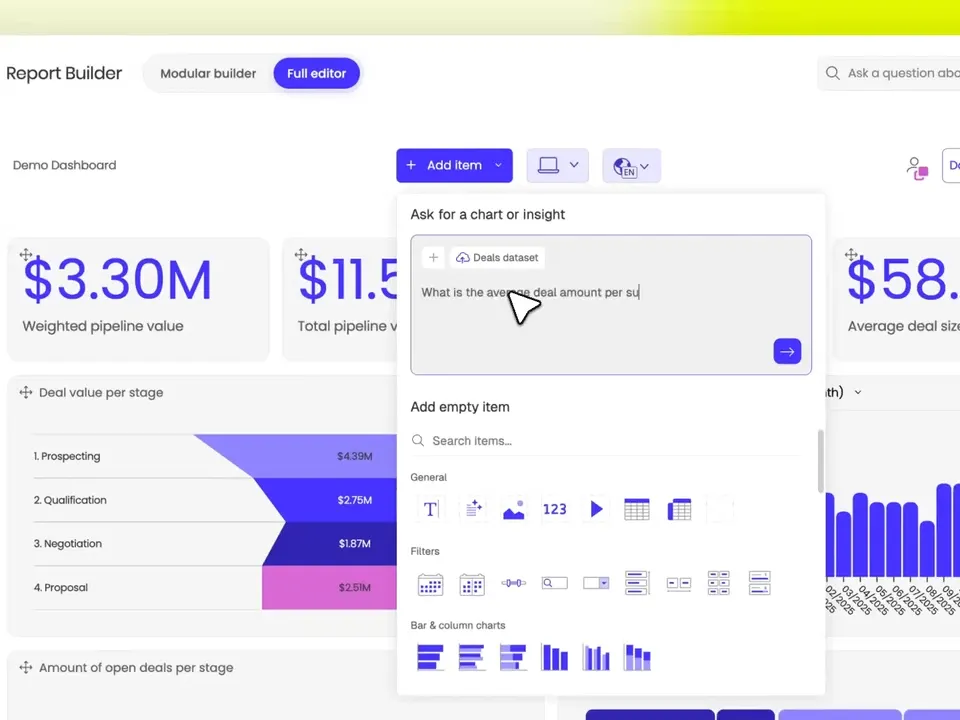
This is especially useful for multi-tenant SaaS products. One customer may want a high-level executive dashboard while another needs detailed operational views. The product can support both without creating a separate analytics implementation for every account.
Luzmo handles multi-tenant analytics with tenant-aware access controls so customer data stays separated while teams reuse the same analytics foundation.
Composable analytics when the UI needs to become truly yours
Some teams outgrow dashboards.
You may want a KPI inside a workflow, a chart next to a table, an analytics panel inside a customer profile or a completely custom data experience tied to your design system.
That is where composable analytics becomes important.
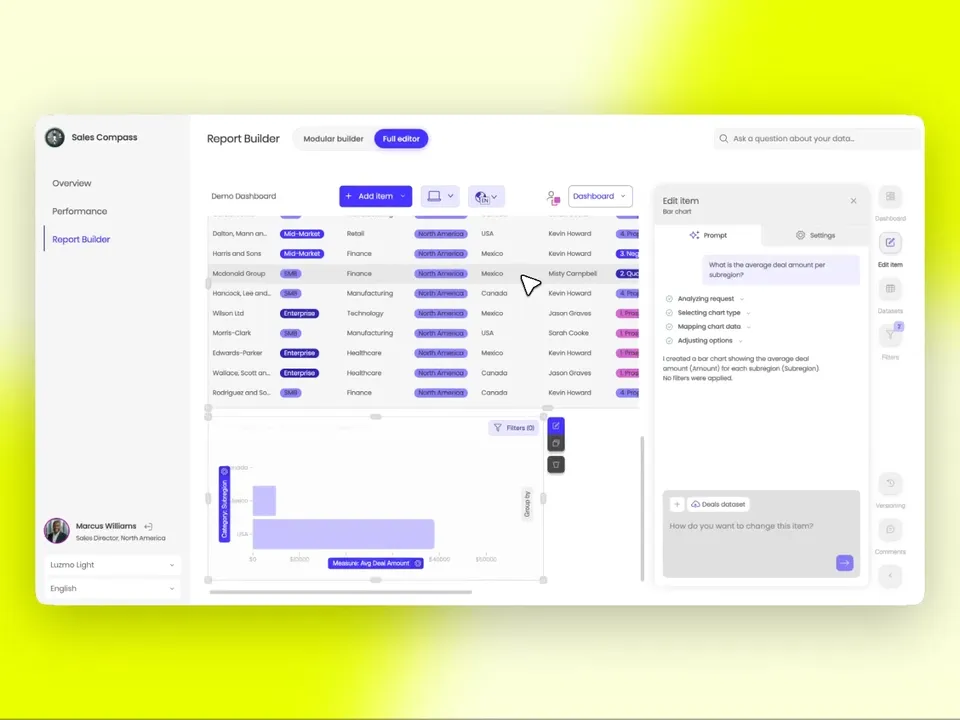
Instead of treating the dashboard as the smallest unit, developers can work with individual analytics components and build them into the product.
This gives product teams more UI control without asking them to recreate data querying, permissions and analytics behavior from scratch.
For a deeper explanation of the model, see what composable analytics is.
Embedded AI that stays inside the product experience
Cube has invested heavily in agentic analytics and analytics chat. This is one of its strongest areas in 2026.
Luzmo takes a different route to a similar end-user goal: let users ask questions of their data without leaving the product they already use.
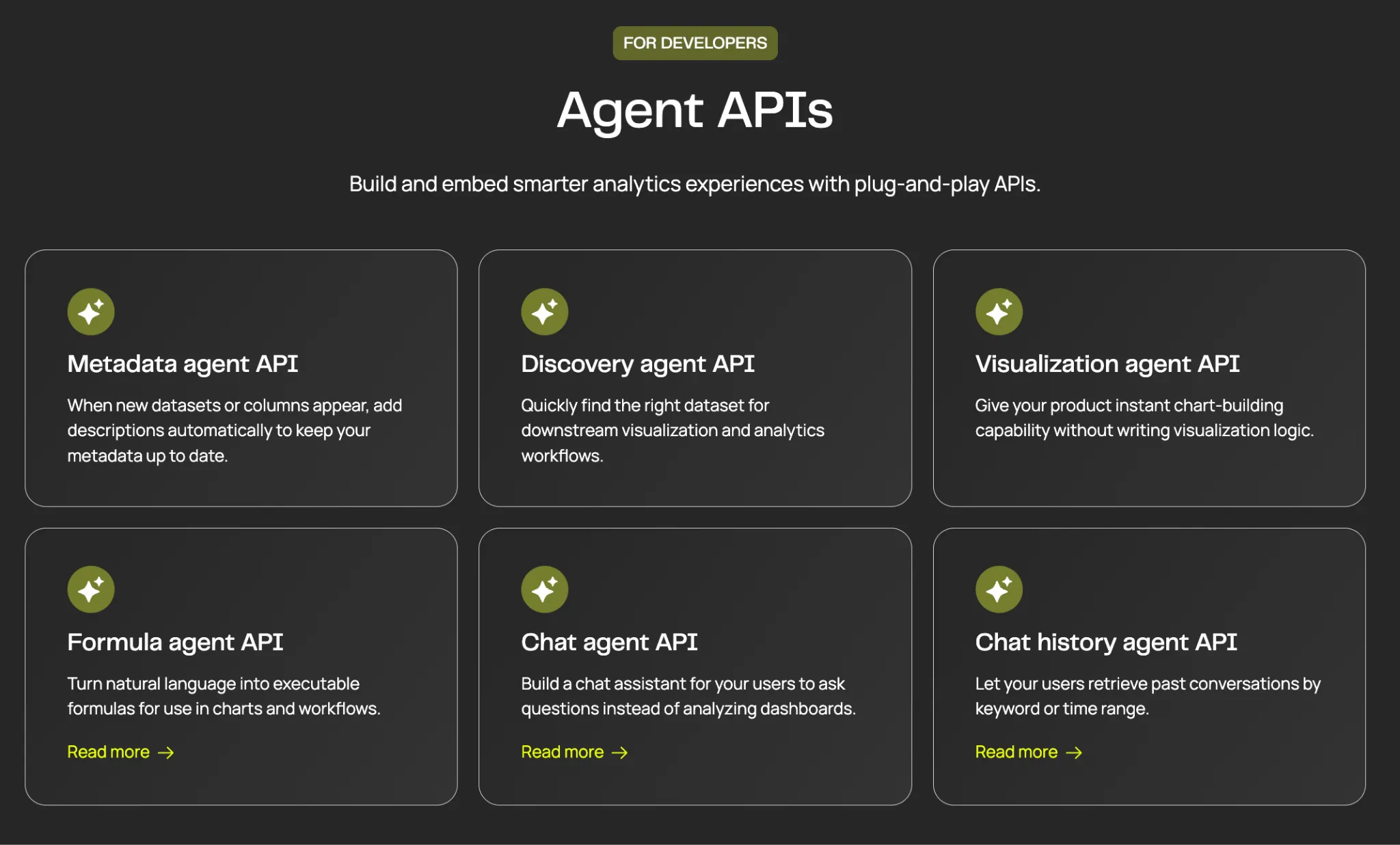
Luzmo IQ is a conversational analytics experience designed to sit inside a customer-facing application. Users ask questions in plain language and get answers grounded in governed data.
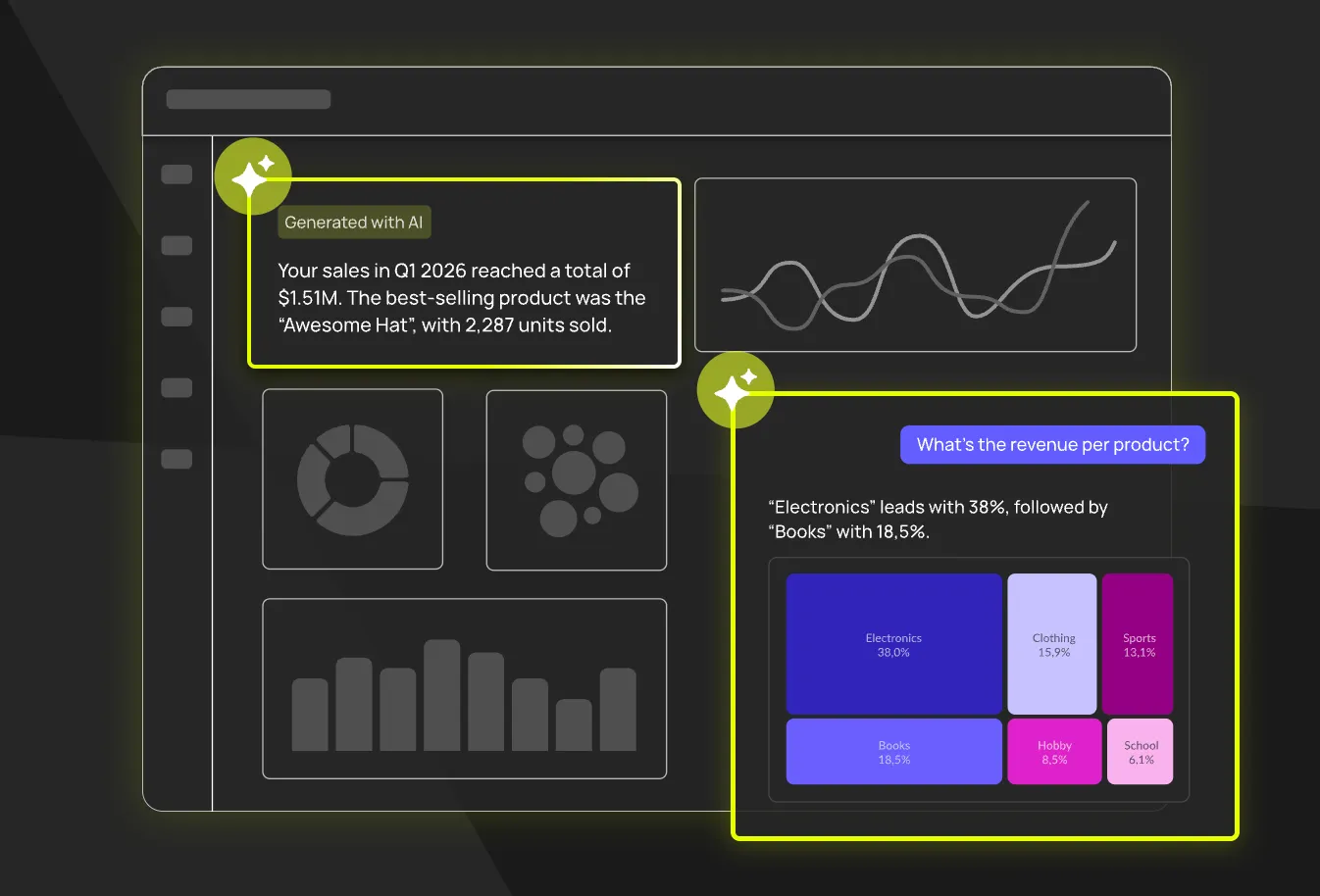
For product teams, the practical difference is where the implementation starts.
Cube starts from a semantic layer that can power AI, BI and embedded surfaces. Luzmo starts from an embedded analytics product experience and adds AI inside that experience.
Choose based on which foundation matches your roadmap.
Pricing designed around product usage
Luzmo publishes its pricing.
Embedded Everywhere begins at €1,995 per month, billed annually, and Enterprise requirements change the deployment rather than the product feature set. Plans are tied to the solutions you deploy and monthly active users rather than charging every external viewer as a named BI seat.
That can make forecasting easier for SaaS products where many customers may have access to analytics but only a portion use them in a given month.
The full breakdown is available on the Luzmo pricing page.
Best for: SaaS product teams that want to ship native customer-facing analytics quickly, add self-service over time, support secure multi-tenancy and keep control over the product experience without building the analytics stack from scratch.
2. GoodData
GoodData is a strong Cube alternative for enterprises that care deeply about governance, semantic modeling and deployment flexibility.
Like Cube, it treats the governed analytics layer as foundational. GoodData supports embedded analytics, APIs and custom applications while putting strong emphasis on controlled metrics and enterprise security.
That makes it a better comparison for Cube than a lightweight dashboard tool.
Where GoodData differs is in its enterprise orientation. It has years of experience with large embedded deployments and supports organizations that need tighter control over hosting, data residency and security.
The trade-off is complexity.
A company choosing GoodData is usually making a platform decision, not adding a simple dashboard feature. Modeling, governance and implementation require more planning than a lightweight embedded tool.
Luzmo's GoodData review goes deeper into the platform's strengths and trade-offs.
Best for: larger enterprises, regulated industries and teams that want governed analytics with flexible deployment options and have the resources to support a more involved implementation.
3. Looker
Looker remains one of the strongest choices for companies that want a mature semantic layer and already run heavily on Google Cloud.
Its core modeling system, LookML, gives teams a centralized way to define metrics, dimensions and business logic. Those definitions can feed dashboards, exploration and embedded experiences.
Google also offers a dedicated Looker Embed edition for external analytics and custom applications.
For a company comparing Cube and Looker, the overlap is clear: both can act as a governed layer between the warehouse and many analytics surfaces.
The difference often comes down to ecosystem and operating model.
Looker makes the most sense when your company already has LookML expertise, a data team that owns the model and a strong Google Cloud footprint. It can be administratively heavy for smaller SaaS teams that primarily want to ship customer-facing dashboards.
Pricing is also sales-led. Google lists platform and user licensing as separate parts of Looker pricing, with the final cost quoted through sales.
See the full Luzmo vs. Looker comparison for a more detailed breakdown.
Best for: enterprises standardized on Google Cloud that want mature semantic modeling, strong governance and embedded analytics from the same BI platform.
4. Omni
Omni is a natural Cube alternative for modern data teams that want a semantic layer without giving up flexible exploration.
The platform combines modeled, governed metrics with point-and-click analysis and SQL. It can support both internal analytics and customer-facing data products.
That puts Omni and Cube in a similar strategic category: both want one trusted analytics foundation to serve multiple user experiences.
Omni may appeal more to teams that want a polished analyst-facing BI environment around the model. Cube may appeal more when teams want the semantic and API layer to act as infrastructure across many tools and agents.
For product teams, neither is as narrowly focused on embedded customer-facing analytics as Luzmo.
Omni's pricing is not published as a simple public plan table, so buyers should validate embedded user economics and deployment costs during procurement.
For a full breakdown, read the best Omni Analytics alternatives.
Best for: data teams that want governed metrics, flexible exploration and both internal and external analytics from one warehouse-first platform.
5. Holistics
Holistics is a good Cube alternative for SQL-first teams that like code-based analytics workflows but want a more traditional BI experience around them.
The platform supports semantic modeling, dbt integration, Git workflows, dashboards and self-service analytics.
Its core pricing is unusually transparent for this category. Current public plans include Entry, Standard and a Security Compliance Suite, while embedded analytics uses custom pricing and includes capabilities such as white-labeling, dynamic row-level permissions and unlimited dashboard viewers.
If dbt is already where your business logic lives, the closest comparison isn't really Holistics but the dbt-native tools, and the Lightdash alternatives for dbt-native analytics cover that group. Holistics sits slightly apart because it brings its own modelling language alongside dbt support, so you aren't fully committed to one transformation tool. For a closer look at that trade, see the Holistics alternatives with a modelling layer.
Compared with Cube, Holistics is less focused on being an infrastructure layer for APIs and agents across an entire data stack.
That can be a benefit when the team wants governed BI without turning the analytics platform into a broader application architecture project.
Embedded analytics is available, but product teams should evaluate how much customization they need and how the embedded experience fits their UI.
Best for: SQL-first data teams that value code-based modeling, dbt workflows and transparent core BI pricing.
6. Metabase
Metabase is one of the easiest alternatives to shortlist because it covers a wide price range.
The open-source edition is free to self-host, which makes it attractive for teams experimenting with BI or building internal analytics on a tight budget.
Paid plans add the capabilities product teams need for more serious embedding.
Metabase Pro currently starts at $575 per month before annual discounts and user-based charges. It includes multi-tenant embedded analytics, white-labeling, row and column security, SSO and modular embedding capabilities.
That is a major evolution from Metabase's earlier reputation as "just an open-source internal BI tool."
Still, its product DNA remains broader than customer-facing embedded analytics alone. Product teams should model user-based pricing carefully as external adoption grows.
Metabase is the clearest illustration of the dashboard-first end of the spectrum, where Cube sits at the headless end. If you want to weigh that whole axis, our guide to Metabase alternatives with a more technical stack runs from GUI-first tools through to semantic layers.
Best for: teams that want an open-source starting point, need standard BI alongside embedding or want to start small and move into paid embedded capabilities later.
7. Sisense
Sisense is a mature enterprise analytics platform with a strong embedded focus.
Its Compose SDK gives development teams control over how analytics components appear inside an application. Sisense also supports iframe embedding, multi-tenant architectures, white-labeling and enterprise deployment requirements.
In 2026, the company is pushing further into AI with Sisense Intelligence and natural-language analytics.
Compared with Cube, Sisense puts more of the analytics application layer in the product itself. Cube puts more emphasis on the governed semantic foundation that can serve many downstream surfaces.
The trade-off is procurement and implementation complexity.
Sisense pricing remains largely custom and enterprise deployments can involve more setup than lighter embedded platforms. Teams should verify which capabilities sit on each plan and how costs scale with external users.
Luzmo's guide to Sisense pricing covers the commercial side in more detail.
Best for: enterprise teams that want mature embedded analytics, SDK-level customization and hands-on support for complex deployments.
How to choose the right Cube alternative
Start with the reason Cube made your shortlist.
If it was the semantic layer, be clear about how central you need that layer to be before choosing a platform.
If it was the ability to build APIs and data products on top of governed metrics, Cube may still be the right fit. The question is how much of that infrastructure you genuinely need.
The biggest mistake is comparing feature checklists without deciding what layer you are actually buying.
Cube can be a semantic and data-serving foundation, a BI environment and an embedded platform.
A purpose-built embedded vendor is a different purchase. It takes ownership of more of the analytics experience your customers actually see.
That distinction matters more than counting chart types.
Compare semantic layer and analytics platforms
If Cube is part of your stack evaluation, these alternatives are especially relevant for semantic modeling, analytics-as-code and developer-led BI:
Need the analytics experience to live inside your SaaS product? Explore Luzmo for embedded analytics.
The bottom line
Cube is a compelling product for teams that want one governed semantic layer powering analytics, APIs and AI.
Its 2026 expansion into embedded dashboards and analytics chat makes it much more than the headless semantic-layer tool many buyers still remember.
But broader does not automatically mean better for every use case.
For SaaS product teams whose main job is to ship analytics customers will actually use, the better alternative may be the platform that starts with the product experience rather than the semantic architecture.
Luzmo is the strongest fit in that scenario. It combines embedded analytics, self-service, composable components, multi-tenancy and embedded AI without asking your team to assemble each layer separately.
Cube is strongest when the governed model is the center.
Luzmo is strongest when the customer-facing analytics experience is the center.
That is the decision to make first.
FAQ
All your questions answered.
What is Cube?
Cube is an analytics platform built around a semantic layer. It lets teams define governed metrics and permissions once, then use them across business intelligence, embedded analytics, APIs and AI experiences.
How much does Cube cost?
Cube has a Free plan, Starter at $40 per developer per month and Premium at $80 per developer per month. Premium includes embedded dashboards and embedded analytics chat. Enterprise pricing is custom. Infrastructure and additional seat costs can also apply depending on the deployment.
What is the best Cube alternative for embedded analytics?
Luzmo is the best Cube alternative when your main goal is customer-facing embedded analytics. It is built around native product experiences, self-service analytics, multi-tenancy, composable components and embedded AI rather than requiring the semantic layer to be the center of the implementation.
What is the best open-source Cube alternative?
Metabase is the most accessible open-source alternative if you primarily need dashboards and BI. It has a free self-hosted edition, while advanced embedded features such as white-labeling, tenant isolation and modular embedding are available on paid plans.
Is Cube an embedded analytics platform?
Yes. Cube now offers multiple embedded analytics surfaces, including embedded dashboards, analytics chat, Creator Mode and data APIs. Its key difference from dedicated embedded analytics vendors is that these experiences sit on top of Cube's semantic layer, which remains the core of the architecture.
Which Cube alternative is open source?
Cube Core itself is Apache 2.0 licensed. Among alternatives, Metabase Open Source is free to self-host for dashboards and BI, and Apache Superset suits more technical teams. None of the three matches a commercial embedded platform on tenant isolation or white-labeling without real engineering work.
Cube vs Metabase: which is easier to embed?
Metabase is easier to get embedded quickly, since it ships a finished application and an embedding SDK. Cube gives you a governed semantic layer and expects you to build more of the customer-facing interface, which means more control and more engineering time.
Cube vs. Looker: which is better?
Cube is a strong fit for teams that want a semantic layer serving multiple tools, APIs and AI experiences. Looker is a stronger fit for organizations already invested in Google Cloud and LookML that want mature governed BI and embedding in one enterprise platform.
Cube vs. Luzmo: which is better for SaaS products?
Cube is stronger when a governed semantic layer is the foundation of a wider analytics stack. Luzmo is stronger when the priority is shipping native customer-facing analytics quickly, with self-service, composable UI, multi-tenant controls and AI built around the embedded product experience.
Written by

Ship the future of your data
Let us show you what Luzmo can do for your product.

Book your session with our analytics expert.