7 Best Holistics Alternatives in 2026 for Embedded and Code-First BI

Holistics sits in an interesting part of the BI market. It combines code-based semantic modeling, self-service analytics, dashboards, AI and embedded analytics in one platform, with Git workflows and dbt integration built into the way data teams work.
That mix is a strong fit for companies that want analytics to stay close to engineering practices.
It is not the only way to build an analytics stack, though.
A product team shipping customer-facing analytics may care more about how natively analytics fit into the application. A dbt-heavy data team may want a more open-source workflow. An enterprise may need a deeper governance layer. Another company may want a headless semantic layer that feeds several downstream tools instead of bundling modeling and BI in one product.
The best Holistics alternative depends on which part of the platform matters most to you.
The 7 best Holistics alternatives in 2026 are:
- Luzmo: best overall for native, customer-facing embedded analytics
- Lightdash: best for dbt-first teams that want open-source, analytics-as-code workflows
- Looker: best for mature semantic modeling in the Google Cloud ecosystem
- Omni: best for modern warehouse-first BI with governed exploration
- Metabase: best for an accessible open-source BI starting point
- Cube: best for a headless semantic layer serving multiple analytics surfaces
- GoodData: best for governed enterprise and multi-tenant analytics deployments
Holistics alternatives at a glance
| Tool | Best for | Embedded-first? | Public pricing? | AI capabilities |
|---|---|---|---|---|
| Luzmo | Native customer-facing analytics in SaaS products | Yes | Yes, MAU-based plans | Luzmo AI + Luzmo IQ |
| Lightdash | dbt-first analytics teams and analytics-as-code workflows | No, BI-first with embedding add-on | Yes | AI agents + MCP |
| Looker | Enterprises standardized on Google Cloud and LookML | No, broad BI + dedicated Embed edition | No, quote-based | Conversational Analytics powered by Gemini |
| Omni | Warehouse-first teams combining governed metrics and exploration | Internal + embedded analytics | No public list pricing | AI grounded in semantic models |
| Metabase | Open-source BI and lower-cost entry | No, embedding on paid plans | Yes | AI querying and embedded AI on paid tiers |
| Cube | Headless semantic layer, APIs and multiple analytics surfaces | No, semantic-layer-first | Yes for self-serve plans | Analytics chat + agentic use cases |
| GoodData | Enterprise governance, multi-tenancy and deployment flexibility | Strong embedded focus | Pricing model public, exact quotes sales-led | Embedded AI, agents and governed analytics |
Why look for a Holistics alternative?
Holistics has become a much broader platform in 2026.
It now positions itself around analytics-as-code, AI, self-service and embedded analytics, rather than simply being a SQL-based BI tool. Its embedded product supports branded dashboards, secure multi-tenancy and full analytics portals.
That makes it a credible option.
The trade-offs come from how it is built.
The primary embedding route is a signed iframe
Holistics can make embedded analytics look branded and integrated. It supports white-labeling, custom domains and row-level permissions.
On mechanics, its embedded documentation describes generating a signed URL that loads inside an iframe, with the payload signed using an HMAC-256 mechanism and a JWT token carrying the viewer's identity and permissions. Holistics recommends a short token expiry, commonly 24 hours, to limit exposure if a token leaks. Holistics also documents JavaScript SDK embedding for deeper integration, so iframe isn't the only route, but it is the quick-setup path most implementations start from.
For many use cases, that is perfectly fine. Iframes are fast to deploy and keep most of the analytics application contained inside the vendor's environment, and the signed-URL model is a sound security design.
The ceiling appears when your product team wants analytics to behave less like an embedded destination and more like individual parts of the product UI.
A KPI beside a workflow. A chart inside a customer record. An analytics control that reacts to your application's state. A custom interaction that needs to feel exactly like the rest of your design system.
Holistics itself describes iframe embedding as one integration method with trade-offs in styling and control, with the JavaScript SDK as the deeper-integration option. Worth confirming which method your intended plan covers, and testing the SDK route against your design system before assuming it closes the gap.
Teams that need deeper UI composition may prefer an embedded analytics platform with native components, SDKs and APIs designed for analytics to disappear further into the host product.
Embedded pricing is not publicly listed
Holistics is more transparent than many BI vendors when it comes to its core plans.
Its current US monthly pricing starts at:
- Entry: $960 per month
- Standard: $1,200 per month
- Security Compliance Suite: $2,400 per month
Annual billing lowers those effective monthly rates to $800, $1,000 and $2,000 respectively.
Embedded analytics is different.
Holistics lists it as a custom offering with white-labeling, dynamic row-level permissions, unlimited dashboard viewers and interactive visualizations, but does not publish a standard embedded price.
That means teams can compare the cost of internal BI before talking to sales, but not the full cost of a customer-facing deployment.
For SaaS companies, that distinction matters. External adoption can scale very differently from internal BI usage.
Luzmo, for example, publishes embedded analytics pricing around the solutions you deploy and monthly active users.
Analytics-as-code is a strength, but not every team needs it
Holistics is clearly built for data teams that value software development workflows.
Its positioning leans into version control, Git, code-defined models, dbt integration and a semantic layer maintained with engineering discipline.
For the right team, that is a major advantage.
But a product manager trying to launch a customer dashboard may not want analytics to become another codebase to own.
A small SaaS company may prefer a visual workflow where analysts and product teams can build dashboards quickly, while developers step in only for deeper customization.
The right question is not "Is analytics-as-code better?"
It is: does your analytics team actually want to work that way?
If not, a tool with a stronger visual build experience and self-service analytics may get more people involved without pushing every change through a technical workflow.
A full BI platform can be more than an embedded use case needs
Holistics supports internal analytics, semantic modeling, dashboards, scheduled delivery, AI and embedding.
That breadth is useful when one platform needs to serve the whole organization.
But some software companies have a narrower job to solve.
They already have a warehouse. They already have internal BI. What they need is a customer-facing analytics layer that can ship inside their product without turning into a second BI transformation project.
In that scenario, a purpose-built embedded platform can be simpler to evaluate.
You are choosing based on the user experience your customers see, not replacing every part of your internal analytics stack.
For a wider category comparison, see Luzmo's guide to the best embedded analytics tools.
White-labeling and native composition are not the same thing
Holistics offers white-labeling for embedded analytics.
That matters, but white-labeling can mean different things.
Changing logos, colors, domains and dashboard styling can make an embedded BI interface look much closer to your product. Native composition goes further: the analytics components themselves can sit inside your existing layouts and interaction patterns.
This distinction becomes more important as analytics spread beyond a single "Reports" tab.
For teams building a deeply integrated data experience, compare not only how well a vendor can theme a dashboard, but how much control you get below the dashboard level.
That is where composable analytics becomes a different product model.
How much does Holistics cost?
Holistics publishes pricing for its main BI plans.
On monthly billing in the US:
- Entry: $960 per month, including 100 reports and the first 10 users
- Standard: $1,200 per month, with unlimited reports and the first 10 users
- Security Compliance Suite: $2,400 per month, adding more granular identity and access controls
- Custom Plan: quote-based
- Embedded Analytics: custom pricing
Annual billing reduces the effective monthly cost of the first three plans to $800, $1,000 and $2,000.
Extra users and report capacity can add to the bill on applicable plans.
Holistics says embedded analytics includes unlimited dashboard viewers, along with options such as white-labeling and dynamic row-level permissions. The company asks buyers to contact sales for pricing.
That makes the embedded model worth quoting against a realistic scenario before you choose.
Use the same assumptions for every vendor: number of tenants, monthly active users, dashboard builders, self-service users, expected traffic, dev/stage/prod environments and any AI usage.
How we evaluated Holistics alternatives
We compared these platforms on the criteria that decide a code-first BI or embedded analytics choice:
- Modelling language. Whether you write models in the vendor's own language, in dbt, or not at all.
- dbt dependency. Whether dbt is required, optional or irrelevant. This is the sharpest fork in the group.
- Git workflow. Whether models and dashboards are version-controlled files or GUI state you can't diff.
- Embedding method. Signed iframe, SDK or native components, and what each costs you in frontend control.
- Frontend control. How much of the customer-facing interface you own versus configure.
- Pricing structure. Published platform tiers versus custom embedded quotes, and whether those are the same purchase.
Research date. Product and pricing facts were checked against current vendor documentation on August 5, 2026.
Our bias, stated plainly. Luzmo builds embedded analytics, so we compete with Holistics where the goal is customer-facing product analytics. We don't compete with it as an internal analytics-as-code platform, and if that's what you need, Holistics is genuinely good at it. Below, Lightdash wins for dbt-native teams, Cube for headless architecture and Metabase on cost, and those recommendations are meant literally.
Holistics versus Lightdash versus Cube
These three get shortlisted together constantly because they all promise code-first analytics. They're actually solving different problems:
| Holistics | Lightdash | Cube | |
|---|---|---|---|
| Modelling | Own language (AQL), plus dbt support | dbt is the semantic layer | Own semantic layer, can consume dbt |
| Ships an interface? | Yes, full BI application | Yes, full BI application | No, headless by design |
| Open source | No | Yes, self-hosted edition | Yes, Cube Core under Apache 2.0 |
| Embedding | Signed iframe, plus JavaScript SDK | Iframe and React SDK, add-on priced | APIs, iframes, creator-mode |
| Published price | Entry $960/month, or $800 billed annually | Cloud Pro $3,000/month | Cube Cloud from $40 per developer/month |
| Embedded pricing | Custom, unlimited viewers | Add-on, $0.05/load or $790/month per Embed Worker | Included in Premium |
| Best when | You want code-first modelling without tying everything to dbt | dbt already defines your metrics | Several surfaces must share one metrics layer |
The practical read: pick Lightdash if your metrics already live in dbt and you want that to stay the single source of truth, and compare the Lightdash alternatives for dbt teams if you're weighing that group. Pick Cube if the semantic layer needs to outlive any one interface, and the Cube alternatives for a headless semantic layer cover that architecture. Pick Holistics if you want analytics-as-code with a finished BI application and no hard dbt dependency.
There's a fourth pattern worth knowing: BI-as-code tools define dashboards in YAML or SQL and optimise for fast operational exploration rather than governed reporting. If your questions are operational, the Rill alternatives for BI-as-code are the better comparison.
And the opposite end of the spectrum: if nobody on your team actually wants to write models in code, that's worth admitting early rather than three months in. The Metabase alternatives for dashboard-first teams cover the GUI-first options, and there's no shame in that being the right answer.
Migration effort and model portability
Leaving Holistics is mostly a question of how portable your models are, and the answer is less comforting than "it's all code":
- AQL doesn't port. Holistics models are written in its own language. Version-controlled files are easier to read and reason about than GUI state, but they still need rewriting against whatever the target platform uses. Being in Git makes migration auditable, not automatic.
- dbt models do port. Anything you've defined in dbt moves cleanly, which is the strongest argument for pushing logic into dbt rather than into a vendor's modelling layer, whoever the vendor is.
- Re-derive permissions from scratch. Row-level rules and tenant boundaries should be rebuilt and tested with real tenant data, never ported unreviewed. This is where migration bugs turn into data-exposure incidents.
- Embedded integrations get rewritten. If you're on the signed-iframe route, moving to a component-based platform means changing how analytics is placed in your app, not just where it points.
- Audit before you port. Count which dashboards people actually open. The long tail is an opportunity to retire things rather than carry them forward.
- Separate the two purchases. Holistics prices internal BI publicly and embedded analytics custom. When you compare alternatives, make sure you're comparing the right one, because mixing the entry BI price with a competitor's embedded price is how these evaluations go wrong.
Best alternatives to Holistics
1. Luzmo: best overall Holistics alternative for customer-facing embedded analytics
If you like Holistics because it can put analytics inside your product, but your priority is the product experience rather than running a broader BI platform, Luzmo is the strongest alternative.
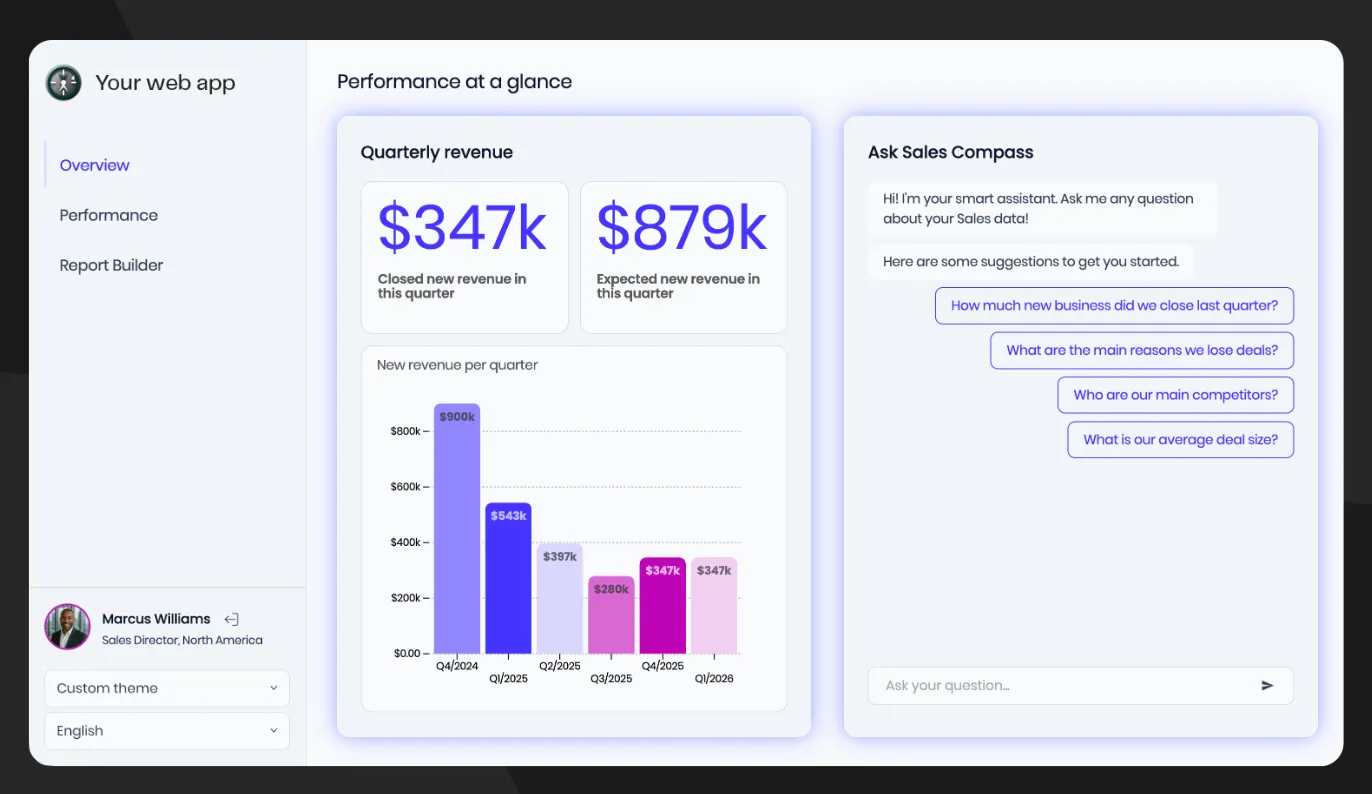
Luzmo was built around embedded, customer-facing analytics.
That difference shows up in the way teams build, embed, customize and scale the experience.
Build visually first, add code when you need it
Holistics puts strong emphasis on analytics-as-code and a governed semantic layer.
Luzmo gives teams a more visual starting point.
Product managers, analysts and designers can build dashboards in a drag-and-drop environment, connect data and get an embedded experience running without turning every dashboard change into an engineering task.
Developers still have APIs and SDKs when the product needs more control.
That balance works well for SaaS teams where analytics is shared ownership. The data team may define access and logic, the product team shapes the experience and engineering handles the deeper integration points.
You do not have to choose between no-code and code-first from day one.
Customer self-service without exposing a BI tool
Customer-facing analytics changes once users want to build their own views.
A fixed dashboard can answer the first five questions. It rarely answers the next fifty.
Luzmo's self-service analytics lets end users edit or create dashboards inside the product while staying inside the permissions and data access model the product team controls.
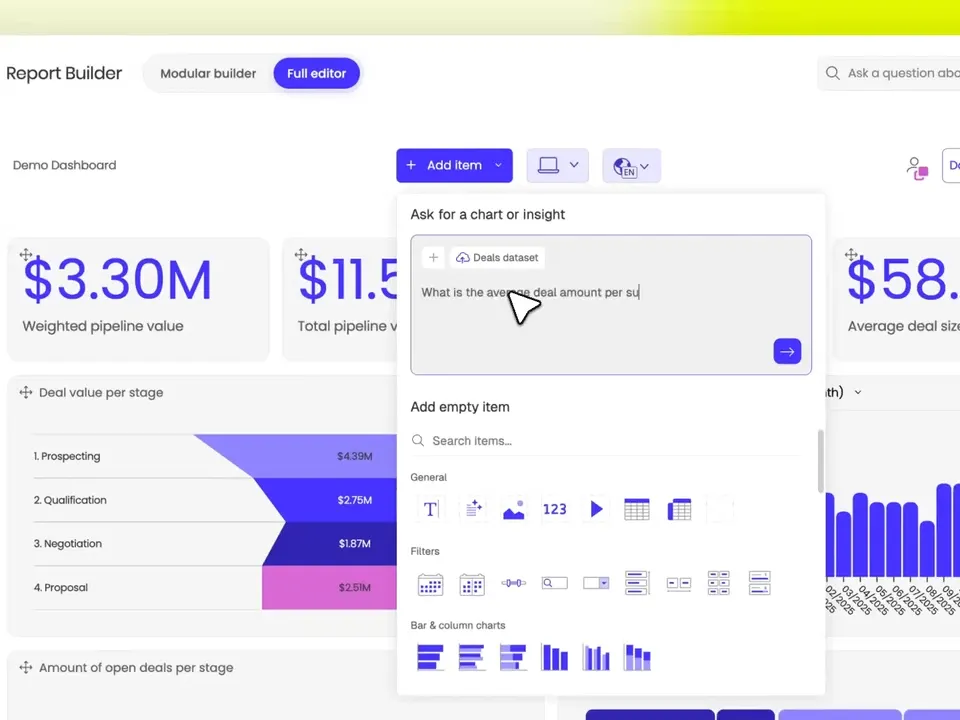
The goal is not to give every customer access to an internal BI environment.
It is to give them enough freedom to answer their own questions inside your application.
This works particularly well in multi-tenant analytics, where many customers share the same product but need isolated data and different analytics experiences.
Go below the dashboard with composable analytics
An iframe is fast when the dashboard itself is the product surface.
It becomes less flexible when analytics need to appear across many workflows.
Luzmo's composable analytics gives developers a component-level route.
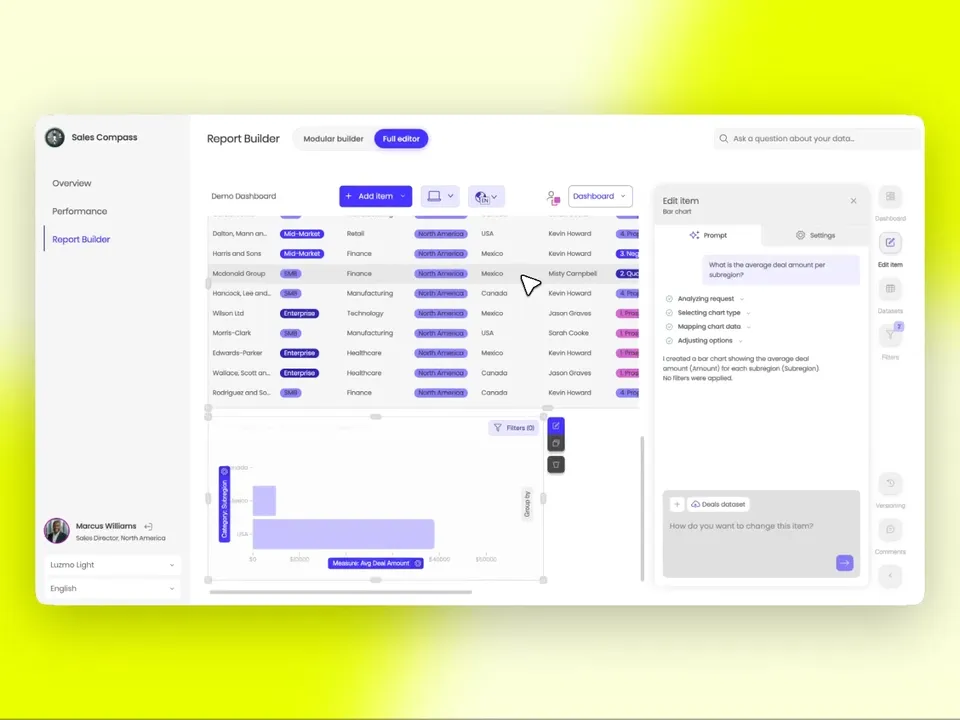
Instead of embedding one complete analytics application, teams can assemble analytics components into their own UI.
That is useful when a chart needs to sit next to a form, a KPI belongs inside a workflow or analytics have to follow an existing design system closely.
You keep the analytics engine, permissions and data behavior while taking more control over how the experience is composed.
The guide to what composable analytics is explains the difference in more detail.
Embedded AI as part of the customer experience
Holistics has moved quickly into AI. Its current positioning includes AI analysis grounded in the same semantic layer that powers dashboards.
Luzmo also treats governance as central, but starts from the embedded user experience.
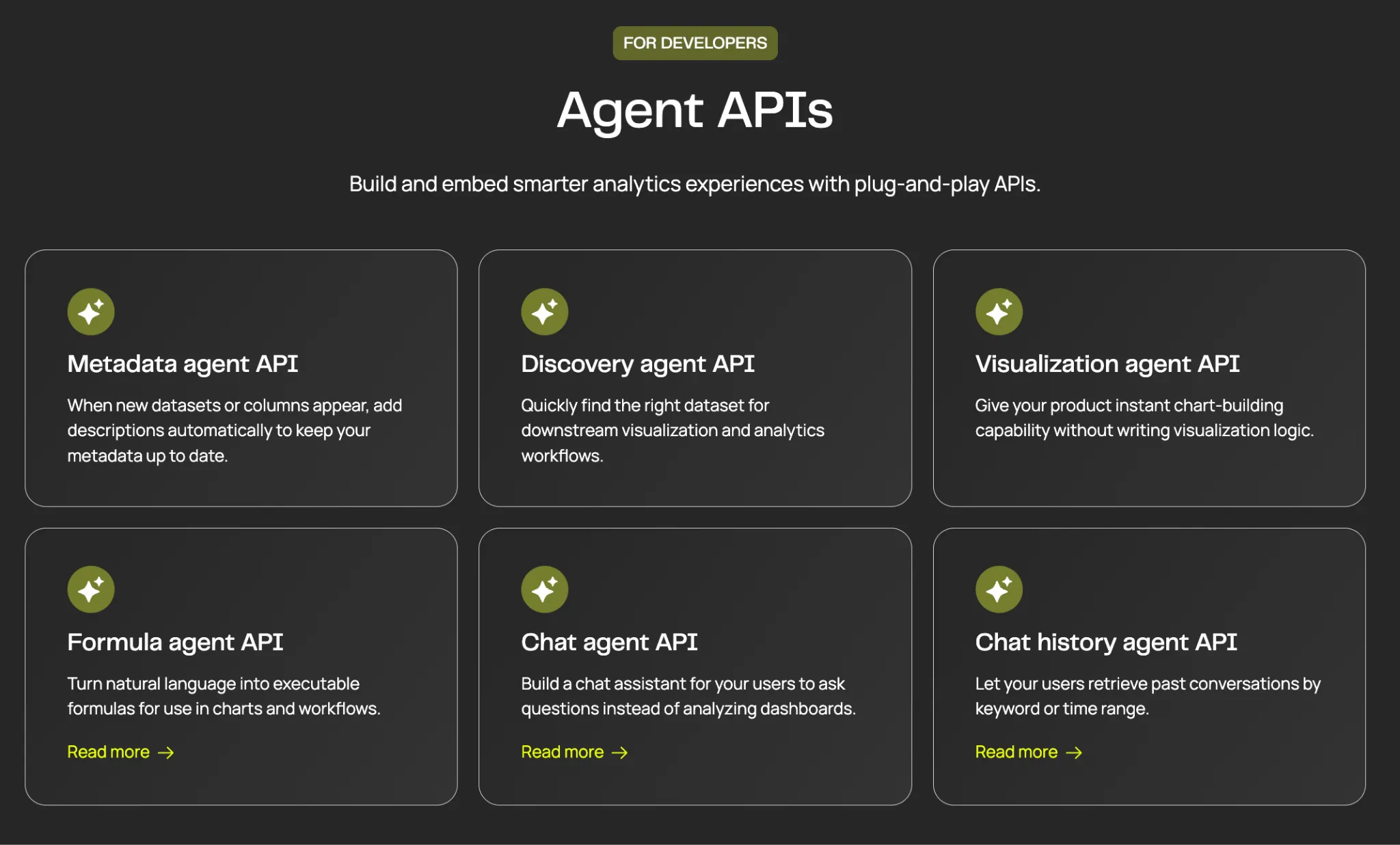
Luzmo IQ lets end users ask questions in plain language inside the host application.
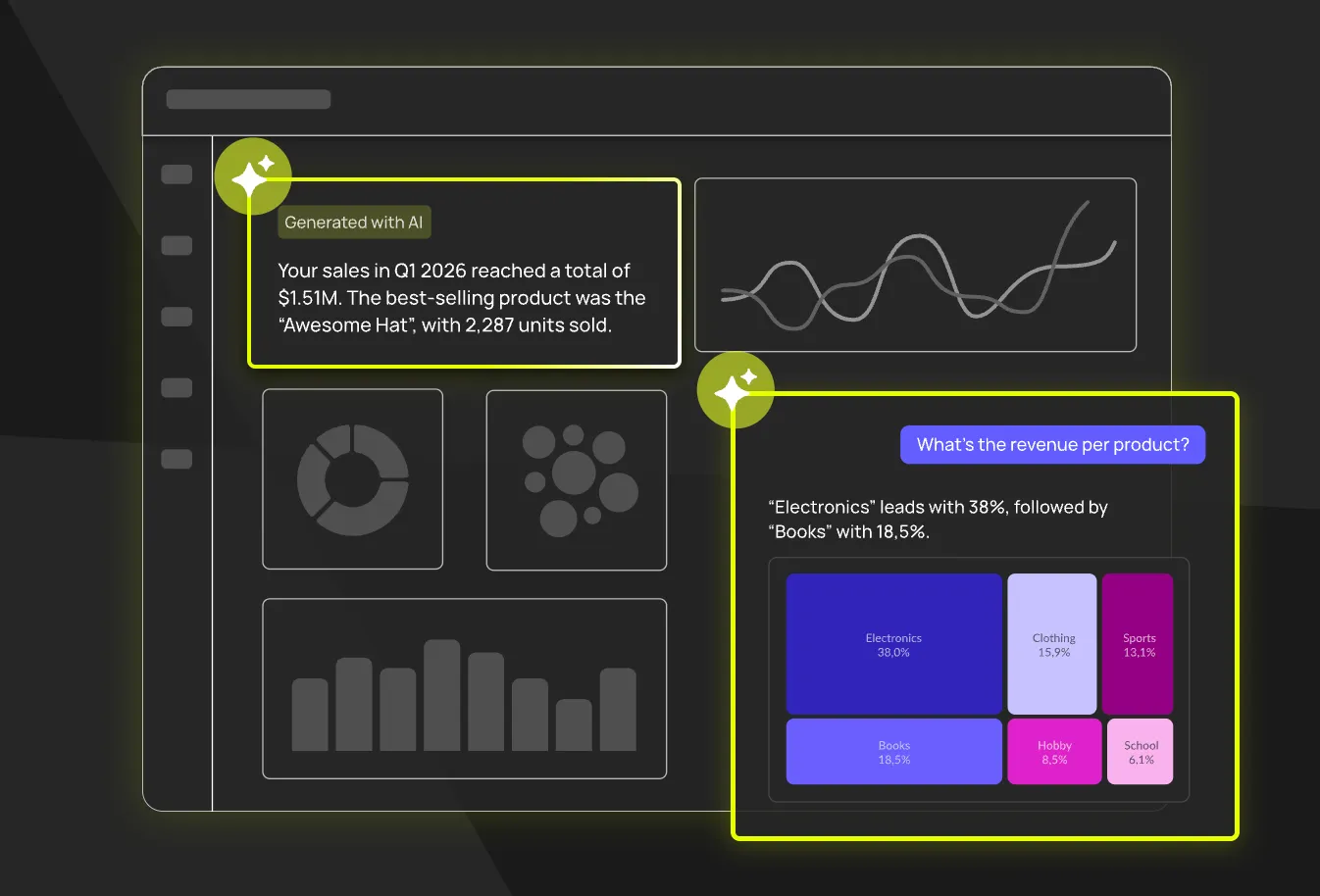
That matters for SaaS teams because AI is not a separate destination users have to learn.
It becomes another way to interact with the analytics already inside the product.
The larger positioning difference is simple.
Holistics starts from a BI and semantic layer platform that can also be embedded.
Luzmo starts from analytics that need to live natively inside someone else's product.
Transparent pricing for embedded use
Luzmo currently starts at €1,995 per month, billed annually, on a single Embedded Everywhere plan combining a platform fee with adoption-based usage. Enterprise requirements change the deployment rather than the product feature set.
The single plan combines a platform fee with adoption-based usage.
The plan includes embedded, white-labeled analytics, custom charts and themes, AI-assisted dashboarding plus API and SDK access. Self-service analytics and Luzmo IQ are included rather than reserved for a higher tier.
That makes it easier to model a customer-facing use case before entering procurement.
See the current Luzmo pricing for the full breakdown.
Best for: SaaS product teams that want analytics to feel native, need fast implementation, want self-service for external users and need a path from ready-made dashboards to component-level experiences.
2. Lightdash
Lightdash is the most natural Holistics alternative for teams that like analytics-as-code but want a stronger dbt-first and open-source path.
Its open-source edition can be self-hosted. Cloud Pro currently costs $3,000 per month and includes unlimited users, a native dbt integration, a governed semantic layer, dashboards-as-code, AI agents and MCP.
The philosophical overlap with Holistics is strong.
Both tools treat analytics as something that should fit software development workflows rather than live only in a point-and-click BI interface.
The difference is where the workflow starts.
Lightdash grew directly around dbt. Teams with a mature dbt project can use that work as the basis for metrics, exploration and AI.
Embedding is available as an add-on through iframe and React SDK options. Lightdash currently offers pay-as-you-go embedding with the first 1,000 loads free and then $0.05 per load, or a predictable plan starting at $790 per month for 100,000 loads per Embed Worker.
For a company evaluating Holistics mainly because of Git, dbt and code-based governance, Lightdash deserves a serious look.
Best for: dbt-heavy data teams that want open-source optionality, unlimited BI users and analytics-as-code workflows.
3. Looker
Looker is the mature enterprise choice in this group.
Its LookML modeling layer has shaped the way modern BI teams think about governed metrics, reusable business logic and version-controlled analytics.
For organizations already standardized on Google Cloud, the ecosystem fit is hard to ignore.
Looker also has a dedicated Embed edition for external analytics and custom applications. Google documents signed embedding, custom themes, APIs and an Embed SDK, while conversational analytics adds Gemini-powered natural-language interaction on top of governed data.
The trade-off is weight.
Looker is an enterprise platform with annual, sales-led pricing. Its pricing model combines platform costs and user licensing, and implementation usually assumes teams can support LookML development and administration.
Holistics may feel lighter for teams that want code-defined BI without adopting the full Looker operating model.
Looker may feel safer for enterprises that want a mature semantic layer and already have the skills to run it.
See Luzmo vs. Looker and the current guide to Looker pricing for a deeper comparison.
Best for: enterprises with LookML expertise, a strong Google Cloud footprint and mature governance requirements.
4. Omni
Omni is a strong Holistics alternative for warehouse-first teams that want governed metrics and flexible exploration without making everything code-only.
Its founders came from Looker, and the product keeps the idea of a semantic layer while giving analysts several ways to work: modeled data, point-and-click exploration and SQL.
That can make Omni attractive to mixed teams.
A data engineer can care about governance. An analyst can explore quickly. Business users can consume dashboards without understanding how the model is built.
Omni has also pushed deeper into embedded analytics and AI in 2026.
The main trade-off versus Holistics is transparency and workflow preference.
Holistics publishes core BI pricing and leans more visibly into analytics-as-code. Omni pricing remains sales-led.
For a complete breakdown, read the best Omni Analytics alternatives.
Best for: modern data teams that want a governed semantic layer with flexible analyst exploration and both internal and embedded analytics.
5. Metabase
Metabase is a strong alternative when Holistics feels like more platform than you need.
Its open-source edition gives teams a free, self-hosted route into BI. The visual query builder also makes it accessible to users who do not want to work in SQL or code for every question.
That simplicity is its biggest advantage.
You can connect a database and get useful dashboards running quickly.
Paid tiers add the controls needed for more serious deployments, including white-labeling, row and column permissions, SSO and multi-tenant embedding.
The trade-off is that Metabase is not built around the same analytics-as-code philosophy as Holistics.
If Git-based modeling and sophisticated semantic definitions are the reason you are evaluating Holistics, Metabase may feel too lightweight.
If the goal is accessible BI with an open-source starting point, it may be exactly enough.
Read Luzmo's full guide to Metabase alternatives.
Best for: startups and smaller teams that want approachable BI, open-source flexibility and a lower barrier to entry.
6. Cube
Cube is a different kind of Holistics alternative.
Instead of bundling semantic modeling with one primary BI experience, Cube centers the semantic layer itself.
Teams define governed metrics, permissions and business logic, then serve that layer to several downstream surfaces through APIs, dashboards, analytics chat and other applications.
That model makes sense when the organization wants one data-serving foundation for more than BI.
Your product may need metrics. Internal dashboards need the same definitions. AI agents need governed context. Another application needs an API.
Cube can sit in the middle.
Holistics keeps more of the modeling and consumption experience inside one BI platform.
The trade-off is ownership. A headless or infrastructure-first model gives your team more architectural flexibility, but it can also leave more of the final user experience to your own developers.
Best for: engineering and data platform teams that want a reusable semantic layer serving several tools, APIs and AI experiences.
7. GoodData
GoodData is the enterprise-heavy option on this list.
It combines a governed semantic foundation with embedded analytics, multi-tenancy, AI, SDKs and deployment flexibility.
Its current Professional pricing model is based on a platform fee plus workspaces, with unlimited users and data. Exact pricing requires a sales conversation. Enterprise plans add more deployment, governance and support options.
For customer-facing products, GoodData supports white-labeling, embedded dashboards, self-service analytics and multi-tenant deployment patterns.
Compared with Holistics, GoodData is more likely to enter the conversation when enterprise architecture, deployment control and large-scale tenant management are major requirements.
The trade-off is implementation weight.
Smaller product teams may find themselves buying a broader platform than they need.
Luzmo has a full guide to GoodData competitors and a direct Luzmo vs. GoodData comparison.
Best for: enterprises and regulated products that need strong governance, multi-tenancy and deployment flexibility.
How to choose the right Holistics alternative
Start with the reason Holistics is on your shortlist.
The most important distinction is not the number of charts or connectors.
It is the layer you want the platform to own.
Holistics can own modeling, BI, self-service and an embedded analytics portal.
Lightdash is closer to a dbt-native analytics workflow.
Cube can become shared semantic infrastructure.
Luzmo owns more of the customer-facing product experience.
Choose that architecture first. Feature comparisons make much more sense after.
Compare analytics-as-code platforms
For teams comparing Holistics with other code-first or semantic-layer-driven options, these are the closest next reads:
Want customer-facing analytics without building the full frontend yourself? Explore Luzmo.
The bottom line
Holistics is a capable analytics platform for teams that like code-based governance, Git workflows, semantic modeling and self-service BI.
Its 2026 product is also much stronger in embedded analytics and AI than older descriptions of Holistics suggest. It supports white-labeling, tenant-aware permissions, embedded self-service and AI inside customer-facing experiences.
The decision is no longer "Holistics can or cannot embed."
It clearly can.
The better question is what kind of embedded experience do you want to build, and how much of it should the analytics vendor own?
For data teams that want analytics-as-code at the center, Holistics remains a compelling option.
For SaaS product teams that want analytics to disappear into their product, Luzmo is the stronger fit. It combines embedded analytics, self-service, multi-tenancy, composable components and AI around the customer-facing experience rather than around an internal BI workflow.
That is the distinction to make before comparing feature lists.
FAQ
All your questions answered.
What is Holistics?
Holistics is a business intelligence and analytics platform built around a governed semantic layer, analytics-as-code workflows, self-service BI, AI and embedded analytics. It supports Git version control, dbt integration, dashboards, scheduled reporting and customer-facing analytics.
How much does Holistics cost?
On monthly US billing, Holistics Entry costs $960 per month, Standard costs $1,200 per month and the Security Compliance Suite costs $2,400 per month. Annual billing lowers the effective monthly rates. Embedded analytics uses custom pricing.
What is the best Holistics alternative for embedded analytics?
Luzmo is the strongest Holistics alternative when the main goal is native, customer-facing embedded analytics. It combines visual dashboard building, white-labeling, secure multi-tenancy, self-service, composable components and embedded AI in one product-focused platform.
What is the best open-source alternative to Holistics?
Lightdash and Metabase are both strong open-source options for different reasons. Lightdash is better suited to dbt-first, analytics-as-code teams. Metabase is easier to start with for general BI and visual exploration.
Is Holistics open source?
No. Holistics is a commercial product, though it emphasises analytics-as-code, so your models and dashboards live in version-controlled files rather than locked in a GUI. If you need an open-source licence, Metabase, Cube Core and Lightdash all have self-hostable editions.
Which Holistics alternative is best for dbt?
Lightdash, since its workflow is built directly on dbt models and metrics. Cube can consume dbt models while keeping the semantic layer separate. Holistics supports dbt too, but its own modelling language sits alongside it rather than deferring to it entirely.
Does Holistics support embedded analytics?
Yes. Holistics supports embedded dashboards and full analytics portals, white-labeling, custom domains and secure multi-tenancy. Its documentation states that embedded content is delivered through signed URLs loaded in an iframe.
Holistics vs. Lightdash: which is better?
Holistics is a broader BI platform with its own semantic modeling language, dashboards, self-service and embedded analytics. Lightdash is a stronger fit for teams that already organize analytics around dbt and want an open-source, dbt-native workflow.
Holistics vs. Luzmo: which is better for SaaS products?
Holistics is a good fit when a data team wants one governed BI platform for internal and embedded use cases. Luzmo is a stronger fit when customer-facing analytics is the primary job and the product team needs analytics to feel native, support self-service and extend into component-level experiences.
Written by

Ship the future of your data
Let us show you what Luzmo can do for your product.

Book your session with our analytics expert.